Showing posts with label Emil Karl Blümml. Show all posts

Jul 22, 2013

Theresia Mozart's Original Baptismal Entry

Mozart's first daughter Theresia Konstanzia was born on 27 December 1787, in the house Stadt 281, "Zum Mohren" (The Sign of the Moor, today Tuchlauben 27, today's building dating from 1884).

The house Stadt 281 at the corner of Tuchlauben and Schultergassel (W-Waw, Sammlung Woldan)

The entry concerning the baptism, published for the first time in 1919, by Emil Karl Blümml in his article "Mozarts Kinder", in Mozarteums Mitteilungen, Mai 1919, Heft 3, p. 5 (and in 1961 referred to by O. E. Deutsch), is based on the following document in the registers of the parish of St. Peter's Church in Vienna.

 The clean copy of Theresia Mozart's baptismal entry (St. Peter, Tom. 1, 195/1787)

Apart from publishing this entry with a wrong number (198 instead of 195), with several mistakes, and without the name of the officiating priest Joseph Petz (which is given on the far right), Blümml was also unaware of the fact that the document he copied was only a later fair copy of the original 1787 entry. Only a few of the old original baptismal registers of St. Peter survive. Mozart scholarship was unaware of their existence, until on 24 August 2006 I realized their significance and published the original entry concerning Theresia Mozart's baptism for the first time in my article "Mozart's Apartment on the Alsergrund" on 8 June 2009. Contrary to Blümml's and Deutsch's assumption, the original document shows that Theresia Mozart was not baptized at St. Peter, but in the apartment of her parents on the Tuchlauben.

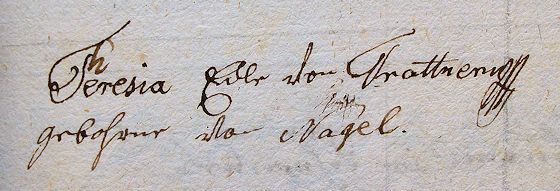
[officiating priest] Jos. Petzmp / Coop.[erator] / 1787 / 27tr Xbris / N: 281 / unter Tuchlaub[en] / [the child's name] Theresia, Constantia, / Adelhaid, Friderica / Marianna / [midwife] Marianna Kaudelkin / N: 882 in der / kleine[n] Schullerstraße[n] [catholic, girl, legitimate] / [father] Wolfgangus Ama / ―deus Mozzar / Mozart K K / Hof= Kapellen= / =Meister. / [mother] Constantia ge= / borne Weber eines / Amtmans Tochter / aus freyburg. / [godparent] Theresia / Edle von / Trattnern / [note] Im Hause ge= / =tauft. wider die Ver / ordnung; wegen angeblicher Schwach / heit des Kinds. [Baptized at home. Against the regulation; owing to alleged weakness of the child.] (A-Wstm, St. Peter, Taufbuch [original copy], Tom. 2, fol. 123)
 The note in vol. 2 of the original baptismal registers of St. Peter: "Im Hause getauft. wider die Verordnung. wegen angeblicher Schwachheit des Kinds." which shows that Theresia Mozart was baptized at home. The surviving original baptismal and marriage registers of St. Peter have never been digitized.

The note regarding the baptism at home "against the regulation" shows that the minister generally opposed this procedure, because the alleged weakness of the child often served the only purpose of sparing the midwife and the godparent the walk to the church. The signature of the godmother Theresia von Trattner (1758–1793, herself a goddaughter of Maria Theresia) in the original entry is not autograph which is proved by her signature on the occasion of Elisabeth Mansfeld's baptism on 10 August 1784 in the records of the Piarist church of Maria Treu (Maria Treu, Tom. 5, fol. 142).

172 years after the foundation of the Mozarteum, which (among other objectives) was established "to collect Mozart documents", there are still many pivotal Mozart documents in Vienna's archives that so far have escaped the attention of researchers who are confined to a desk.

© Dr. Michael Lorenz 2013. All rights reserved.

Updated: 9 November 2024


In his article "Mozart: In und vor der Stadt" in the journal Wiener Geschichtsblätter (2/2012) the Viennese amateur historian Walther Brauneis plagiarized my discovery of Theresia Mozart's original baptismal entry by simply copying everything from my article and from the pictures of the entry that I had published online in 2009. Brauneis gave himself away by shortening the shelfmark "A-Wstm, St. Peter, Taufbuch (original copy), Tom. 2, fol. 123" in footnote 8 of my article into the revealingly false "Taufbuch Pfarre St. Peter, Bd. 2, fol. 123". This incomplete (and therefore wrong) shelfmark refers to a completely different and much later "Band 2" of the baptismal records in question. In the course of his copying Brauneis did not understand what the words "original copy" in the footnote of my article meant. Because he had never actually seen the books in the parish archive, he did not know that there are two series of early baptismal records of St. Peter: the original books (which had been ignored prior to my research and to which I referred with the words "original copy") and the later copies of these books with volume two beginning only in January 1804.

Mar 24, 2013

A Child named Christian Mozart

On 16 November 1789, Constanze Mozart gave birth to a child that was so weak that it only lived for one hour. If a newborn child was very weak or stillborn, it was the midwife's obligation to perform an immediate emergency baptism. In such cases the child was filed under the term "fraugetauft" ("baptized by the midwife"). If the newborn died soon after its birth, no official entry in the baptismal records of the parish was entered up and the child's name and the circumstances of its christening only appear in the records related to the child's burial. In the 1789 death register of the municipal Totenbeschreibamt (A-Wsa, Totenbeschreibamt 92, M, fol. 48v), Mozart's fifth child is given with the rather curious first name "Kristian".

Den 16ten
Mozart          Wohledler H:[err] Wolfgang, K:K: Kapelmeister / s.[ein] frauengetauftes K[ind] Kristian, so bei St. Nicolai / N° 245 am Judenplatz an der Fraißen von / Mutterleib besch[au]t word[en]                             M[atthäus] R[auscher]
Sir Wolfgang Mozart, imperial and royal Kapellmeister, his child Kristian, baptized in emergency, at St. Nicholas No. 245 on the Judenplatz was inspected [as having died] of spasms right after its birth.    Matthäus Rauscher [coroner]
"Kristian" (or "Kristina") was a provisory name for a Christian (i.e. baptized) child which in eighteenth-century Vienna was used in cases of emergency baptisms, as long as the child's real first name was still unknown. When the above entry was made, the coroner of the Totenbeschreibamt did not know the name and the sex of the child yet and simply followed his instructions. Not surprisingly, the death of Mozart's child was not reported in the Wiener Zeitung. What follows are four examples of similar entries in eighteenth-century Vienna death records.

[Den 10 Oktober 1763]
Stadler Joseph ein Schuhmacher sein Frau[en] ge- / tauftes Kind Christian, ist auf der / Windmüll beÿn Grün Thor an d.[er] / Frais b[e]sch[au]t word[en] nachmittag um / 4 uhr Gebohr[en] word[en] J:[ohann] C:[hristian] B:[aldamuß] (A-Wsa, Totenbeschreibamt 57, S, fol. 74v).
This short-lived Christian Stadler was a younger brother of the legendary clarinet players Anton and Johann Nepomuk Stadler. Here is an example from the death records of the Vienna Schotten parish:

Den 30 dito [November 1709] deß Herr[n] Johann / Baptist Hilverting Comedianten / Brincipal, sein Nothgetauftes Kind Christian, in dem Ballhauß, in der / [T]ainfaltstr[aßen]     15 [Kreuzer] (A-Ws, Tom. 2, fol. 119r)
The father of this child Christian was the legendary puppeteer and actor Johann Baptist Hilverding, the father of the dancer Franz Anton Hilverding. Here is an example from the 1734 Totenbeschauprotokoll:

[9 November 1734]
Dem Herrn Francisco Alborea, Kaÿ[serlichem] Hof=Musico / sein Kind Christian, ist in Stadtschloßer[ischen] Hauß am Hof frauen Getaufter an der Frais b[e]sch[au]t worden. (A-Wsa, Totenbeschreibamt 37, fol. 244r)
Francesco Alborea (b. 1691 in Naples, d. 20 July 1739 in Padua [not in Vienna, as given in every encyclopedia]) was one of the most important cello virtuosi of the eighteenth century. He is frequently confused with his son Francesco, the cellist known as "Franciscello". Here is another, final example from the 1776 records of St. Michael's, concerning a female child named "Christina".

[9 January 1776]
Lorenzin Christina / fil:[ia] Ruperti Lorenz / bürg: Schneidermeisters / Cath:[olisch] Zu Maria / Hilf [No.] 8 frau getaufet. (A-Wstm, Tom. 9, p. 187)
When on 17 November 1789, the burial of Mozart's daughter was reported and paid for at the Bahrleiheramt of St. Stephen's (the office that collected burial fees for the Vienna Magistrate), the child's name was still unknown. This resulted in the following entry in the 1789 Bahrleihbuch (which was first published in June 2009, in my article "Mozart's Apartment on the Alsergrund").

Mozart Rub:[rica] 4ta / 2te Class / Pfarr / am / Hofe. / Dem Tit[ulo] Herrn Wolfgang v:[on] / Mozart K:K: Kapellmeister sein / frauget.[auftes] Mädchen, am Juden= / =platz bei St. Nickolai Nro 245. / an d[er] Frais von Mutterleib be = / = schaut, alt – / Im Freÿdhof A:[ußer] Mazlstorf / Bezahlt p [Partheÿen] 1.20. – [Kirche] 30 - / [Summa] 1 f 50 x
Mozart, 4th category, 2nd class, parish Am Hof, a girl baptized in emergency of Herr Wolfgang von Mozart, imperial and royal Kapellmeister, on the Judenplatz at St. Nicholas No. 245, was inspected [as having died] of spasms after her birth. In the cemetery beyond Matzleinsdorf, paid 1 f 20 x [the personnel] 30 x [the church] [overall sum] 1 Gulden 50 Kreuzer. (A-Wd, Bahrleihbuch 1789, fol. 377r)
This is one of six documents I published in 2009 that show Mozart as being addressed with the appropriate particle of nobility "von". By now, the Bahrleiher already knew that the child was a girl, but the continuing uncertainty regarding the child's real name is reflected in the index of the particular volume of the payment records where the "fraugetauftes Mädchen" is given as "v:[on] Mozart Kristina".


We would not know the first name of Mozart's second daughter, if not one of its parents had told Johann Herbst, the priest of the parish church Am Hof, that the child's name was Anna.

The entry concerning the obsequies of Mozart's daughter Anna on 17 November 1789, at the parish church "Zu den Neun Chören der Engel" Am Hof: "Dem Herrn Wolfgang von Mozart K. / K. Käpelmeister sein Kind Anna [Lebensjahre] 1 Stund" (Am Hof, Tom. 1, fol. 48). The picture shows the two halves of the entry whose original goes across two pages.

The first scholar who delved into the Viennese church records related to Mozart's children was Emil Karl Blümml (1881–1925) who in 1919, published an article entitled "Mozarts Kinder", in Mozarteums Mitteilungen, Mai 1919, Heft 3, p. 4 (which he published again in his 1923 book Aus Mozarts Freundes und Familienkreis). Commendable as Blümml's work was 94 years ago, his article does not meet present-day standards, because he overlooked several important sources and misunderstood some of the documents. Blümml's flawed work became a problem only decades later, when in his 1961 edition of Mozart documents, Otto Erich Deutsch decided to spare himself the effort of checking the Viennese parish records in favor of simply referring to Blümml's completely out-of-date article. Deutsch's intriguing aversion to ever step inside a Viennese parish office is one of many reasons why some Viennese Mozart sources remain unpublished to this very day. As far as the name "Kristian" Mozart in the death records was concerned, Blümml had no idea what it meant and showed himself slightly baffled.
Während das kirchliche Protokoll von einem Kinde weiblichen Geschlechtes spricht, verzeichnet das amtliche Beschauprotokoll der Stadt Wien unterm 16. November 1789 einen Knaben. Wer hat demnach recht? Es sei nur bemerkt, daß der Name Christian bei Katholiken zu den Seltenheiten gehört.
While the entry in the parish register speaks of a girl, the official register of deaths of the City of Vienna for 16 November 1789 lists a boy. Which, then, of the two entries is correct? It should be mentioned that the name "Christian" is rare among Catholics.

© Dr. Michael Lorenz 2013. All rights reserved.

Updated: 26 April 2025