Jun 19, 2014

Haydn and Mozart in the Memoirs of Ludwig-Wilhelm Tepper de Ferguson

In the summer of 1789, on his way home to Warsaw from Strasbourg, where he had spent six years studying at the university, the Polish musician and composer Ludwig-Wilhelm Tepper de Ferguson (1768–1838) visited Vienna. During that stay, he visited Joseph Haydn in Eszterháza. He could not meet Mozart who was in Berlin at that time. In his memoirs, he describes the events as follows.
Enfin nous entrâmes dans cet heureux pays d'Autriche. Tout y avait un autre aspect. L'abondance et le bien-être se manifestaient partout; et l'esprit éclairé de Joseph Second, commençait à se répandre sur les campagnes. Nous restâmes trois semaines à Vienne dont le séjour me plut tant, qu'il fallait tout le désir que j'avais de revoir les miens, pour me résoudre à m'en séparer. Je fis un voyage à Esterhazy en Hongrie; pour voir Joseph Haydn, qui y était établi auprès du prince de ce nom, grandpère de celui d'à présent. Ce prince vivait en grand seigneur, ayant une petite cour, un très bon spectacle, et réunissant autour de lui tout ce qu'une grande fortune peut procurer d'agréments et de plaisirs. Lorsqu’un étranger arrivait, on lui envoyait aussitôt un équipage pour voir les jardins et des billets pour le théâtre. Je m'y rendis le soir même, et j'y trouvai Haydn, que je reconnus à l'instant sur les nombreux portraits que j'avais vu de lui. Je l'abordai en lui disant qu’un amateur passionné de la musique et admirateur de ses compositions avait fait ce voyage pour faire sa connaissance personnelle. Il vint souper avec moi: le lendemain matin une voiture du prince nous attendait pour la promenade: je fus prendre Haydn qui me montra les détails du jardin; ensuite il vint diner avec moi et l'après diner je retournai à Vienne. Il me conta en abrégé son histoire, qui était accompagnée de détails tres curieux. Lorsque je lui fis connaitre tout ce que je pensais de ses compositions, et que je lui retraçai le juste enthousiasme qu'elles causaient partout, il me répondit: "Ah! Monsieur: nous avons à Vienne quelqu’un qui nous écrasera tous; c'est un génie universel, auprès duquel je ne suis qu’un enfant." Il parlait de Mozart. Celui-ci vivait encore à cette époque, mais je n'eus pas la satisfaction de le voir, car il était absent. Il rendait, à ce qu'on dit, le même respect à Haydn, qu'il regardait comme son maitre en composition. 

[translation:]

Finally we entered this happy country of Austria. Everything there looked different [from Salzburg]. Abundance and prosperity were manifest everywhere; and the enlightened spirit of Joseph II was beginning to spread across the country. We stayed in Vienna for three weeks, a stay that pleased me so much that I had no desire to see my family and bring myself to depart. I made a trip to Esterhazy in Hungary to see Joseph Haydn who had settled there with the prince of that name, the grandfather of the present one. This prince lived like a great lord, with a small court, a very good theater, surrounding himself with all attractions and pleasures that a great fortune can provide. When a foreigner arrived, he immediately sent a carriage to see the gardens, together with theater tickets. I went there the same evening and I found Haydn, whom I recognized instantly from the many portraits I had seen of him. I approached him and told him that a passionate lover of music and admirer of his compositions had traveled to make his personal acquaintance. He came to have dinner with me. The next morning a carriage of the prince was awaiting us for the excursion. I took Haydn who showed me the details of the garden; Then he came to dine with me and after dinner I returned to Vienna. He gave me a brief outline of his story which was accompanied by very curious details. When I told him what I thought of his compositions and described to him the real enthusiasm they caused everywhere, he replied: "Ah! Sir: we have someone in Vienna who will crush us all; he is a universal genius, compared to whom I am a child." He spoke of Mozart, who at that time was still alive, but I had not the satisfaction of seeing him, because he was absent. They say that he showed the same respect for Haydn whom he regarded as his teacher in composition.

Eszterháza Palace seen from the garden, painting from 1780 by Bartolomeo Gaetano Pesci (Magyar Építészeti Múzeum, Budapest)

In July 1793, Tepper de Ferguson was in Vienna for the second time. At first he had no intention to stay for more than ten days, but then he changed his schedule.
Je ne comptais m'arrêter à Vienne que huit ou dix jours, et j'étais sur le point d'en partir, quand je vis annoncé dans les affiches du théâtre, la reprise de l’opéra, "La Flute Magique". Le vif désir que j’avais d'entendu ce chef d'œuvre de Mozart, dont retentissait toute l’Europe; me retint une semaine de plus. Il fut, à ma grande satisfaction donné trois jours de suite. La disposition d'esprit où j'étais me fit doublement gouter les beautés de cet ouvrage. Il me mit dans un tel ravissement, que je souhaitais mourir au sortir du théâtre, afin de ne pas perdre une seule des impressions que j'éprouvais. Je me disais comme les napolitains lorsqu'ils parlent de leur capitale: "Vedi il flauto magico e poi mori".

[translation:] 

I had planned to stay in Vienna eight or ten days and I was about to leave, when I saw the restaging of the opera "The Magic Flute" announced on theater posters. The strong desire to hear this masterpiece of Mozart, which resounded throughout Europe, held me back for another week. To my great satisfaction it was given on three consecutive days. The state of mind I was in, made me doubly enjoy the beauties of this work. It put me into such delight that when I left the theater I wanted to die, so as not to lose a single one of the impressions I felt. I said to myself like the Neapolitans do when they say about their city: "See The Magic Flute and then die".

One of four surviving original Zettel of the premiere of Die Zauberflöte which was discovered in 2012, in the parish archive of St. Stephen's in Vienna.

The impression that Die Zauberflöte had on Tepper is reminiscent of the words of Robert Townson who in 1793 also attended a performance of this opera in Vienna (perhaps the same as Tepper). On p. 16 of his book Travels in Hungary, With a Short Account of Vienna in the Year 1793 (London: G.G. and J. Robinson, 1797) he writes the following:
In the suburbs there are several smaller theatres: and at one of these it was where I heard Mozart's Sauberflöte, the sweetest music ever composed.


The passages from Tepper de Ferguson's memoirs were first published in July 2011, by Olga Baird in her paper "Ludwig Wilhelm Tepper de Ferguson (1768–1838): Viennese years" at the 13th International Congress for Eighteenth Century Studies in Graz.

Updated: 17 November 2021

© Dr. Michael Lorenz 2014. All rights reserved.

Jun 16, 2014

Mozart: New Documents

Dexter Edge and David Black are pleased to announce the availability of a new online resource, Mozart: New Documents, a website presenting previously unknown references to Mozart or his music during his lifetime. Many of the new documents have been located through the expanded search opportunities of large-scale digitization projects such as Google Books, while others have been found using traditional methods.


Over 30 documents are available in this initial publication; we expect to add at least 60 more in the coming weeks, and our research continues. For each document we present a facsimile of the original (where available), a transcription, and commentary. Among the highlights of our first installment are previously unknown reports of the premieres of Le Nozze di Figaro and Così fan tutte, a previously unknown benefit concert given by Mozart in 1787, and a name-day serenade in Vienna in 1789 that featured the composer's "latest symphonies."

The site is a work in progress, and we welcome comments, corrections, and notifications of other new documents.

http://www.mozartdocuments.org/

Dexter Edge and David Black

dexedge@gmail.com
davidblack@post.harvard.edu

Jun 9, 2014

Haydn Singing at Vivaldi's Exequies: An Ineradicable Myth

The following post is based on a paper, which, in September 2002, I submitted to the conference "Music and Death in the Eighteenth Century" (King’s College London, 8–9 February 2003) and which was rejected by the organizer of this conference.

Introduction

That on 28 July 1741, the nine-year-old Joseph Haydn sang at Antonio Vivaldi's obsequies at St. Stephen's Cathedral in Vienna, is one of the most beloved myths of music historiography. Many authors seem to be deeply enamored with the image of two great artists, unknown to each other, meeting and somehow "passing the torch" from one creative spirit to the other. And yet, this scenario is pure fiction. Caused by a series of mistranslations and misunderstandings it became a popular myth and made its way into the biographies of both composers.

I have developed a simple and quick litmus test for the quality of a new Haydn biography: look for Vivaldi's name in the index, go to the page where Vivaldi is referred to (usually near the beginning of the book), and check if the boy Haydn is described as "having sung at Vivaldi's funeral". And if this is the case the book can be put away immediately. Countless books about Haydn – especially some of those published on the occasion of the 2009 anniversary – did not pass this test, because many authors simply cannot let go of this beloved myth. The most recent item that caused my surprise at the longevity of this story, is Frank Huss's book Joseph Haydn. Das unterschätzte Genie (who on earth ever underrated Haydn?), published in 2013, where on p. 17 the author states: "Likewise Haydn sang in the Requiem which was performed in the course of the funeral service of the composer Antonio Vivaldi (1678-1741), who had surprisingly died in Vienna." On p. 823 of the Haydn-Lexikon (Laaber-Verlag 2010), Christin Heitmann writes: "Haydn war zu dieser Zeit Chorknabe an St. Stephan es ist daher zu vermuten, dass er im Chor bei der Beerdigung Vivaldis gesungen hat." The Vivaldi and the Haydn literature are equally flawed concerning this issue. Since every author copies from all the others, scholarship soon ends up in a kind of echo chamber and printed misinformation is being spread relentlessly. As I stated in a lecture on source studies that I gave in October 2005, at the University of Salzburg: "Going back to the original sources often leads to a systematic demolition of the secondary literature."

To shed more light on the fascinating genesis of the Haydn-Vivaldi myth we have to go back several decades when the music world first learned where and when Abbate Vivaldi left the living to meet his maker.

Vivaldi's Funeral

Until 1938, the year and place of Vivaldi's death were unknown. It was generally assumed that Vivaldi had died in Venice around 1743, until the Venetian scholar Rodolfo Gallo (1881–1964) came across the following passage in the Commemoriali of Pietro Gradenigo (1695–1772) in the collection of the Museo Correr (Mss. Gradenigo II, cap. 36).
L'Abbate Antonio Vivaldi eccelentissimo Sonatore di Violino detto il Prete Rosso, stimato compositore de concerti, guadagnò ai suoi giorni cinquantamille ducati, ma per sproporzionata prodigalità mori miserabile in Vienna.

The Abbé Antonio Vivaldi, a most excellent violinist called the Red Priest, the famous composer of concertos, is said in his times to have earned fifty thousand ducats, but owing to excessive prodigality died a pauper in Vienna.
Gradenigo's reference made it easy to locate the Viennese sources related to Vivaldi's death. In 1938, Rodolfo Gallo was the first to publish the entry in the death records of St. Stephen's Cathedral concerning Vivaldi's funeral on 28 July 1741, and the second, more detailed one in the so-called Bahrleihbuch (protocol of funeral fees) concerning the costs of this ceremony. Surprising as it may seem, the original document has never been transcribed completely and without mistakes. The entry in question in the 1741 Bahrleihbuch (fol. 177v and 178r) looks as follows.

The entry concerning Antonio Vivaldi's obsequies on 28 July 1741 in the Bahrleihbuch of the parish of St. Stephen's Cathedral (A-Wd, Bahrleihbuch [henceforth BLB] 1741, fol. 177v and 178r)

This entry can be translated as follows:
28 July
Conduct Vivaldi
The Hon. Mr. Antonius Vivaldi, secular priest, who died of internal inflammation at the age of 60, was seen by the coroner at the Saddler's House next to the Carinthian Gate and was buried in the graveyard of the civic hospital.
Peal of the small bells .........." 2"36"
Curate ..................................." 3"―
Shroud .................................." 2"15"
Parish picture ......................." 0"30"
Gravesite .............................." 2"―
Bier renter and sexton .........." 1.15"
Sacristan ..............................." –"30
6 bearers with coats .............." 4"30
6 lanterns .............................." 2"―
6 cowlboys ..........................." –"54"
Bier ......................................." –"15"
Pelican                        S[um] "19"45"
Most translations in the literature, like the one in the 1970 English edition of Walter Kolneder's book Antonio Vivaldi: His Life and Work (with the symptomatically wrong shelfmark "necrology, Vol. 23, fol. 63"), and in Karl Heller's Antonio Vivaldi: The Red Priest of Venice (Portland: Amadeus Press 1997), are flawed: a Bahrleicher is not a gravedigger and a Kuttenbub is not a choirboy. It seems that David Marinelli, the translator of Heller's book, copied some of his mistakes directly from Kolneder.

The "Wallerisches Haus" and the "Spitaller Gottsacker"

On 28 July 1741, Antonio Vivaldi died in the house of Agatha Waller, née Freisinger (1674–1751). The spelling of her name as "Wahler" which appears in the literature is based on a mistranscription of the h-like sign before the l, which – as I have explained on several occasions – was not an h, but a sign that doubled the following consonant.

The entry in the municipal death records concerning Vivaldi's death. Note the spelling "Waller[isches] Hauß" (A-Wsa, Totenbeschreibamt 42, fol. 395r)

In 1714, the four-story building at the south end of the Kärntnerstraße was bought by the Prague-born saddler Augustin Waller (1678–1730). Waller was able to afford this purchase, because he was the personal master saddler of the widowed Empress Wilhelmine Amalia. Even in 1830, there was still a saddler's workshop located on the ground floor of the building.

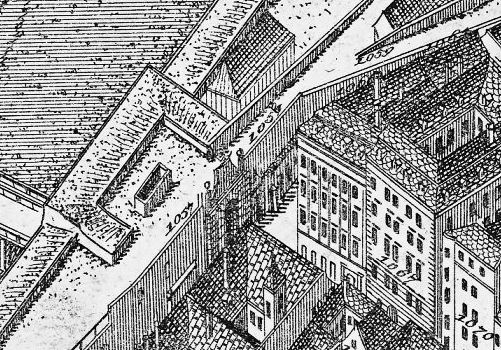
The "Wallerisches Haus" at the southwest corner of the Kärntnerstraße opposite the Kärntnertor in 1778. This clip from Huber's map shows that in the eighteenth century the building had only four storeys (W-Waw, Sammlung Woldan).

The groundplan of the fourth floor of the "Wallerisches Haus" which was drawn in March 1826, on the occasion of the addition of a fifth floor (the red color marks the reenforcements of the walls). On the right is the Kärntnerstraße, at the bottom the Sattlergasse towards the city wall. This floor is described in the 1788 tax register as consisting of two apartments of which each consisted of "2 rooms, 2 chambers, 1 kitchen". On the top a small atrium is visible. On the ground floor the big room at the corner of the house was the seating room of an inn (A-Wsa, Unterkammeramt, A33, Alte Baukonsense, 11811/1826).

There is a well-known photograph (Wien Museum, I.N. 19330), dating from 1858, that shows the two top floors of Vivaldi's last residence looking over the old city wall right beside the old Kärntnertor. I refrain from using this photograph which has been published many times in the literature. Instead I present an unknown photograph that has so far completely escaped the attention of Vivaldi scholars. It was taken in 1863 from the roof of the newly built Heinrichshof and, because the city wall and the Kärntnertor had already been torn down, shows the full facade of the house Stadt No. 1038, (the "Wallerisches Haus") where Vivaldi had died 122 years earlier. The fifth floor was added in 1826, and the roof is not the old tiled original. This may well be the very last photograph ever taken of this building. In the foreground we can see the early stages of the construction of the new K.K. Hof-Oper, in the back the rebuilding of the south tower of St. Stephen's is in progress.

The house Stadt No. 1038 (on the left) in 1863, where Vivaldi died in 1741. The two houses which today mark the beginning of the narrower part of Kärntnerstraße are not located on the exact same area as the buildings Stadt Nos. 1038 and 1019 that appear on this photograph (A-Wn, 114.145C).

The façade of Stadt 1038 towards the Kärntnerstraße with the newly added fifth floor. On the left of the entrance is the door of the inn, on the right the one of the saddler's workshop. (A-Wsa, Unterkammeramt, A33, Alte Baukonsense, 11811/1826)

The information in the Vivaldi literature (Talbot 1993, p. 69) that this house was destroyed in 1858, together with the Kärntnertor, is false. On Emil Hütter's elliptical watercolor of the Bürgerspitalszinshaus and its surroundings we can see the small atrium, the yellow facade and the round-shaped verdigris copper plated roof which had been added in 1826.

A clip from Emil Hütter's 1865 watercolor (Wien Museum). The Kärntnertortheater is at the center, on the upper left is a section of the Bürgerspitalszinshaus with the Komödiengassel, and visible on the far right is the green-roofed "Wallerisches Haus".

Augustin Markus Waller, the saddler who had given the house both its names, died on 1 August 1730, of biliary fever (his funeral cost 37 gulden 32 kreuzer), and, after having agreed to a settlement with her sons, his widow inherited the building.

Seal and signature of Vivaldi's landlady Agatha Waller on her will written on 14 August 1751 (A-Wsa, AZJ, A1, 10112/18. Jhdt.). Agatha Waller died on 11 December 1751.

Based on information in the Viennese topographical literature, some authors have pointed to the fact that Beethovens's lawyer Johann Zizius (1772–1824) and the legendary dancer Fanny Elßler lived in the Haus Stadt No. 1038. But from a musical point of view, the far more prominent residents of this particular building were the composer Conradin Kreutzer (who lived there in 1830 with his family and his sister-in-law), the dancer and theater director Louis Duport and – in my opinion more interesting – Therese von Droßdik, née Malfatti, Beethoven's never-to-be bride, who died in this house on 27 April 1851.

After the obsequies in the cathedral, Vivaldi's body was transported all the way down the Kärntnerstraße to the Kärntnertor again, then across the 85 meters long bridge which spanned the city moat and the Kärntnertorbrücke across the Wien River to the cemetery of the Bürgerspital. 

The "Wallerisches Haus" beside the Kärntnertor on the right and the "Spitaller Gottesacker" beside the Karlskirche on the left on Joseph Daniel von Huber's 1778 map of Vienna (W-Waw, Sammlung Woldan).

The way across the Kärntnerbastei (A-Wsa,  Einzelstück 3.2.1.1.P1.65.1)

The cemetery of the Bürgerspital with the St. Augustine Chapel (built in 1701). This is not a contemporary drawing, but a nineteenth-century watercolor copy of the cemetery as it appears on Huber's map (Wien Museum). 

The groundplan of the Bürgerspital cemetery superimposed on a modern-day cadastral map (drawing by Othmar Jordan from Leopold Senfelder: Der kaiserliche Gottesacker vor dem Schottenthor, Berichte und Mittheilungen des Alterthumvereines zu Wien 37, Vienna 1902, p. 2)

 The "Spitaller Gottesacker" on Steinhausen's 1710 map of Vienna before the building of the Karlskirche (A-Wsa, Kartographische Sammlung, 3.2.1.1.P1.234.1)

The cemetery and the chapel were closed on 1 May 1783. In 1785, after the chapel had been torn down, the houses of the priest and the gravedigger were sold to the military and used as uniform depositories. Because these premises did not meet the demands, they were sold back to the Bürgerspital in 1788. In 1791, the ground was leased to the military command which established a riding area there, until in 1807, the area was put up for auction and a number of houses were built there.

The first page of the Vienna City Council's response of 17 November 1791 to the military command concerning the military's request to let the Bürgerspital cemetery be turned into a riding area ("Wegen Uiberlassung des Armensündergottesackers zur Errichtung eines Reiterpikets") (A-Wsa, Hauptregistratur, A17, 7/1791)

The memorial plaque for Vivaldi on the east wing of the Vienna University of Technology is slightly misplaced: the Bürgerspital cemetery was located closer to the Karlskirche, on the adjacent area between Argentinierstraße and Karlsgasse.

Vivaldi's Bahrleihbuch Entry in the Literature

Somehow the problems connected to the publication of the pivotal primary source already began in 1938 with Rodolfo Gallo, who, having never actually seen the original document at the Cathedral's archive in Vienna, published the entry with a wrong name of the book ("Totenbuch"), one transcription error ("Grabstall" instead of Grabstell), an incomplete folio number (only "Fol. 177"), and without the word "Pelican" at the end. Furthermore, Gallo failed to include any information regarding the general context of this document, as well as the currency of the expenses – mistakenly calling them "spese modeste" and noting their sum only as "19:45". He did not provide a usable translation of this entry and because of the words "im Satleri[schen] Haus" he erroneously assumed that Vivaldi had died "nella casa della famiglia Satler".

Gallo's unclear documentation was to affect the Vivaldi literature for decades. It seems easy to correctly transcribe a short entry concerning an eighteenth-century funeral, but for scholars who only knew two pages from the Bahrleihbuch this proved to be a too difficult task. In his article "Biographisches um Antonio Vivaldi" (Österreichische Musikzeitschrift 2/1952), Walter Kolneder more or less copied Gallo's version, adding the mistake "Kartnerthor", because he took the "f" (of "florin") for the letter t. Like Gallo, Kolneder also ignored the mysterious "Pelican". In his 1965 book Antonio Vivaldi, Kolneder added the word "Pelican" (without explaining its meaning), but provided a wrong shelfmark of the Bahrleihbuch, conflating it with "Tom. 63, p. 23" of the parish's regular death register. Equally flawed is the transcription in Karl Keller's book Antonio Vivaldi (Reclam 1991). A case in point is the presentation of the entry in Theophil Antonicek's and Elisabeth Hilscher's 1997 book Vivaldi. There is a wise rule concerning the publication of transcriptions from historical documents: avoid publishing them alongside facsimiles of the original source, because this might backfire. Antonicek and Hilscher provided a transcription of the list of expenses, but not only is their spelling flawed ("Bahrleibuch"), two of the numbers are wrong as well, and therefore do not add up to 19 gulden 45 kreuzer.

Antonicek/Hilscher: Vivaldi (Graz: Akademische Druck und Verlagsanstalt 1997, p. 137): The date is wrong and the expenses do not add up to 19 gulden 45 kreuzer.

A truly amazing conglobation of errors is the presentation of the document on p. 252 of Siegbert Rampe's Antonio Vivaldi und seine Zeit (Lilienthal: Laaber-Verlag, 2010). Rampe looked at the entries related to the two funerals before and after Vivaldi's and (because he could not read them) concluded the following: "The funeral of Lothar[sic] Englhart which preceded Vivaldi's only cost 12 kreuzer, Anton[sic] May's, the one after Vivaldi's on 28 July cost 1 gulden 27 kreuzer." The truth is: Caspar (not Lothar) Engelhart's son Bernhard was a two-year-old child, Peter May (son of Anton May) was a fifteen-month-old child. The "Pelican" was turned into a "Delican" in Rampe's edition of the entry, a word that makes no sense and is explained nowhere in the book. Because Rampe not only copied the misspelled "Windliechter", but also the list of expenses from Antonicek's edition, it is flawed (the numbers again do not add up to the correct sum).

A section of p. 252 of Rampe's book Antonio Vivaldi und seine Zeit. The date at the top "29. Juli" (copied from Antonicek and Hilscher) is wrong. The comma after "19" is wrong and the quotation mark does not mean gulden, it means kreuzer. Five sequins were not 19,7 ducats. Johann Joseph Fux's burial, which did not take place on 16, but on 15 February 1741, did not cost 170 gulden, but 180 gulden 52 kreuzer (Rampe knew nothing about Fux's burial, except what he had extrapolated from Heller's book). The "Spitaler Friedhof" was not located "unweit der Hofburg", the "Kuttenbuben" were not boys and they did not sing "Grablieder" (burial songs). The fact that Vivaldi was buried in the "Armesünder-Gottesacker" had nothing to do with his status as foreigner. Note that Rampe called the two dead children "die Herren Englhart und May". Together with the typo "Beerdingungen", this jumble is vintage Laaber material.

Enter the "Choirboys"

The honor of having created the myth of choirboys having sung at the "pauper's burial" of Vivaldi belongs to the great Vivaldi scholar Marc Pincherle who, in his 1948 book Vivaldi: Génie du baroque, translated – or rather interpreted – the entry in the Bahrleihbuch as follows.
Le livre de caisse de Saint-Etienne (même année, folio 177) indique de façon assez vague qu'il est mort d'une inflammation interne (an inneren Brand bschaut), et fournit le décompte des frais exposés pour ses humbles funérailles: 19 florins 45 kreutzer. Il n'a eu droit qu'au "Kleingleuth" (Kleingeläut) ou sonnerie des cloches pour les pauvres[!], moyennant 2 florins 36, à six porteurs de civière, à six enfants de chœur[!]; un noble homme[!] enterré la veille avait eu le glas à 4 florins 20, huit porteurs, douze enfant de chœur, six musiciens, le reste à l'avenant, à concurrence de 102 florins! (Pincherle 1948, p. 27)
This statement proves that at some point Pincherle must have seen (the by then unpublished) folio 177r of the original 1741 Bahrleihbuch. It also proves that he had only a small notion of what the words in this book really mean. Robbins Landon's misunderstanding, which consequently was to appear all over the Haydn literature, originates from this passage in Pincherle's book. A "Kleingleuth" was not a "pauper's peal of bells". 2 florins 36 kreuzer was a week's salary of a well-paid manservant. The commissioning of a holy mass cost 30 kreuzer in Vienna, a price that did not change for at least two centuries. The six "Kuttenbuben" were not even boys, but men in cowls and they surely did not sing. The "nobleman", who according to Pincherle was buried the day before Vivaldi, was actually a noblewoman: the widow Maria Agnes von Feichtenberg who had died of "Wassersucht" (dropsy) on 26 July 1741, at the "Goldener Hirsch", on the Fleischmarkt.

The entry concerning the burial of Maria Agnes von Feichtenberg on 27 July 1741, inside St. Stephen's Cathedral (A-Wd, BLB 1741, fol. 177)

Von Feichtenberg received a "Fürstengleuth" for 4 gulden 20 kreuzer, twelve Kuttenbuben folded their hands at her bier, and she had musicians (for six gulden) performing in the church and singing "[Der] grimige todt" which at the Cathedral at that time was the "ordinari" (standard) funeral song whose a capella performance always cost six gulden. That there were exactly six musicians was Pincherle's assumption. As can be seen, the item that made Feichtenberg's burial so expensive was not the "Gleuth", but the tomb in the crypt of the Cathedral which cost 50 gulden.

In his book Vivaldi (London: Chappell & Co., 1978), Alan Kendall took the mistaken "choirboys scenario" to an even more suggestive level. Basically echoing Pincherle, Kendall wrote:
Only nineteen florins and forty-five kreutzer were spent on the funeral, and he was only entitled to the Kleingeläut or pauper's[sic] peal of bells, which only cost two florins and thirty-six kreutzer. He has six pall-bearers and six choirboys[sic], too, but one sees how mean all of this was when the same records reveal that a nobleman's[sic] funeral might cost at least one hundred florins. (Kendall 1978, p. 93)
The idea of Vivaldi having died a pauper now really took hold. In the 1993 edition of his book on Vivaldi in the Dent Master Musicians series, Michael Talbot writes:
The expenses, which totalled 19 florins and 45 kreutzers, were kept to the minimum. If Mozart's burial 50 years later was that of a pauper, Vivaldi's deserves that sad epithet equally. (Talbot 1993, p. 69)
In his book Vivaldi: Voice of the Baroque (London: Thames & Hudson, 1993), Robbins Landon expressed a similar judgement: "He was entitled, only to the Kleingeläut, or the pauper's peal of bells, costing two florins and thirty-six kreuzer." In his Vivaldi article in The New Grove Dictionary of Music and Musicians, Talbot states: "[...] he was given a pauper's burial on the latter day at the Hospital Burial Ground (Spittaler Gottesacker)." (New Grove, Vol. 26, p. 820). In the other prominent music encyclopedia Musik in Geschichte und Gegenwart, Karl Keller tells us that Vivaldi was buried "mit einfachster Zeremonie" (with the simplest ceremony) (MGG, Vol. 17, col. 89). None of the authors who wrote books about Vivaldi ever scrutinized the Viennese sources to actually figure out how obsequies at the time of Vivaldi's death were performed in Vienna.

Obsequies at St. Stephen's Cathedral Around 1740

For someone, who for about fifteen years has been studying the Bahrleihbücher of St. Stephen's (which survive from 1662 into the 1830s, with lots of gaps in the late years), Vivaldi's entry leaves no room for ambiguity or misunderstandings. It refers to a regular funeral ceremony with a "Kleingleuth", i.e. the peal of the small bell on the west section of the Cathedral's roof. At the time of Vivaldi's death, there were four kinds of peals of bells at St. Stephen's (fl stands for florins, x for kreuzer):
  1. "Großgleuth" at 9 fl 41 x (or ordinari at 19 fl 22 x)
  2. "Fürstengleuth" at 4 fl 20 x
  3. "Bürgergleuth" at 3 fl 45 x
  4. "Kleingleuth" at 2 fl 36 x
These four classes of "Gleuth" actually referred to four different bells on the cathedral. On rare occasions, at a price of 50 gulden, the "große Glocke" (the old Pummerin) was pealed, but this was not a separate class, it was an additional luxury which was only available for members of the Landstände  (i.e. the noble members of the Niederösterreichische Landtafel). Of course, combinations were also possible: after a "Großgleuth" at the beginning of the ceremony, there could be an additional "Fürstengleuth" right before the Requiem prayer ("zum Requiem vorgeleuth"). There were bells of many other churches that could be pealed on demand on the occasion of funerals at St. Stephen's: the Magdalene Chapel beside the Cathedral, St. Peter's Church, the Minoritenkirche, the Bürgerspitalskirche, the Ruprechtskirche, "Unser Lieben Frauen Stiegen", St. Nicola, St. Salvator and the "Deutsches Hauß". Furthermore, there were bells of chapels in privately owned houses all over the city that could be pealed for funerals, such as the ones in the Freisingerhof, the Gundelhof, the Seitzerhof, and the Johanneshof. Many funerals, like those of small children and really poor people, had no peal of bells at all.

 A funeral without a peal of bells: Georg Planckh being buried on 5 May 1740, in the "Spitaller Gottsacker" (A-Wd, BLB 1740, fol. 119r)

There were a number of general rules and customs concerning funerals at the Cathedral that can be figured out by studying the eighteenth-century Bahrleihbücher of St. Stephen's. The "Kleingleuth" was not part of a pauper's burial. Real pauper's burials were "gratis".

The "gratis" burial of Giulio Cesare Birravri on 30 May 1741, in the cemetery of St. Stephen's (A-Wd, BLB 1741, fol. 131r). This entry proves that poor adult foreigners were also buried in the "St. Ste[phans] Freind Hof", i.e. the cemetery around the Cathedral.

The "Kleingleuth" was the standard procedure for the funeral ceremony of adult citizens. Court officials, civil servants, civil craftsmen, and secular priests all received this kind of peal of bells. Karl Heller's claim that "the sum of nineteen florins and forty-five kreutzers would have been sufficient for only the simplest of ceremonies" (Heller 1997, p. 265) is simply false.

The entry concerning the funeral of the "Königlicher Laufer" (Royal footman) Lucrezio Bonno on 8 April 1742, which proceeded exactly like Vivaldi's (A-Wd, BLB 1742, fol. 95r). Bonno (born in 1683 in Pralboino) was the father of Hofkapellmeister Joseph Bonno (1711–1788). Bonno's first name was not Giuseppe (as given on Wikipedia and in the recent Mozart literature), but expressedly "Joseph Johann Baptist2, because his godfather was Joseph I. Contrary to the date given in the literature, Joseph Bonno was born on 30 January 1711 (A-Wd, Tom. 54, fol. 397r).

The entry concerning the funeral of the secular priest Joseph Russignol on 1 February 1741, in the "Schwarz Spanier" cemetery on the Alsergrund (A-Wd, BLB 1741, fol. 24r). Except for the Kelch (chalice), which was put on the bier, this funeral resembled Vivaldi's.

The entry concerning the funeral of the composer Carlo Agostino Badia on 25 September 1738 (A-Wd, BLB 1738, fol. 254r). Note that, owing to the lack of lanterns, the funeral of the "Kaÿs: Hof- und Cammer-Musicus" was two gulden cheaper than Vivaldi's, suggesting that the lanterns at Vivaldi's funeral were a dispensible luxury.

The entry concerning the funeral on 9 Desember 1741, of the court musician (bass singer) Marco Antonio Berti (A-Wd, BLB 1741, fol. 269v). Because Berti was buried in the cemetery around the Cathedral, his expenses included the ringing of the cemetery bell and the fee for the gravedigger which added 66 kreuzer to the costs of Vivaldi's ceremony.

The class of peal of bells was not the decisive factor concerning the costs of funeral ceremonies at the cathedral. The most expensive items – apart from the very high costs of tombs in the cathedral's crypt which sometimes came with the additional wage of a master builder – were always the services of qualified people, such as the presence of a high number of additional clergymen (Curaten and Canonici). One Canonicus cost three gulden, a curate two, an accolidus (acolyte) 50 kreuzer. The Kuttenbuben only cost nine kreuzer apiece, the better Minestranten cost one gulden each. High fees had to be paid for musicians (in variable numbers) who actually sang a Miserere and one or several "Motteten" (an exception being the obsequies of prominent musicians such as Antonio Caldara for whom, on 29 December 1736, his colleagues performed "gratis"). Even more expensive was the participation of instrumentalists (for 15 gulden) who accompanied the singing "mit Sartin" (also spelled "mit Sardin") or "Sartindl" (with muted trumpets or trombones). The most expensive musical service available was the performance of an actual Requiem which required additional musicians for at least 15, or up to 24 gulden. Sometimes the conduct was followed by a group of poor people from various poorhouses, such as the "Nepomuceni Spitall" on the Landstraße or the poorhouse in the Alstergasse, who received alms from the attendants and the clergy. This was an important additional income for the poor and this custom was observed in Vienna into the nineteenth century (on its way from the Alsergrund to Währing, Beethoven's coffin was followed by inmates of the "Versorgungshaus am Alserbach" who got paid for this service). Sometimes the bier was also accompanied by regular people who are listed as Steuerdiener (tax payers) in the Bahrleihbuch.

A group of poor people, following the bier of Georg Gaber, a law student, who was buried on 23 December 1741, on the "Spitaller Gottsacker": "Mitgang. 12. paar arme Leüth auß Nep:[omuceni] Spitall 12. paar auß d[er] alstergass[en] [Gleuth] Paulaner und Francis:[caner]. Pelican" (A-Wd, BLB 1741, fol. 280r).

What follows are several examples of expensive eighteenth-century funerals at St. Stephen's Cathedral.

The entry concerning the exequies of the architect Joseph Emanuel Johann Fischer von Erlach in the evening of 29 June 1742 (A-Wd, BLB 1742, fol. 173v and 174r). Prominent people often received a Nachtbegräbnüß (night funeral). Note the five altars which were put up on the following day and the additional "gleuth" at "[St.] Magdalena, Bürger Spitall" and the "Johannes Hof".

The first part of the entry concerning the funeral on 10 January 1726, of Carlo Agostino Badia's first wife, the singer Anna Maria Badia, née Lisi (A-Wd, BLB 1726, fol. 7r), whom Badia had married on 18 October 1700 (A-Wd, Tom. 34, pag. 710). Again, the grave in the crypt was the most expensive item. The last item are "12 stiell" (12 chairs). Note that the song "[Der] grimmige Todt" could also be accompanied by muted trumpets or trombones ("mit Sartindln"). When Johann Steinecker tried to transcribe this entry for his 1993 dissertation Die Opern und Serenate von Carlo Agostino Badia (supervised by Herbert Seifert), he could not figure out the meaning of the note "grimmiger Todt mit Sartindln" and transcribed it as "gereinigte Tote mit Sortinol", as if "Sortinol" was some kind of disinfectant for corpses. This is one of the all-time funniest transcription mishaps in Viennese historical musicology. Several gravely bungled passages in Steinecker's dissertation prove that his supervisor never read the thesis.

The obsequies for Princess Maria Theresia von Auersperg, née von Rappach, on 21 January 1741, with "VorLeithen" (a preceding peal), two peals of the Pummerin ("gar grosse glocken") on two separate days, and a double ("ordinari") "grossgleüth". This was not a a funeral, but only the consecration of the Princess whose body, on 23 January 1741, was transferred to Garsten where it was buried in the crypt of the monastery (A-Wd, BLB 1741, fol. 16r).

The entry concerning the exequies of the merchant Joseph Jenamy on 12 November 1740 (A-Wd, BLB 1740, fol. 259). The list of expenses included a "Fürstengleuth" and the already known expensive grave in the crypt. Here we see that the song "Der grimmige Todt" was also performed without brass and (in addition to the Miserere for six gulden) had to be paid extra. The external bells included St. Magdalene's, St. Peter's Church, and St. George's Chapel in the Freisingerhof. Joseph Jenamy (b. 1686 in Saint Nicolas de Véroce) was a great-uncle of Nikolaus Joseph Jenamy (1747–1819) who, in 1768, married Louise Victoire Noverre (1749–1812), the dedicatee of Mozart's piano concerto K. 271.

The most expensive funeral in the Bahrleihbuch of 1741 is that of Johann Caspar Joseph Kolb von Kollenburg, "Weÿl[and] der K.K. M[ajestät] Unter Stabelmaister" (deputy staff holder of His late I. & R. Majesty Charles VI), which cost 195 gulden and 16 kreuzer (A-Wd, BLB 1741, fol. 10v and 11r). It included a Großgleuth, a tomb in the crypt, a Requiem with Fürstengleuth, 30 Kuttenbuben, and five altars.

The mysterious "Pelican" that appears at the end of the expenses for Vivaldi's funeral and which previous authors either ignored or left uncommented, was a picture of a pelican as a Christian symbol that was put on the bier.

A pelican reviving her young with blood from her own breast (NL-DHmw, 10 B 25, fol. 32r)

Because the Physiologus claimed that the pelican provides its own blood to its young by wounding its own breast when no other food is available, this bird became a symbol of the Passion of Christ and the Eucharist.

A pelican with her young on the seal of the actor Johann Baptist Hilverding (A-Wsa, Depositenamt)

There were several pictures that could be put on the bier at St. Stephen's: pictures of St. Sebastian, St. John of Nepomuk, the Good Sheperd, Todtangst (Agony of Christ), the Holy Rosary, the Holy Trinity, one of a Bruderschaft (confraternity), a Dominicaner, a Carmeliter, and two (unspecified) "Franciscaner Bilter". But the pelican was by far the most frequently used. Sometimes, a devotional scapular was also put on the bier. The custom of displaying these pictures may go back far into the seventeenth century, but it is documented in a Bahrleihbuch for the first time only in 1682.

The final passage of the entry in the Bahrleihbuch concerning the funeral of Catharina Regina Thenig on 30 December 1682: "Seint mitgangen Kaÿ:[serliche] Spitall:[er] und Franscis: Gleüth beÿ St: Maria Magd: Bildter: Todtangst und Francisc." ("on the bier the pictures of the Agony of Christ and the Franciscans") (A-Wd, BLB 1682, fol. 171v).

The final passage of the entry concerning the funeral of the mason Adam Häringsleben on 12 Januar 1683: "Haben tragen 8 Steür diener seint mitgang[en] Kaÿ:[serliche] Spitäller Francisc: Dominic: und Minorit[en] Gleüth S:[ancta] Maria M[a]gd: S. Georgj S: Petri auf d[er] Pahr Pelican und St. Sebastiani Bildt." ("on the bier the pictures of the pelican and St. Sebastian") (A-Wd, BLB 1683, fol. 3v).

The final note of the entry concerning the funeral of Mathias Napert on 5 May 1740: "Mitgang 12. paar arme Leüth auß Nep[omuceni] Spitall 12. paar auß  d[er] Alstergass[en] Franciscaner, Domin:[icaner] gleüth. Magdalena, Bilder Pelican, Rosen Cr:[antz] guten Hürten." ("pictures: pelican, rosary and Good Sheperd") (A-Wd,  BLB 1740, fol. 118v).

The four categories of "Gleuth" existed until March 1751, when an Imperial edict replaced them with four "Classen". The prices of the peals in these classes were reduced to (from 1st to 4th class) seven, four, three, and one gulden. These classes could be subdivided into rubrics – mostly for the burials of children – but to delve deeper into the intricacies of this new system would lead too far. The first funeral ceremony at the Cathedral, which was accounted according to the new regulation, took place on 3 March 1751.

A clip from the entry concerning the funeral of the baby girl Magdalena Krumbschnabel on 3 March 1751: "Die Erste Begräbnuß nach de[m] Neüe[n] Patent. 2te Class Rubrica Tertia" ("The first burial according to the new edict. Second class third rubric [a child between one and seven years]") (A-Wd, BLB 1751, fol. 38v)

It has been suggested in the literature that Vivaldi may already have died on 26 or 27 July. But after closely comparing the official death register of the Vienna Magistrate (the Totenbeschauprotokoll) with  the 1741 Bahrleihbuch of St. Stephen's, I came to the conclusion that during the summer, people in Vienna were always buried the very same day they died. Especially interesting – although not particularly surprising – is the fact that there are a number of deaths recorded in the Bahrleihbuch that are missing in the Totenbeschauprotokoll. The fact that Vivaldi was buried in a cemetery which was traditionally called "Armesünder-Gottesacker" (cemetery of the executed) has sometimes been explained with the composer's status as poor foreigner, who had no civil rights, because he was not a citizen of the Austrian monarchy. This hypothesis is false. It was a complete coincidence that Vivaldi was buried on the Wieden, because the records show that in the eighteenth century the dead were buried in whatever cemetery at the moment could provide space. Apart from the Cathedral's crypt (where the graves were expensive), the following burial sites were used for people who were consecrated at St. Stephen's at that time – regardless of their age, wealth or nationality: the cemetery of St. Stephen's (surrounding the Cathedral), the "Spitaller Gottesacker" on the Wieden, the cemetery of St. Nikolai ("auf die Landstraß"), the crypt of the convent church of the Trinitarian Order and the "Montserrater Gottesacker"on the Alsergrund ("zu den Schwarzspaniern"), the crypts of St. Michael's Church, the Minorites Church and the Augustinian Church, and the monastery church of St. Nikola on the Singerstraße. The fact that Vivaldi was buried in an own grave at a relatively high cost of two gulden makes the fact that his funeral has repeatedly been described as that "of a pauper" even more bizarre.

Back to Haydn

The spark of wishful thinking concerning Vivaldi's funeral jumped to Haydn scholarship when H. C. Robbins Landon published his five-volume standard work Haydn: Chronicle and Works. Robbins Landon, of course, immediately fell in love with the idea of choirboys in 1741 which were nothing but Kendall's mistranslation of Pincherle's mistranslation of the original word "Kuttenbuben". In the first volume (p. 58) of his Haydn chronicle, Robbins Landon went so far as to even quote from Kendall's Vivaldi book.


"It seems almost certain." Does it? In his 1993 book Vivaldi: Voice of the Baroque, Robbins Landon (providing a wrong folio number for the Bahrleihbuch entry) again rhapsodized on one of his most beloved bit of trivia:
There were six pall-bearers and six choirboys from the parish church where Vivaldi died, which happened to be St. Stephen's Cathedral. The six members of the Cantorei of St. Stephen's included the young Joseph Haydn, who was thus probably one of the few to witness the demise of this great composer, now a pauper and already forgotten, placed, like Mozart half a century later, in an ignominious and anonymous grave somewhere under the great capital city of the Austrian Monarchy. (Robbins Landon, Vivaldi, p. 166)
From the countless books about Haydn that present Robbins Landon's idea as proven fact, I want to point out Hans-Josef Irmen's Joseph Haydn Leben und Werk (Vienna: Böhlau, 2007) where the information that Haydn sang at Vivaldi's funeral is even attributed to Pohl ("and others"[sic!]): "Pohl u.a. berichten, daß der junge Haydn bei den Exequien für Vivaldi mitgewirkt habe." (Irmen, p. 335). Of course, Carl Ferdinand Pohl (1819–1887) reports no such thing in his biography of Haydn. Pohl did not even know that Vivaldi had died in Vienna.

It is amazing to see how the probability of this romantic scenario is suddenly destroyed by having seen all the above entries from the eighteenth-century Bahrleihbücher. From 1715 on, the Cantorei of St. Stephen's employed six Capellknaben (choirboys). The documents presented above show that it was a mere coincidence that exactly six Kuttenbuben attended Vivaldi's funeral. And yet, this exact number – the number of Capellknaben at the Cantorei – played a major role in the misunderstanding that led to the metamorphosis of these Kuttenbuben into choirboys.

Capellknaben and Kuttenbuben

Haydn was accepted into the Cantorei of St. Stephen's Cathedral in 1740. Since Kapellmeister Reutter was in a position to only pick the most talented choirboys, Haydn's recruitment was a big privilege and a stroke of luck for the country boy. Haydn lived together with the other choirboys in the building of the Cantorei which was administered by the municipal Kirchenmeisteramt (i.e. the City of Vienna). The administration of the Cathedral and its music was traditionally subordinate to the Vienna Magistrate, which is the reason that Mozart, when in 1791 he applied for an adjunct postion at the cathedral, submitted his application to the municipal authorities. The so-called Kirchenmeisteramtsrechungen (ledgers of the church administrator of the Vienna Magistrate) provide detailed information about the organisation of the Cathedral and its employees. They show that the records of expenses for the regular staff ("Außgaab auf ordinarÿ Besoldung", i.e. expenses for ordinary salaries) were strictly separated from the expenses for the musicians of the Cantorei.

The beginning of the list of expenses ("Außgaab. Auf die Cantoreÿ beÿ St. Stephann") for nine months for the Cantorei of St. Stephen's in the 1742 Kirchenmeisteramtsrechnung (A-Wsa, Handschriften, A 41.24, fol. 79r). In 1741, the Kirchenmeister (church administrator) was Claudius Jenamy (1702–1776), a nephew of the abovementioned merchant Joseph Jenamy. Today the eighteenth-century Kirchenmeisteramtsrechnungen are held by three different archives: the Vienna Municipal Archives, the Vienna Diözesanarchiv, and the Domarchiv.

In 1742, the choir at St. Stephen's Cathedral consisted of the following musicians:
Kapellmeister Georg von Reutter
Six Capellknaben
Nine Vocalisten
Extra-Vocalisten (whose number varied according to requirements)
Subcantor Adam Gegenbauer
The organist at that time was Anton Neckh who in 1736 had succeeded Reutter's son Karl on this post. Georg von Reutter's annual salary consisted of 300 gulden Gebühr (salary), plus 24 gulden Kleÿdergeld (clothing allowance). For the boarding of the six Capellknaben (among them Joseph Haydn) Reutter received an additional sum of 1,200 gulden plus 75 gulden Instructionsgeld (teaching fee). Each of the nine Vocalisten received an annual salary of 130 gulden plus an annual Choraladjutum (choral subsidy) of 26 gulden 60 kreuzer per capita. In addition to that they were also paid one gulden "Rorate Geld" plus (at least in 1742) one gulden forty kreuzer for substituting for dismissed choirboys.

Only two Kuttenbuben were permanently employed at the Cathedral. In 1742, they were assisted by an "Extra Jung" (extra boy). The other Kuttenbuben worked freelance for a fee of nine kreuzer for every funeral which added up to a nice income of about five gulden a month. This relatively high income (and the income of the permanently employed Kuttenbuben) are proof that those "Buben" were not boys at all, but adult men who were majors (above 24 years of age). The term "Kuttenbuben" had originated in the middle ages and was still applied to men dressed in cowls centuries later. The two regular Kuttenbuben were members of the ordinary staff and their salary was filed under the "ordinarÿ Besoldung". Among the employees that are listed together with the Kuttenbuben were the Bahrleiher Johann Leydl, the Capelldiener at the cemetery "vor dem Schottenthor" Bartholome Kießling, and the two church servants and "Preinglöckler" (the ringers of the prime bell). In addition to their individual annual salary of sixty gulden, each of the two regular Kuttenbuben also received five gulden for their service during the litany for the Court. The "Extra Jung" Geusgruber was paid 50 gulden a year. The two items in the 1742 Kirchenmeisteramtsrechnung pertaining to the salaries of the three Kuttenbuben, read as follows:
147:/ Denen 2. Kutten Jungen Dobraletnig und Vogl ihr gebühr von 1. April bis lezten Xber 742. auf 3/4. Jahr lauth N° 147. vergüthet . . . . 90 .––
148:/ Dem Extra Jung Michael Geusgruber sein gebühr von 1. April bis lezten Xbr 742. auf 3/4. Jahr inhalt N:° 148. entrichtet mit . . . . . . . . 37 " 30.
The entries concerning the salaries of the Cathedral's three "Kutten Jungen" Dobraletnig, Vogl and Geusgruber between 1 April and 31 December 1742 (A-Wsa, Handschriften, A 41.24, fol. 77v and 78r)

The overall expenses of the Kirchenmeisteramt in 1742 amounted to 20,255 gulden and half a kreuzer. The surplus in that year was 2,722 gulden and 29 kreuzer.

Claudius Jenamy's seal and signature in the 1742 Kirchenmeisteramtsrechnung of St. Stephen's

Conclusions

  • Vivaldi's funeral ceremony on 28 July 1741, at St. Stephen's corresponded to that of ordinary Viennese citizens. Because the performance of music was not ordered and paid, no music was performed at this ceremony.
  • To have musicians sing at a funeral at St. Stephen's in 1741, one had to pay at least six gulden for the performance of the song "Der grimmig Tod". A performance of a motet was even more expensive, especially if it was accompanied "mit Sardin" (i.e. with muted trumpets or trombones).
  • The Kuttenbuben who were present at Vivaldi's exequies did not sing. They just stood at the altar and folded their hands in silence. They were not choirboys of the Cantorei, but members of the ordinary staff of the Cathedral. There was a strict organizational separation between the ordinary employees and the musicians of the Cathedral.
  • Joseph Haydn had nothing to do with Vivaldi's obsequies. The mistaken assumption that choirboys were present at this ceremony originated with Marc Pincherle, who in 1948, translated the entry "6 Kuttenbuben" in the original source with "six enfants de chœur". After Alan Kendall, in 1978, had turned these "enfants de chœur" into "choirboys", Robbins Landon could not resist the appeal of this scenario and presented Haydn's singing at Vivaldi's exequies as a fact. It is a myth.

Despite repeated statements in the literature that the chances are slim of finding unknown sources concerning Vivaldi's final stay in Vienna, research on this topic is far from finished. It has only just begun.

© Dr. Michael Lorenz 2014. All rights reserved.

Updated: 21 April 2025

May 19, 2014

Agnes Selby: Constanze, Mozart's Beloved (Wien: Hollitzer Wissenschaftsverlag 2013)

Why the Hollitzer Wissenschaftsverlag published a second edition of this smorgasbord of howlers, whose first edition, in 1999, had already been the laughing stock of Mozart scholarship, is a total mystery. Agnes Selby is completely ignorant of the recent Mozart literature. She has to quote Mozart's letters from Emily Anderson's out-dated edition and simply repeats all the old popular nonsense that has been debunked ages ago. This book literally runs over with hogwash and could be turned into a successful comedy program, easily providing endless laughter for attendees of a meeting of musicologists.


A piece of popular literature like this does really not deserve a detailed review. But because this opus has been republished and contains passages that are outrageously funny, I want to quote some of them and point out some of the most glaring mistakes it contains. Selby has an uncanny ability to create what I call "Selbyisms": statements that sparkle with so much nonsense that they are irresistibly funny. For example (from p. 96): 
Mozart had more immediate problems. He was known to be a Freemason and the French revolution had been fostered by French Freemasons who were in contact with their Viennese brethren. King[sic!] Leopold's secret police were well informed about the Lodges in Vienna and soon those connected with Freemasonry were discharged from their government posts.
Where to begin in the face of such ignorance? After the unification of the Lodges by Joseph II in 1785, the Freemasons had to register by name. They were completely harmless and under control. Hence, they posed no threat at all to the Court, and nobody was discharged from a government post. Even professors at the Vienna University (such as Franz Schubert's patron Heinrich Watteroth) were Freemasons. The French Revolution had not "been fostered by the French Freemasons" (it is immensely funny to imagine those French Freemasons beating down the Bastille with their trowels and to visualize all the suddenly unemployed noblemen wandering the streets of Vienna). Mozart's Vienna is presented as a kind of fairytale paradise. That nonsense like this is being published in 2013 by a publishing house that calls itself a Wissenschaftsverlag is truly amazing:
The Vienna that Constanze encountered was unlike any other city in Europe. The population was so homogeneously united that only the epithet 'Viennese' fits its description. There was no question of 'nationality' as such among the inhabitants of Vienna, where Magyars, Bohemians, Slovaks and Slovenes, Germans, Italians and Poles rubbed shoulders in good humour. (p. 23)
This description of the eighteenth-century Viennese population is completely false and obviously caused by Selby's mistaken concept that the Ringstraßenzeit of the late 1900s – when huge numbers of people from all parts of the monarchy moved to Vienna – took place one hundred years earlier. Mozart's Vienna was not "unlike any other city in Europe", and, at that time, only an extremely small part of the city's population were foreigners.
The modest sum of 31 kreutzer would purchase a meal consisting of two meat dishes, soup, vegetables and unlimited bread with a litre[!] of wine. Because people were generous, even industrious citizens accepted the fact that some individuals might prefer begging to working, extreme poverty was practically nonexistent and those who made begging their profession often profited handsomely by it. (p. 23)
Of course, the price of 31 kreuzer for such a meal is based on pure fantasy. And extreme poverty could be found everywhere in Mozart's Vienna. Here is another classic (from p. 32): 
In an amazing display of ill-will Leopold Mozart accused Constanze of being a slut.
Of course, Leopold Mozart did no such thing, and this insult cannot be found anywhere in the Mozart letters. Selby's slanderous claim (which she has repeatedly presented on various Mozart websites and internet forums) is based on her deep hatred of Leopold Mozart and her pathological jealousy of all people, who, in her opinion, were not fond enough of Constanze. There are more of these priceless statements (p. 71):
Mozart had many opportunities to gamble. Mozart's concerts at the Mehlgrube Casino were always followed by gambling tables being set up to allow the aristocracy to participate in their favorite sport. [...] Gambling was also endemic in Salzburg.
There was no public gambling in Joseph II's Vienna, because gambling (except for the state lottery) was illegal. It was also illegal in deeply Catholic Salzburg. That "men would gamble at street corners" in Salzburg (as claimed by Selby) is pure nonsense. All through her book, Selby mistakenly thinks that the word "Casino" refers to a gambling venue. The word Casino, in eighteenth-century Vienna, referred to a venue for social gatherings and events. The book's low scholarly flight level becomes apparent in Selby's imagining Mozart in Prague, losing money to Casanova in a series of card games: 
Casanova was an inveterate gambler who could never resist tempting his friends with a game of cards and it would not be inconceivable that Mozart lost considerable sums to him." (p. 85)
One can only wonder: where was Constanze and why could Mozart's guardian angel not forestall her husband's nightly activities? Emperor Franz II – one of the most hardworking monarchs of all time – is described by Selby in the following inimitable way:
Franz II lived through this period as though in a dream, occupying himself with gardening, attending to his family and walking through the streets of Vienna dressed as just another burgher enjoying a bit of window shopping.
Some of the most glaring nonsense to be found in this book is already well-known from Selby's longstanding and relentless self-praising activities on the Internet. The problem is that all these sparkling bloopers should really not be republished in 2013. Here are some of the most impressive examples (and this list is far from complete):
  • That Joseph Lange signed a document "which bound him to grant his widowed mother-in-law an annual income of 700 ducats" (p. 23) is, of course, false. Lange promised to pay Cäcilia Weber 700 gulden which is less than a quarter of the sum given by Selby. That at the time of her wedding, Aloysia Weber was already pregnant is still an unproven assumption.
  • That Gottfried van Swieten was "dismissed from the Imperial Service on suspicion of participating in the Freemasons' conspiracy of 1791" (p. 35) is a piece of gross misinformation that Robbins Landon presented in his book Mozart: The Golden Years. There was no "Freemasons' conspiracy of 1791". Van Swieten was dismissed by the Emperor "in good grace", because of their differing views concerning the universities' role in science and the freedom of education which was part of van Swieten's political concept.
  • Like many amateur Mozart researchers, Selby mixes up the family of Adam Isaac Arnsteiner (1721–1785) with that of his daughter-in-law Fanny Arnstein. Fanny Arnstein did not "occupy the house at Graben No. 1175" (p. 35), her father-in-law Arnsteiner lived there as subtenant on the second floor.
  • "Johann Thorwart was an altogether unpleasant and unsavory character". We have absolutely no documentary information concerning Thorwart's character. Selby is just jealous of him and picks her negative judgement out of thin air.
  • Selby is unable to let go of the story regarding the music supposedly performed at Mozart's wedding dinner: "During the dinner Constanze was surprised by the unexpected performance of Mozart's Serenade in B-flat (K. 361)." (p. 40). This alleged performance is a myth which may have been caused by a sentence that was willfully added into one of Mozart's letters in Nissen's Mozart biography. There is absolutely no documentary evidence to support it.
  • On p. 50 Selby claims that, on the occasion of the christening of Mozart's first child Raimund Leopold, on 17 June 1783, "Baron Wetzlar could not be present due to the death of his father". What looks like very educated information, is based on pure fantasy. Wetzlar's father Karl Abraham Wetzlar von Plankenstern only died on 3 September 1799 (Wiener Zeitung, 11 September 1799, p. 3063). 
  • The information that "Neustift suburb No. 250 is now Lerchenfelder Straße[sic!] No. 65" (p. 52) is false. As Hans Rotter published in 1925, and as I have explained on this blog, it is Mariahilfer Straße 94.
  • That Mozart "composed the two duets for violin and viola for Michael Haydn [...] who was ill (supposedly due to heavy drinking)" (p. 53) is a fairy tale that has been debunked by Mozart scholarship a long time ago. It should really not reappear in a book released by a publishing house that calls itself Wissenschaftsverlag.
  • Maynard Solomon's estimates concerning Mozart's income, which Selby copied into her book, are based on speculation. They have absolutely no basis in archival sources.
  • "The banns for their marriage were read at the Theatines Chappel." (p. 39) No, they were not. Everybody who has seen Mozart's marriage entry knows that he and Constanze were exempt from the three readings of the banns. Furthermore, no banns were ever read at this chapel, because it was not a parish church. Mozart and his bride visited this chapel to go to confession and to get the "Beichtzettel" (certificates of confession) which they needed for the wedding.
A typical Viennese "Beichtzettel" of the composer Joseph Eybler (A-Wkhm, Archiv der Burgpfarre)
  • "After Lodge meetings, Mozart would join his brother Freemasons at the Cafe Jüngling, whose owner, Johann Jüngling belonged to the Lodge 'Zur neugekrönten Hoffnung'. There the men would sit down to dinner after which they gambled well into the early morning." (p. 63). There was no "Cafe Jüngling" in 1785, because Johann Jüngling (1762–1835) became the owner of this coffee house only in 1791. There was also no gambling at this Cafe. The whole scenario of this supposed "Freemasons' Casino" is the product of one of Selby's countless brain bubbles, obviously triggered by abysmally flawed secondary literature.
  • The "ballet story" concerning Le nozze di Figaro is nice, but it has been shown ages ago that it is purely fictional. There is no documentary confirmation that dancers were hired for the complete production of Figaro in 1786.
  • Franz de Paula Hofer's annual salary in 1788 at St. Stephen's Cathedral was 25 gulden, but (just like another writer, who in her new book calls Hofer a "penniless violinist") Selby is unaware of the fact that Hofer was a court musician and held several well-paid jobs simultaneously. Why should Josepha Weber have married a poor church mouse? At the time of his death, Hofer was making 360 gulden a year at the Court and 100 gulden at St. Stephen's, and he had additional jobs in other churches. Selby's claim (p. 142) that he "left Josepha and their daughter burdened with enormous debts" is simply false. Franz Hofer's debts were managable, because, unlike Mozart, he had actually joined the Tonkünstler-Sozietät to secure the livelihood of his widow and child. Between the death of her first husband on 14 June 1796, and her second marriage on 23 December 1797, Josepha Hofer was paid a pension from the Tonkünstler-Sozietät which, according to § 15 of the society's regulations, in 1797 was passed on to her daughter who received it until 1813, the year she married Karl Hönig.
An unpublished document, issued on 21 July 1788, by the "Stadtwiener Conscriptions Amt", stating that Franz Hofer "is 31 years of age, Catholic, was born in Vienna, is employed as K.K. Hof-Capell Musicus, has been living at Stadt 587 for twelve years", and that "the conscription office does not object to his marriage". The information in the Dokumente that Hofer only became a court musician in 1789 is false.
  • Landstraße No. 224 was not "a large house". It was rather small. The Danish actor Joachim Daniel Preisler did not visit the Mozarts in 1787 at Landstraße No. 224, but in 1788 at Alsergrund No. 135.

A groundplan of the front section of the house Landstraße No. 224 where Mozart lived in 1787 (A-Wsa, Unterkammeramt, Baukonsens 87/1833)
  • Nannerl Mozart did not "retain all the valuable gifts given to the young Mozart". The list, which was drawn up on the occasion of the auction of Leopold Mozart's belongings, proves that those gifts had been sold by Leopold many years earlier. Selby's description of the distribution of Leopold Mozart's estate is based on Solomon's erroneous speculation and is therefore completely false. Nannerl did not "receive 6,000 to 10,000 florins from her father". As I explained in detail in 2012, Solomon's theory is based on a miscalculation of Nannerl's heritage from her husband, who not only bequeathed to his widow an annual pension of 300 gulden from the interests of her children's share, but also the main share of his estate of 22,000 gulden. Selby's descripton of the events after Leopold's death is rife with unfounded speculation and – as always – driven by hatred against all of Constanze's "less well-meaning" contemporaries. That Mozart "received punishment through Leopold's will" is a classic "Selbyism". Selby is ignorant of the sources and the literature dealing with Leopold's estate.
  • Gluck did not receive "a lavish funeral." As a matter of fact, this funeral was performed "in der Stille" (without music) and only cost 28 gulden 49 kreuzer (of which 12 gulden were paid for the carriage with four horses to the Matzleinsdorf Cemetery).
The entry concerning Gluck's modest obsequies on 17 November 1787 at Vienna's Paulanerkirche: "NB: Ist in der Stille Eingesegnet worden" (A-Wd, Bahrleihbuch 1787, fol. 408v)
  • In 1787, Mozart did not earn "1,700 florins in Prague". This estimate is based on Maynard Solomon's flawed presumption.
  • Selby writes: "On December 7, Mozart was appointed to Gluck's vacated position as Chamber Music Composer to the Viennese Court" (p. 86). No, he was not. a) Gluck's position was not that of a "Chamber Music Composer to the Viennese Court". Gluck held an honorary position as a supernumerary which also explains his high annual salary of 2,000 gulden. b) Mozart was not appointed "Chamber Music Composer", but "k.k. Kammermusikus" which is a huge difference and explains the modest annual salary of 800 gulden that came with that position.
  • That Mozart's begging letters to Puchberg are proof for his poverty in 1788 is an out-dated point of view. At this time, Mozart was living in a 300m2 apartment for which he paid an annual rent of 250 gulden. He also owned a horse and a carriage. Of course, he shamelessly took advantage of a well-to-do brother Mason. The suggestion that Mozart's begging letters were mostly theatrical scrounging efforts (which I first published in 2012 in my review of Günther Bauer's book Mozart. Geld, Ruhm und Ehre) has been echoed in a 2014 interview by Nikolaus Harnoncourt who (to nobody's real surprise) disingenuously presented my concept as his own brilliant idea.
  • Selby's account of the origin of Così fan tutte is based on the out-dated popular literature and is therefore worthless.
  • "Theresia von Trattner stood godmother for the little girl and the christening took place in St. Peter's Church". As I have shown in 2009, Theresia Mozart's christening did not take place in St. Peter's Church, but in Mozart's apartment.
  • Prince Lichnowsky's 1791 lawsuit against Mozart had nothing to do with gambling. As a matter of fact, gambling debts were classified as "Naturalobligationen" (so-called imperfect debt relations) and therefore their payment could not be claimed in a court of law. Debts incurred from illegal gambling, on the other hand, were legally void, i.e. they did not exist at all in the eyes of the law. Hence, they could not be considered "Naturalobligationen". On 20 February 1753, Maria Theresia had issued a Patent die hohen Spiele und Wetten betreffend, ruling that "von niemanden, was er auf Borg verspielet, es mag wenig oder viel seyn, dem Gewinner, wenn selbser schon derentwegen eine schriftliche Recognition in Händen hätte, etwas bezahlet, noch der Verspieler von einer Obrigkeit hierzu angehalten werden soll" ("Nobody, who has gambled away money, be it little or much, should be forced by the authorities to pay the winner, even if this person is in possession of a written recognition."). The only gambling contracts that were legally valid were those concluded in connection with legal gambling, such as the official state lottery. Selby's repeated description of Mozart's debts as having been caused by gambling is comparable to the plot of Groundhog Day transferred into late eighteenth-century Vienna.
  • Walther Brauneis did not come across information "in a Logbook of the Special Courts of Aristocrats" (Selby will never understand the correct name of this source). The entry that Otto Mraz found (and Brauneis then mistranscribed and published with a wrong date) is located in the 1791 Cameralprotocoll (FHKA NHK Kaale Ö Bücher 94) of the I. & R. Court Chamber (today's Finanz- und Hofkammerachiv of the Austrian State Archives).
  • The address "Schulerstraße 816" is wrong. Johann Michael Auernhammer was neither a nobleman, nor a wealthy merchant. Gottfried Ignaz von Ployer was not "a high official of the court". He was a minor "Hof-Agent" who, at the time of his death in 1797, was totally broke. Babette Ployer was not a "von Ployer".
The seal of the Sovereign Military Order of Malta and the signature of its Viennese administrator Johann Michael Auernhammer (A-Wsa, Patrimoniale Herrschaften, Johanniter A12/1, 134/1747)

Seal and signature of Gottried Ignaz von Ployer from 1774 (A-Whh, OMaA 641-20)
  • That in 1789 "the priest of the Church am Hof was able to administer an emergency baptism to Anna Mozart" is false. Selby does not know the sources, the literature, or any other documents related to this child's birth. Mozart's daughter Anna was baptized by the midwife.
  • The idea that Mozart's mass K. 317 was performed at the 1790 coronation in Prague (as Selby claims on p. 97) has been soundly debunked by Mozart scholarship years ago.
  • That Die Zauberflöte "embraced the philosophy of Freemasonry" (p. 101) is a popular misconception that has been refuted in several recent scholarly publications. Die Zauberflöte is not a cryptogram of Freemasonry, but a classic fairy tale opera. Its supposed relation to Freemasonry (which nobody ever noticed back in Mozart's days) is a creation of fanciful twentieth-century writers.
  • In summer 1791, in Baden, Constanze was not – as claimed by Selby – "again housed on the first floor above the butcher's". This error is one of the most ancient "Selbyisms", mostly because for years Selby has relentlessly been repeating it on several online forums. In his letter to Anton Stoll of May 1791, Mozart expressedly referred to Joseph Goldhann's former apartment on the ground floor: "das nothwendigste aber ist; daß es zu ebener Erde seye [...] zu ebener Erde, beym Fleischhacker". Because of her bad feet, Constanze could not live "on the first floor above the butcher's", but had to use the apartment beside the butcher's. 
  • The estimation (copied from Solomon) that "Mozart in 1791 earned 5,000 florins" is of course pure hogwash. The rent for Mozart's apartment at the Camesina house was not "320 gulden for six months" (p. 63). It was 450 gulden for one year. 
  • The claims that "Süssmayr had a gift for composing in the style of famous composers" and that "Süssmayr composed numerous ballets which often lasted for three hours and were performed by the monks" (p. 106) are two other priceless "Selbyisms". That Franz Xaver Süßmayr "died of alcoholism" – as Selby impudently states – is nothing but slanderous malarkey. All surviving documents prove that Süßmayr died of tuberculosis.

The previously unpublished entry concerning Süßmayr's burial in the St. Marx cemetery ("An Lungensucht besch[aut] word[en]"). Note that owing to inflation, this third-class burial cost even less than Mozart's 22 years earlier (A-Wd, Bahrleihbuch 1802-03, fol. 304r).
  • Selby claims that "for La Clemenza di Tito Mozart was paid 1,150 gulden[!], including expenses" (p. 107). This alleged fee is an old myth, based on Mozart's claim in 1789 that he was offered "200 Dukaten und 50 Dukaten Reisegeld" for an opera. But there is absolutely no proof that Guardasoni ever made this offer in 1789, and even less that Mozart actually received this amount in 1791.
  • "Many of Mozart's Zettel were found among Süssmayr's papers in the Hungarian National Library." (p. 162). No, they were not.
  • Not "Jakob Haibel's father had been a tenor in the Schikaneder Company", Haibel himself had been that tenor.
  • Like countless amateur Mozart writers, Selby is unaware of the fact that the name of Mozart's last child was not "Franz Xaver", but Wolfgang. The names "Franz Xaver" only appear in the baptismal register and were never used by the parents. Mozart's last child was always called Wolfgang or "Wowi" by his parents and the claim (appearing all over the popular literature) that Constanze "later changed his Christian names" (p. 34, 163, 250 and 253) is simply false. Selby's claim that "Franz Xaver[sic!] inherited from his father his malformed left[sic!] ear" is just too funny to be commented on.
  • On 4 December 1791, Dr. Closset (which one of the brothers, Nikolaus or Thomas?) was of course not "enthralled by Die Zauberflöte that he refused to come". Closset came from the Burgtheater where Die Zauberflöte was not performed.
  • Mozart's belongings were not "catalogued and assessed for taxation purposes", but to secure the assets for the claims of the creditors. Mozart's debts with Lichnovsky, Puchberg, and Lackenbacher were not included in the official records, because "Constanze did not include them in her list prepared for the public records" (as Selby claims on p. 118), but because these creditors did not come forward to file their claims with the Vienna municipal civil court. A widow had no right to determine what the Sperrskommissär put on the list of passiva of her deceased husband.
  • There was no such name as "Walsegg von Stuppach". The correct name is "von Walsegg". Walsegg did not commission "Johann Martin Fischer to create a tomb". He commissioned the sculptor Benedikt Hainrizi to do this.

The design for the tomb of Countess Anna von Walsegg by Benedikt Hainrizi (1749–1799) (Vienna, Albertina)
  • Selby's bizarre presentation of Franz Schubert as "poor, lonely young man who had struggled in a Vienna barely aware of his existence [...]", and who "had died young and of syphilis[sic!]" (p. 119) makes us very glad that Selby has refrained from writing books about other famous dead people.
  • Selby's claim that Constanze "was listed in the Vienna Archives[sic!] as living in the Palais Liechtenstein in the Dorotheergasse which was near the Michaelerplatz" (p. 147) is just a conglobation of errors. There is no "Palais Liechtenstein" in the Dorotheergasse. Selby seems to have mixed it up with the Palais Dietrichstein, where Constanze also never lived. Constanze resided in the Palais Eskeles which is not located near the Michaelerplatz. Wetzlar von Plankenstern's villa in Meidling was not located "on the Grünberg", but at the bottom of this hill, above the so-called "Steurer Mühl Fahrtweg".
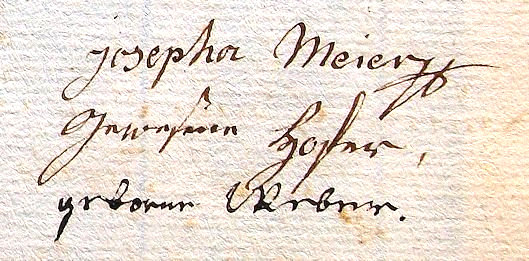
  • The spelling "Friedrich Sebastian Mayer" is wrong. This singer and his wife always signed their names Meier.
Friedrich Sebastian Meier's seal and signature in 1812

 Josepha Meier's signature in 1800
  • Constanze Mozart and her second husband did not get married in Pressburg, because she and Nissen fled from Napoleon's army or wanted to "wait for the storm to blow out". As a matter of fact, in 1809, Pressburg was bombed by Napoleon's army. They went to Hungary, because only there could they get the permission for an interfaith marriage.

In the chapter "Constanze's Second Widowhood" Selby falls into a well-known trap that regularly claims victims among all kinds of enthusiastic amateur Mozartologists: she actually thinks that Leopold Mozart, Euphrosina Pertl, and Genoveva Weber were all buried in the family grave in the cemetery of St. Sebastian in Salzburg. And yet, it has been known for decades – based on the Berchtold von Sonnenburg family papers in Brno – that Leopold Mozart (just like "Theophrastus Paracelsus" as Selby hilariously misnames this historical figure) was not buried in the churchyard, but in the communal crypt of St. Sebastian. The "Mozart family grave" in this cemetery is an artificial site, created by Johann Evangelist Engl for reasons of nostalgia. There were no family graves in today's sense in the eighteenth century. The whole defensive rant, brought forward by Selby against "attacks by Mozartean writers accusing Constanze of desecrating Leopold Mozart's grave by having her aunt Genoveva buried there" is based on ignorance of the literature.

To defend Constanze's absence from her husband's burial, Selby resorts to Philippe Ariès's book Images of Man and Death, but her discussion is completely beside the point. The main issue was not "the wife's place in her home and not at the burial", but the customs related to Josephinism. Constanze was not "forbidden to attend Mozart's burial", she did not even consider to attend it, because it was not customary. At that time, the act of burying a body was no part of the Christian rite as it is today. People bid goodbye to their loved ones at the church and not in the cemetery, a custom that only began to change in the course of the Napoleonic Wars. Selby's musings about "the United States changing western attitudes toward death in the 20th century" (p. 114) have nothing to do with the relevant issues of eighteenth-century cultural life in Vienna. Because Selby is totally ignorant of the intricacies of the Josephinian burial regulations and their partial repeal in 1785, she rehashes all the nonsense about "Mozart having been sewn into a linen sack and having been buried with a reusable coffin". These old misunderstandings have all been refuted and should certainly not resurface in a 2013 publication. Not "eighty-five percent of Vienna's citizenry" received a third-class burial, but ninety-nine percent. Selby extrapolates from a small section of the St. Stephen's burial records which does not represent the situation in all of Vienna's parishes. First-class burials were not (as Selby presumes on p. 117) "reserved for the nobility", but for anybody who was willing to pay for them (this old misunderstanding seems ineradicable). Because Selby's description of the funeral classes is copied from the worst secondary literature (such as Brendan Cormican), it is totally flawed.

Selby repeats her old story about Süßmayr's supposed trip to Kremsmünster Abbey in December 1791, and that after Mozart's death, "Süssmayr was nowhere to be found" (p. 128). Over thirteen years ago, Selby already posed as omniscient archival researcher on public internet forums as follows:
I would like to add that I have serious doubts about Sussmayr working on the Magic Flute which Constanze sold for 100 ducats 23 days after Mozart's death. While working on my book, "Constanze. Mozart's Beloved", I came across Archival evidence at the Vienna National Library, in the archives of Kremsmunster Abbey wherein Sussmayr arrived at the Abbey on 17 December, 1791 in the company of Pater Pasterwitz. It had been Sussmayr's custom to spend Christmas at Kremsmunster where he organised the Christmas festivities. It is also the reason why Constanze could not find him, when pressured for the completion of the Requiem by Count Walsegg's representative and why the Requiem was first handed over to Joseph Eybler who signed for it on 21 December, 1791. Eybler found himself incapable of completing the Requiem and it was then given to Sussmayr on his return from Kremsmunster. I have not been able to find in the archives his departure date from the Abbey. [...] Some further information to iron out one more wrinkle posed by both Carr and Gartner[sic!], Constanze was NOT MAD AT SUSSMAYR when she could not find him after Mozart's death. She was looking for him to complete the Requiem and NOT TO MARRY HER. She could not find Sussmayr because he was at Kremsmunster Abbey making preparations for Christmas festivities which he did every year. Again Kremsmunster archives can be found at the National Library in Vienna. (Agnes Selby on www.openmozart.net, 28 December 2000)
There are no "Kremsmunster archives" at the National Library in Vienna. Apart from that, my on-site research at Kremsmünster Abbey in July 2002 showed that there is no documentary proof that Süßmayr went there in late 1791. The whole story about this Christmas trip is a figment of Selby's imagination. All Viennese sources related to Süßmayr's employment at the Court show that at the end of December 1791, he was working in Vienna at the Burgtheater. Selby has a notorious reputation for fabricating her sources. On 12 June 2001, and on 26 and 27 November 2002, she posted the following statements on the (long defunct) online forum www.openmozart.net.
My studies in the Vienna archives where all Baden records about the comings and goings to and from Baden record that on every occasion Sussmayr was in Baden he travelled with Pater Pasterwitz and not with Constanze. Sussmayr and Pater Pasterwitz were registered at a hotel, the name of which escapes me but if anyone is interested, I would be happy to go through my files. This is very important to understand in order not to perpetuate the lies created by Francis Carr and Heinz Gartner[sic!]. Neither of these two gentleman seems to have taken time for proper research. [...] I checked the Baden records at the Viennese National Library[sic!]. These are records of people coming and leaving Baden. I took as my point of departure the dates of Constanze's presence in Baden. [...] Sussmayr seems to have led a good life, e.g. his trips to Baden. These may have been paid for by Pater Pasterwitz in whose company he travelled. (List of Arrivals and Departures. Baden police file in Archives, Austrian National Library, Vienna). 
There are, of course, no records "about the comings and goings to and from Baden" in the Vienna National Library. None of the archival documents Selby referred to in the above statements do exist, and neither did Selby ever intend to "happily go through her files". Such documents are also not held by the Austrian State Archives. When asked for the location of these mysterious sources, Selby replied: "Records pertaining to this are in Vienna. I am sorry, I do not remember the section in the archives as my research concerned Constanze and the biography I was writing about her." According to Selby, other researchers could not find these sources, "because they lacked the necessary »Sitzfleisch«".

After Dan Leeson, in 2006, had somebody search in vain for these sensational "police records", Selby simply relocated their alleged place of discovery to the Baden City Archives.
Police files from Baden indicate the arrival of Pasterwitz and Sussmayr on at least three occasions and staying together at a hotel in the township. These files are available to researchers in the Baden city archives. (Agnes Selby, 23 November 2006)
The Baden archivist Dr. Rudolf Maurer has assured me personally that these files do not exist. Neither do the Austrian State Archives hold any Baden police files from 1791. The Baden police station was only established in 1809. When Selby was told about Dr. Maurer's statement, she immediately returned to her initial narrative and relocated the fictitious police files back to the Austrian National Library (after all, where else would one expect to find police files?).
As for the Police Files, I know, Mr. Lorenz has had a field day telling me that they do not exist and that they were burnt in a fire. Mr. Lorenz, you know perfectly well that this is not true and the files do exist. Somewhere you have got all this mixed up as the police files rest comfortably in the archives of the Austrian National Library. (Agnes Selby, 17 August 2008)
Needless to say, I had never claimed that "the Baden police files burnt in a fire". Whenever Selby was caught in a lie, she tried to defend herself by producing yet another lie. In 2007, Selby tried to convince the members of an online forum that Alfred Einstein, in his biography of Mozart, had "described the Weber family as useless vagabonds", and "had placed Constanze's sisters as parading in front of Vienna military barracks to catch husbands." (Selby, 11 November 2007). When she was asked to provide an exact quote and a page number to prove these gross accusations, she claimed that she had no access to Einstein's book, because "she had lent it to her daughter Kathryn".

Agnes Selby's fictional sources are not limited to Süßmayr's life. Concerning Mozart's commemorative service, which Emanuel Schikaneder organized on 10 December 1791, she claimed to have received a letter from St. Michael's Church in Vienna.
I wrote to St. Michael's Church and received a polite reply informing me that the singers were listed in the Church records as well as the payment they received from Schikaneder who had organised this Commemorative Service. Although it has often been stated that parts of Mozart's Requiem were performed, I was told that there is no record as to the music performed. (Agnes Selby, 14 August 2008)
This "list of singers in the Church records" does not exist in the parish archive of St. Michael's. It is yet another flimsy figment of Mrs. Selby's imagination. She never corresponded with the staff at St. Michael's who do not even know her name. Selby even claimed to have corresponded with Professor Neal Zaslaw and Robert Levin (or "Levine" as she called him) regarding this issue.
I wrote to St. Michael's Church and was told that although a list of performers exists in the archives of the Church and even how much they were paid, whose Requiem was performed had not been noted. I sent this letter to Dr. Zaslaw who had the same information sent to him. (Agnes Selby, 9 August 2007)
Well it must have been a "ghostie" who wrote to me and to Dr. Levine that the list of performers at St. Michael's Church exists but not what was peformed on that crucial night. (Agnes Selby, 17 August 2008)
It must have been a ghostie indeed, because neither Neal Zaslaw nor Robert Levin ever received any letters from Selby or St. Michael's Church. In August 2004, Selby reported on www.openmozart.net that "an Australian PhD student named Morgan Flannery is currently doing research in the Lichnowsky archive in Prague and will present his findings at a congress in the Mozart Year". This student (originally intended to serve as her sock puppet) also turned out to be one of Selby's countless fabrications. When in 2008 she was asked about Mr. Flannery's research and why he had never published anything concerning the Lichnowsky papers in Prague, Selby simply decided to give Flannery's career an unexpected turn towards family life and to declare the Lichnowsky papers destroyed:
Morgan Flannery lives in London where he has a teaching job. The last I saw him was over a capuccino at the Sydney seaside suburb of Woolloomooloo, where good capos can be found. Morgan has since his Prague adventure got married and has to now "earn his crust". It is true, he has yet to present his findings but I did not realize it was my duty to inform you of his inability to complete his thesis in time. You see, the Lichnowsky files were indeed burnt during World War II by the Germans, and information is difficult to find although he has a good bit of material available. The Germans did a lot of damage to beautiful Prague!!! As a very young and enthusiastic warrior of that era, you must remember it well. (Agnes Selby, 17 August 2008)
It is not quite clear as to whether the words "as a very young and enthusiastic warrior of that era, you must remember it well" were meant to refer to me. The fact that Selby obviously tried to slander me by staging me as Nazi soldier, speaks volumes about her deranged state of mind. I have dealt with Mrs. Selby's amazing concoctions in my article "Süßmayr und die Lichterputzer: von gefundenen und erfundenen Quellen" in the Mozart-Jahrbuch 2006, (Kassel: Bärenreiter, 2008, 425–38).

Selby's book presents a grossly overoptimistic, untrue, and apologetic picture of Constanze Mozart as a flawless saint. This does not correspond to the current state of research and is caused by Selby's only rudimentary knowledge of the scholarly literature. The reissue of Selby's book is a regrettable waste of money and paper. This book has not even come close to an expert musicologist's proofreading eyes, and there is ample reason to presume that not even the publisher bothered to read it with adequate attention. It is a real pity that Selby was unwilling to completely overhaul her work. So many interesting topics related to Constanze Mozart are still waiting to be explored more deeply: Where and when did Constanze move after Mozart's death? Where exactly did Nissen live in Vienna? Why did Constanze reject Schwanthaler's first design of her husband's statue? Who destroyed the many letters of Leopold Mozart? Who is the woman on the supposed "photograph of Constanze Mozart" that, for simple technical reasons, cannot originate from before 1842? What about the early musical career of Karl Mozart who in many Viennese sources is being addressed as "Tonkünstler"?

Karl and Wolfgang Mozart, both addressed as "Tonkünstler" in an 1811 register of the Hauptregistratur of the Vienna Magistrate (A-Wsa, HReg. B1/104, fol. 180r)

Karl Mozart being described as "als Hand[lungs]pr[aktikant] abwesend soll klein seyn" ("absent as business intern, is said to be small") on an 1805 conscription sheet of the Palais Eskeles (A-Wsa, Konskriptionsamt, Stadt 1110/1r). Selby considers it possible that "Constanze feared that Wolfgang might be conscripted into the Austrian army", but in fact both Mozart brothers were exempt from service owing to their small body height. The above entry was first published in 1957 by Gustav Gugitz, but Selby is completely ignorant of the standard German Mozart literature.

Georg "von Niessen" listed as "Dänischer Gesandschafts Rath" on a Viennese conscription sheet from 1805 (A-Wsa, Konskriptionamt, Stadt 4/2r). This entry proves that Nissen already was living with Constanze Mozart in 1805, in the house Stadt No. 4.

The Hollitzer Wissenschaftsverlag did not put any editorial effort into the production of this superfluous book, which is proved by glaring typos such as "Beamarchais", "Greisinger", a "quintet K. 542" (p. 60), numerous missing spaces, and a letter written by Leopold Mozart on "November 17, 1886" (p. 78). It would also have helped if the editors (i.e. the notoriously sloppy Michael Hüttler) had at least done a little research concerning Mrs. Selby's reputation as an extraordinarily imaginative author. While the negative effect of Selby's book had already died down in Australia, her work from the 1990s is now unfortunately being revived in Europe, as if it were a scholarly contribution that meets today's standards.

Selby's book was not the only biography of Constanze Mozart published in 2013. At the same time, the German musicologist Gesa Finke published her dissertation entitled Die Komponistenwitwe Constanze Mozart. This book, which addresses the topic "Mozart's widow" from the perspective of "commemorative and gender studies", also resulted in a massive failure, albeit on an academic level. Finke was completely on her own and had to fulfill her task without any competent help from her incompetent advisor. But this will be the topic of a future blogpost.


Wir sehen voraus, daß wir auch manchmal in den Fall kommen werden, daß ein Liebling der Menge nicht gerade auch unser Liebling sei und wollen die deshalb unvermeidlichen Vorwürfe gern über uns ergehen lassen.

(Goethe: Über strenge Urteile)


© Dr. Michael Lorenz 2014.

Updated: 8 November 2024