In Robert Winter
's book
Music for our Time (Belmont: Wadsworth Publishing Company 1992), the following paragraph appears on p. 358:
FRANZ SCHUBERT (1797–1828)
Franz Schubert was the only Viennese Classicist born in Vienna, and except for an extended summer holiday in the west of Austria in 1825, he never ventured beyond the suburbs of that city. His father was a schoolmaster who taught boarding students in the family quarters, an activity that brought little income or social standing. Franz was the eleventh of twelve children, only four of whom survived infancy. He and his brothers all learned to play musical instruments and often came together in the evening to play chamber music.
The only part of this quote that does not contain a mistake is the title. In 1818 and 1824, Schubert was in
Zséliz, and in 1819, and 1825, he visited Upper Austria. In 1827, he went to Graz, Gastein, and Salzburg. Schubert's father had no "boarding students". Where should he have provided housing for them? He was a regular school-teacher. Not four but five of the Schubert children survived infancy: Ignaz, Ferdinand, Karl, Franz, und Theresia (whom Winter is obviously unaware of). Karl Schubert did not join the music making, but became a painter (see Ferdinand Schubert's account from 1839). To round up the affair,
Schober's caricature of Vogl and Schubert is wrongly attributed to
Moritz von Schwind. Although by 1992 Robert Winter had not even read Maurice Brown's
old Schubert article in
Grove, the editors of
The New Grove commissioned him to write the new one. After several years of absence from Schubert research, in which he dedicated himself to the development of computer software, Winter faced the opportunity to delve into the literature, preparing to write the article on Schubert that, due to
The New Grove's worldwide popularity, must be regarded the most widely read printed publication on Schubert. The result was made available on the internet on
www.grovemusic.com prior to the printed version of the encyclopedia which was officially presented on 8 January 2001. According to the international press, the new owners of
Macmillan demanded
The New Grove's immediate release, a policy which the editors refused for the understandable reason that it was far too premature to guarantee a result that would meet scholarly demands.
Stanley Sadie was appointed "Editor emeritus" and replaced by John Tyrrell, who in the meantime has passed on his function to Laura Macy. To put the encyclopedia to print at all costs, the last corrections were proofread by a "teenage army of non-musicological graduates" (see: "How music got its Grove Back",
The Independent, 30 December 2000). Given the fact that some of the important entries were commissioned long before 1996, even more meticulous correction work could not have provided a less faulty edition. There was ample time to take care of the major mistakes, but unfortunately this time seems to have been wasted.
Avoiding any risk, Robert Winter could have chosen an easy way out by just copying everything from
Otto Erich Deutsch, a method usually applied these days by many Schubert scholars. But this turned out to be impossible. The zeitgeist and the heated and politically influenced discussion about Schubert's sexuality, which had dominated the preceding decade, demanded a heavily revised image of Schubert which was likely to meet the expectations of "new musicology". Therefore, Winter did not rely on the
Dokumente, but wrote his biography of Schubert in the style of a medley, based on the general literature. Although this is by no means an unusual method, the result is a mixture of personal recollection and scholarly impromptu that makes the reader waver continuously between astonishment and amusement. As will be shown, Winter sometimes did not even consult the literature given in his own bibliography. The list of mistakes will be presented quite prosaically, based exclusively on original quotes from Winter's text and any claim of completeness may be premature. My critical point of view is influenced by a statement in a "letter of the editors" on Macmillan's web-page: "The primary objective of a reference work is to give accurate, reliable and up-to-date information."
In the first chapter of Winter's article titled "Background and childhood", we learn that "[Schubert's father] took up the position of schoolteacher, one that offered little social standing or financial reward; education was an enterprise supported only meagrely by the imperial government." If we keep in mind all the various honors the house owner Franz Theodor received, together with all the efforts Empress Maria Theresia had put in place to improve educational standards in Vienna, we cannot accept Winter's statement (see also Herwig Knaus's book
Franz Schubert: vom Vorstadtkind zum Compositeur, Vienna: Löcker 1997). Winter continues to present a strictly personal state of knowledge: "All of the [Schubert] children were born in a one-room apartment in a house called 'Zum roten Krebsen'". This is false. Ignaz and Elisabeth Schubert were not born in this house (see Heinz Schöny's article in
Jahrbuch der Heraldisch-Genealogischen Gesellschaft Adler 1974/78, III. Folge, vol. 9, Vienna 1978, p. 15, an important genealogical publication that is missing in Winter's bibliography). Regarding Schubert's studies with Salieri, the following information is given as a fact: "During his first two years [at the
Stadtkonvikt] he received permission to take regular lessons with Salieri, who urged him to find his models in Italian opera, [...]". Wrong again. As far as we know, Schubert first started studying with Salieri in June 1812. On the occasion of the premiere of the F major mass in 1814, Winter deals with an old imaginary problem that actually has been solved a long time ago: "Near the end of July [1814] he completed his first mass (in F, d105), written for the centenary of the Lichtental church he had attended since a child. Although Schubert's spirituality was never in doubt, his freedom with the text (including the omission of 'Et in unam sanctam catholicam et apostolicam ecclesiam') suggests that the church as an institution was not sacrosanct to him. [...] Schubert conducted the first performance himself in October." We are still waiting for Joseph Haydn being suspected of not believing in Christ being the Son of God and the significance of the Holy Spirit, because in his
Missa in Angustiis, he left out the passage "Et in unum Dominum Jesum Christum Filium Dei unigenitum", and in his
Missa sancti Bernardi von Offida, he failed to set to music the words "Qui ex Patre Filioque procedit". In Haydn's
Missa in tempore belli, even the line "Qui cum Patre et Filio simul adoratur et conglorificatur" is missing. And yet, this composer is still being considered a devoutly Catholic classic. As Erich Benedikt has shown in 1997, in countless masses of Schubert's time, large parts of the Credo text are missing, and not even
Anton Bruckner dealt with this text too meticulously, because the celebrant had to say the complete
Credo anyway. But no, the presentation of Schubert as an individual with shaky religious beliefs must forever be continued. For the sake of his morals and dubious private life this seems to be very important.
Unfortunately, Winter calls the performance of the "
Ouverture in Italian Style" the "first public performance" of one of Schubert's works. This applies to the performance of the
F major mass D. 105, because in the
Lichtental parish holy mass was no private event. The premiere of this mass did not take place – as given by Robert Winter – in October 1814, but on 25 September of the same year. Erich Benedikt's article "Notizen zu Schuberts Messen" (
Österreichische Musikzeitschrift 1-2, 1997, pp. 64-69), where this issue is resolved, is given in Winter's bibliography, but Winter seems never to have read it.
Regarding the topic "
Therese Grob" (Schubert's beloved), Winter quotes the entry of September 8, 1816 in Schubert's diary ("For a free man marriage is a horrible thought these days.") and closes the chapter "Finding a career" with the following statement: "Although not yet 20, Schubert never spoke of marriage again." "To whom?" is the question that comes to the reader's mind here. In chapter five titled "Independence", Winter writes: "At some time that autumn [1816] Schubert refused to return to his father's school, left home and moved to the lodgings of Franz von Schober". But Schubert's note on the autograph of the song D. 509 is no proof that at that time he was actually living with Schober. Schubert's move to the house of his father in August 1817 (Winter writes "In the autumn") was caused – according to Winter – by financial circumstances. The truth is that Schubert had to clear the room for Schober's brother Axel who was expected to return from France.
Franz von Schober simply is out of luck in the recent literature: "Schubert was introduced by Josef von Spaun to [...] Franz von Schober (1797–1882). Although his father died when Schober was six, the family remained prosperous enough for him to attend private schools for the nobility [...] in both Germany and Austria. He began law studies in Vienna in 1816 but failed to complete the course". Note Schober's wrong year of birth. (In
The New Grove's article "Lithographisches Institut" it is also given incorrectly as 1798). According to the death certificate issued by the
Torup parish priest Olof Borup, Franz von Schober senior died on February 8, 1802.
Olof Borup's death certificate for Franz von Schober's father Franz Xaver von Schober (1759–1802) (A-Wsa, Mag. ZG, A2, 3628/1797)
The schools in
Schnepfenthal and
Kremsmünster were nor exclusively reserved for the nobility, and Schober did not study law in Vienna, but philosophy.
On the occasion of dealing with Schubert's activity as music teacher in Zséliz, it becomes apparent that Winter is unaware of the fact that from 1811 on the Austrian monarchy had two different currencies. Schubert's monthly income is given succinctly as "some 75 florin" without the important information that this is
Conventionsmünze (Assimilated Coinage). Regarding Schubert's estimated fee in 1821-22, Winter gives an amount of "more than 2000 gulden" without mentioning that this is the less valuable
Wiener Währung (Viennese Currency, i.e. 800 gulden in Assimilated Coinage). Winter's subsequent claim that "the annual salary of a minor civil servant – the social layer from which Schubert sprang – was about 400 gulden" only confuses the reader, because this again amounts to a mix-up of two different currencies which had an exchange rate of 1 to 2,5. This important detail is also missing in connection with the fee of 100 gulden
Conventionsmünze that in 1826 Schubert received from the Gesellschaft der Musikfreunde. Following a consequent tactic of confusion, the concert revenue in 1828 is again being given in Viennese Currency. Concerning the year 1818, Winter writes: "During that summer Esterházy introduced him to Baron Karl Schönstein (1797-1876), a senior official at the Hungarian ministry of finance who was also a passionate amateur singer".
Carl von Schönstein was not born in 1797, but on 27 June 1796, in Ofen. He also was not an employee of the Hungarian ministry of finance, but, from 1813 on, a practitioner with the county of Pesth and the Hungarian governor. As of 1 April 1816, he was
Konzeptspraktikant at the court chamber, and on 11 September 1823, was promoted to
Hofkonzipist. He retired an official of the Austrian ministry of finance.
Baron Carl von Schönstein's date of birth in his own handwriting in his "Dienst-Tabelle" (table of service) at the Austrian Ministry of Finance (OeStA/FHKA SuS Pers Dept.21 2567)
Regarding the arrest of
Johann Senn, Winter writes: "In mid-March [1820] the other side of Schubert's existence surfaced when he was present at the time his schoolfriend Johann Senn's room was searched by the police". It remains undecided what the paranoia of the Austrian police had to do with Schubert's "other side". Winter also accuses Schubert of dishonesty: "Schubert, who somewhat disingenuously registered himself as the 'school assistant from the Rossau' [...]". In chapter seven, titled "The Professional Composer", in connection with Schubert's residence in 1821, we are again faced with the wrong address "21 Wipplingerstraße" (correct is No. 15), a seemingly ineradicable error that Rudolf Klein already corrected in his 1972 standard work
Schubertstätten (which is listed – without any visible effect – in Winter's bibliography).
According to Winter, Schubert lost his innocence in 1823. On which occasion? Of course, at a Schubertiad, where else? "A Schubertiad at Schober's in mid-January of 1823 probably brought down the curtain on Schubert's age of innocence." In chapter eight, titled "Crisis", Winter addresses the topic of sexuality which was the reason of a new Schubert article being commissioned in the first place: "it was only in the late 1980s that scholars brought the contradictions in the composer's personality into the open." Once again, the well known musings are being presented as facts and as far as this issue is concerned Winter's article proves to be truly out-of-date. His former editor Stanley Sadie was obviously not able to make his influence felt. In the aforementioned article in
The Independent Sadie was quoted as follows: "He [Sadie] pours scorn on the sexual fellow-travellers who now claim
Schubert as gay. 'The evidence is non-existent, but you can't say that
in America without being branded a homophobe.'" Winter mentions Holzapfel's and Bauernfeld's references to Schubert being in love with a girl, but then writes: "On the other hand, it is difficult to explain away Schubert's
pronounced preference throughout his life for the company of men. Not a
single letter survives from Schubert to a woman, or to Schubert from a
woman". This utterly nonsensical statement causes the reader to draw a deep breath, while he realizes that Winter actually meant to write "love-letter", but failed to use this word. Although a few pages later Winter openly contradicts himself with the statement "Upon his [Schubert's] return to Vienna he wrote to Frau Pachler [...]", the editors overlooked this mistake. "However congruent with contemporary practices in Viennese society, his [Schubert's]
most intimate expressions of sentiment are all directed to men. Even
given Josef Kenner's near-puritanical uprightness, it is hard to imagine 'bathed in slime' as applying to orthodox heterosexuality." All the shopworn props are being dragged on the stage again and it becomes obvious that Maynard Solomon knew very well why he grossly mistranslated
Joseph Kenner's "Schlamm" (mud) with "Schleim" (slime). Winter joins a discussion that – unbeknownst to him – is already over: "Hence we are left to ponder many ambiguities – for example, whether 'Greek' describes a homosexual or a devotee of ancient Greek culture, or
whether 'young peacocks' refers to Schubert's need for young boys or
for medicinal food". And regarding the summer of 1826, Winter notes: "When Bauernfeld returned from Gmunden in July he found 'Schubert ailing
(he needs 'young peacocks', like Benvenuto Cellini), Schwind morose,
Schober idle, as usual'". If the 'young peacocks' refer to adolescent
boys rather than a dietetic antidote to syphilis, Schubert's friends
would have been no more explicit." What? Young boys again? How on earth can Winter see a correlation between birds and boys, which, according to Maynard Solomon, is totally objectionable? Just like Solomon and
Kristina Muxfeldt before him, Winter has never actually seen the ominous page 61 of
Eduard von Bauernfeld's diary excerpts and only knows the "peacock quote" from
Carl Glossy's fragmentary edition.
Page 61 of Bauernfeld's notorious diary excerpt. Note that the sentence "(Er bedarf junger Pfauen, wie Benv. Cellini!)" was added separate from the main text and obviously refers to the punchline of a lost inside joke (Wienbibliothek, Ja 59497, p. 61).
Once again – how can anybody ever come up with these ideas? – a scholar has completely misunderstood Maynard Solomon's statements from 1989: "the prospect of sexual relations between a man and a youth, with its
connotations of child molestation and its glimpse of a taboo realm of
experience". Anybody who is aware of Solomon's harsh letter to the
Österreichische Musikzeitschrift in September 1999
("I do not believe that the evidence warrants drawing such connotations
and I do not associate myself with Kenner's attitude which I describe as 'intolerant and condemnatory'."), can expect Solomon to soon direct his protest towards the editors of
New Grove as well. With the statement: "Moreover, the rigid distinction between 'straight' and 'gay', which
solidified only at the end of the 19th century, would have been unknown
to Schubert.", Robert Winter releases us from his world of yesterday. Schubert was certainly unaware of the terms "straight" and "gay", but he surely knew what the word "fornication" meant in common everyday language of Biedermeier Vienna.
In connection with the topic of Schubert's illness, a certain "Dr Joseph Bernhardt" enters the encyclopedic stage. A person by that name does not exist in Schubert's life, and the first name "Joseph" in this context is a fabrication by
George Marek which was copied by
Brian Newbould. As I have shown in 2002, Schubert's mysterious physician was the Polish-born Jewish polymath Dr. Jacob Bernhard (1790–1846).
The signature of Dr. Jacob Bernhard, the man who, according to Franz Gräffer, "knew everything in every field of science".
Winter's description of a diet, supposedly prescribed by Dr. Bernhard, "which in Schubert's time simply meant a new (and medically benign)
diet. This one consisted of alternating days of pork cutlets and a dish
called panada that combined flour, water, breadcrumbs and milk", is Winter's completely incorrect interpretation of Schwind's letter to Schober from 6 March 1824. No connection can be inferred from this document between Schubert's nutrition at that time and a medical treatment. Winter refers to
Joseph von Spaun having been absent from Vienna in 1824. This is not correct, because Spaun left Vienna only on 25 May 1825, to accede his post in Lemberg. It is not possible to uncover the origin of every false bit of information presented by Winter. About
Franz von Bruchmann he writes: "Bruchmann was also educated at a Piarist school and was associated
with the unfortunate Johann Senn. Free of financial worries, he never
trained for a profession, becoming a Redemptorist in 1826." The truth is: when Bruchmann married Juliana von Weyrother on 25 June 1827[!], he held a doctorate in law and was employed as
Konzeptspraktikant at the office of the court- and chamber-procurator (the
Hof- und Kammerprokuratur). He only became a Redemptorist after his wife's death in 1830. It is not necessary to check the marriage records of St. Stephen's to figure this out; a quick look into Deutsch's
Dokumente would suffice as well (p. 438 and 605).
The entry concerning Franz Joseph Vinzenz von Bruchmann's education and profession in the 1827 marriage register of St. Stephen's Cathedral (A-Wd, Tom. 86a, fol. 128). Bruchmann's best man was the philosopher Friedrich von Schlegel.
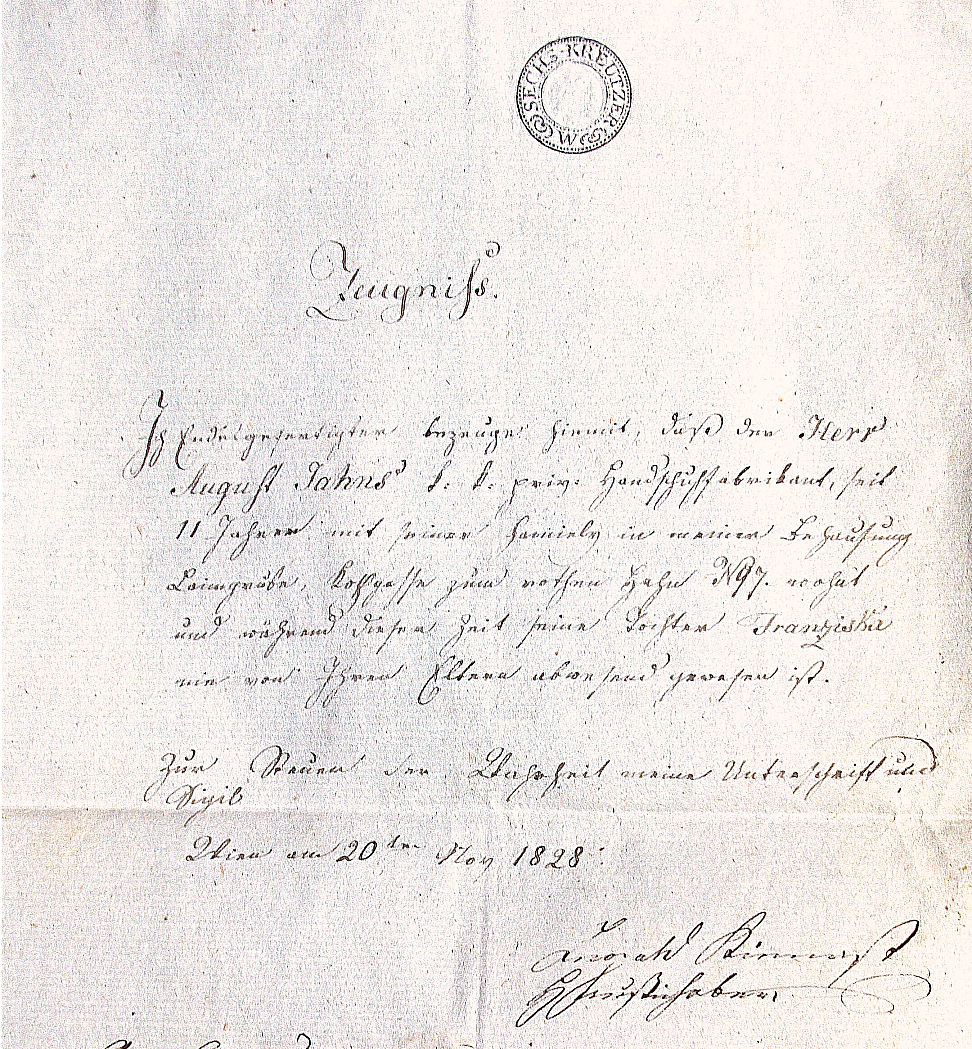
Winter considers Schubert's "abrupt" departure from Zséliz to be in contradiction to the posthumous reports about the composer's love for Caroline von Esterházy. Not a word is said about the fact that Schubert left, because he thought that he had been poisoned. Now follows one of those dictums that we already know too well: "On his return to Vienna, Schubert moved briefly – probably for financial reasons – for one last time into the Schubert family home in the Rossau. To be sure, it was the only place he ever lived in that contained a piano; Schubert never bought, leased or borrowed[!] a piano of his own." Winter is obviously unaware of Schwind's 1821 drawing of Schubert's room with a piano. Several works listed in Winter's bibliography contain this illustration.

In one of the following chapters Winter contradicts his own statement regarding Schubert's access to a piano: "In March [1827] Schubert moved in with Schober for the last time,
remaining, except for a two-month holiday, at the new house on the
Tuchlauben (where he had his own music room) [...]" and in the chapter "Piano music" Winter follows this up with another self-contradiction: "Although he [Schubert] made little use of the extra low notes available
on larger Viennese pianos from 1816 (his borrowed[!] instruments evidently
did not include these notes)".
Let me conclude with a few minor inaccuracies that are simply out of place in the Schubert article of "the world's definitive music reference resource" (as
The Los Angeles Times described
The New Grove on 13 December 2000). Schober did not go to Breslau in August, but in late July 1823. He returned from there not in July 1825, but in June of the same year. Therese Grob's father was not a teacher, but a silk manufacturer. The center of Schubert's Vienna should not be called "the Ring district" and "the inner Ring". The name "Franz Xaver Schlechta" is incomplete and therefore wrong. Winter also denies
Anton von Doblhoff the predicate of nobility which instead is given to members of the Sonnleithner family, although only Ignaz and his son Leopold received it in 1828. The instrument
Arpeggione was not invented in 1814, but in 1823 (a piece of information to be found in the old edition of
Grove). The performance of the A minor quartet
D. 804 on 14 March 1824 is not proved, because the written program of this particular concert is not preserved.
Johann von Dankesreither was not a relative of Schober. None of
Schober's ancestors bears this name. The Schubert bibliography presented by Winter is selective and very fragmentary. In the chapter "Catalogues" the youngest entry is Walburga Litschauer's book
Neue Dokumente zum Schubert-Kreis from 1986. The periodical
Schubert durch die Brille appears only with a few and less significant contributions (obviously Winter does not know any other). The existence of Ernst Hilmar's und Margret Jestremski's 1997
Schubert-Lexikon is kept secret. To find this book in
The New Grove, one has to read the article about Hüttenbrenner[!] revised by Ewan West. The list of Schubert's works was copied from the old edition almost without change. Thus, newly discovered compositions are absent, such as the
Ombre amene and a
Canon à tre, both dating from 1816. The "Grazer Fantasie" (D. 605A), however, whose authenticity is being strongly doubted in the standard literature, has been included without any comment.
In the age of the computer, it has become possible to accumulate endless amounts of text which easily turn out to be too much for editors to deal with. Some publishers are not willing to pay the necessarily qualified staff that can handle the mistakes that are likely to be amassed in 29 volumes. Robert Winter's article does not stand out that negatively. In his article about Beethoven,
Scott Burnham shows that he still considers the English sentence "I will arrange it with you and me that I can live with you" to be an acceptable translation of Beethoven's statement "mit mir und dir rede ich mache daß ich mit dir leben kann". Accidents like this have almost become a rule in today's monstrous encyclopedias. According to
The New Grove, the great-grandfather of Johann Strauss II moved to Vienna "around 1850", and since the editors consulted an pseudo-expert such as Herbert Krenn, Joseph Lanner is now presented with a wrong date of birth and a wrong date of marriage. A correction of the mistakes is projected only for
The New Grove's web-based edition. On 5 January 2001, Macmillan's then chief executive Richard Charkin was quoted in
The Guardian as follows: "I very much doubt that the hard copy will ever become obsolete, but I would anticipate a gradual movement in scholarly circles from usage of the book to usage of the online version." The scholarly damage that was done by the Schubert entry of the printed edition will remain irreparable for a long time to come.
This review was first published in the journal Schubert durch die Brille 26 (Tutzing: Hans Schneider, January 2001). The online version of the Schubert article in The New Grove has still not been overhauled.
© Dr. Michael Lorenz 2001.
Updated: 22 August 2026


.JPG)




.JPG)