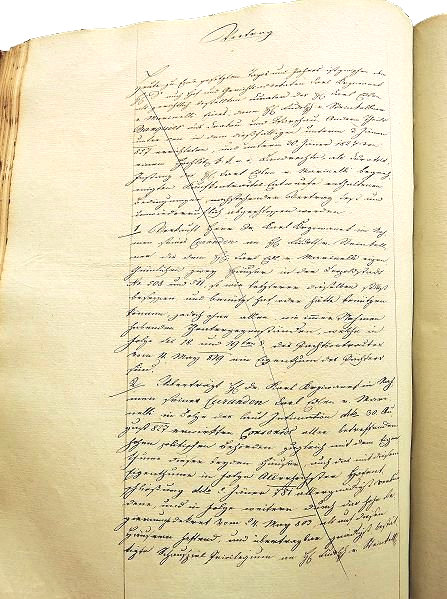
Chopin's landlady Baroness Lachmanovich appears two more times in the conscription records of Stadt 1151. First, together with Auguste Steinhart, her lady companion from Kassel, in a regular sheet where – like Chopin – she is described as "fremd" (which means that she is listed again in the table of foreigners).
Second, Lachmanovich is still registered as living at Stadt 1151 in a
Fremden-Tabelle from 1834.
Auguste von Lachmanovich in a list of foreigners from 1834 (A-Wsa, Konskriptionsamt, Stadt 1151/23r)
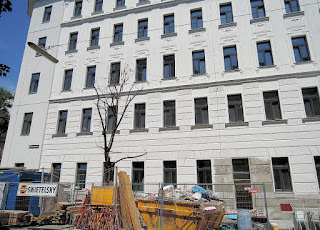
In 1900 the house Stadt 1151 was torn down and replaced with the so-called "
Artaria-Haus", an
Art Nouveau building, designed by
Max Fabiani. On the occasion of the 100th anniversary of Chopin's death, the Austrian Chopin Society, then headed by Franz Zagiba, planned to establish a small Chopin museum in the "Artaria-Haus", but no rooms were available in the building to realize this project. Therefore, the society commissioned a memorial plaque (inspired by Chopin's profile portrait of 1830) which was unveiled on
17 October 1950.
The Chopin memorial, presumably a work by Robert Ullmann, on a front pillar of the house Kohlmarkt 9
Polish Friends
Apart from Viennese musicians and
Johann Baptist Malfatti (who spoke Polish fluently), during the time of his second stay in Vienna, Chopin mostly socialized with Poles. Constanze Beyer was Polish, Madame Elkan had been born Eleonora Milkuschitz von Milieski in Kraków. Rozalia Aleksandra Rzewuska was a daughter of Princess
Rozalia Lubomirska, and on 17 August 1805 – at the age of sixteen – had married Count
Wacław Seweryn Rzewuski.
Countess Rozalia Aleksandra Rzewuska. Drawing by Thomas Lawrence (GB-Lbm 1900,0717.5)
Countess Rzewuska, at whose home (as Chopin puts it) "the whole world sometimes meets" and where the composer also made the acquaintance of
Catherina Cibbini-Kozeluch, lived on the Wieden, "next door to Hussarzewski" who lived at Wieden 308 (
Favoritenstraße 20). After his marriage to Countess Helena Sierakowska, the I. & R. chamberlain Count Adolph Husarzewski (1790–1855) would buy this house from Joseph Blöchlinger in 1835.
The families of Joseph Blöchlinger (Karl van Beethoven's teacher) and Adolph von Husarzwewski on a conscription sheet of Wieden 308 (A-Wsa, Konskriptionsamt, Wieden 308/46r)
Signature and seal of Count Adolph von Husarzewski from 1837 (A-Wsa, Konskriptionsamt, Stadt 512/27r)
That Chopin made regular excursions to the suburb of
Wieden has previously not been noticed by Chopin scholars. Another fellow countryman, with whom Chopin had regular contact, was his former classmate, the composer
Tomasz Napoleon Nidecki who in December 1830 visited Chopin every day to practice Chopin's concerto. At that time Nidecki lived not far away from Chopin, at Stadt 571 (
Graben 22), where he obviously had not enough space for a piano.
Tomasz Napoleon Nidecki ("Thomas Nidetzky 807 Tonkünstler Warschau Pohlen m.[it] Auf.[enthalts] Karte") on a list of foreigners at Stadt 571 (A-Wsa, Konskriptionsamt, Stadt 571/27r). When Nidecki worked at the Theater in der Leopoldstadt, he lived at Leopoldstadt 261 (today Tandelmarktgasse 8).
In spring of 1831, with the help of his fellow countryman Peter Anton Steinkeller, Nidecki was able to secure a commission from the
Leopoldstädter Theater. In 1833 he was appointed musical director of the theater, a post he also owed to his Polish origin.
The Baptism of Peter Alexander Steinkeller
The name
Steinkeller, a person with whom Chopin interacted socially in Vienna, is rarely ever being commented in the standard Chopin literature. During the time of his second stay in Vienna this name appears four times in Chopin's letters.
- 26 December 1830 (to Jan Matuszyński): "Next
morning I was awakened by an invitation to dinner at Mme Elkan's, the
Polish wife of a banker. I got up, played a little in a gloomy mood.
Then Nidecki came with Leidenfrost and Steinkeller and when we separated
I went off to dine with Malfatti."
- 1 January 1831 (to Matuszyński): "I'm going to lunch [to] Malfatti. Tomorrow I am at Steinkeller's."
- 29 January 1831 (to Josef Elsner): "Just as today every barrel organ can play Strauss, maybe in a few months Nidecki will also be played; but in another sense. I was with him yesterday at Steinkeller, who has given him an opera to write. He counts a lot on it; Schuster, that famous comedian, will perform in it, and Nidecki can make a name for himself."
- 20 July 1831 (according to Karasowski's summary of a lost letter) "Chopin tells his parents that he is leaving with Kumelski en route for Munich via Linz and Salzburg. He is in good health, and Steinkeller has supplied him with money."
It is important to note that the first two appearances of the name Steinkeller could refer to two different persons: the Polish banker and industrial magnate Peter Anton Steinkeller and his younger brother Rudolph, who, at that time, was the owner of the
Leopoldstädter Theater. The third and the fourth quotes definitely refer to Peter Steinkeller, because owing to his bankruptcy, Rudolph on 17 January 1831, had fled from Vienna on (see below) and Peter was busy clearing up his brother's economic mess at the
Leopoldstädter Theater. Both Steinkeller brothers were very well-acquainted with the city of Vienna, because in their youth they had both spent time there, attending the
k.k. Polytechnisches Institut. The opera that Peter Steinkeller "had given
Nidecki to write", was
Die Kathi von Hollabrunn,
Meisl's parody of Kleist's
famous play, that was to premiere with mixed success on
11 March 1831. Rudolph Steinkeller had originally planned to have
Johann Strauss write the music for this play (
Wiener Theater-Zeitung,
29 Jan 1831, p. 52), but not only did Strauss not need the money, he obviously was also clever enough not to get engaged with a theater of dwindling artistic reputation. Chopin seems to have known Peter Steinkeller from Warsaw, because Steinkeller's father-in-law was the Warsaw merchant Jan Anthonin who had been one of the organizers of Chopin's concert on 24 February 1818, at the
Radziwiłł Palace. Peter Steinkeller and his family are documented in the
Wiener Zeitung to have arrived in Vienna from Warsaw on 14 June 1830. Steinkeller moved into an apartment at Leopoldstadt 510, because this house was located right beside his brother Rudolph's residence, the
Leopoldstädter Theater.
The next announcement of Peter Steinkeller's arrival in Vienna on
7 December 1830 ("Herr Steinkeller mit Familie von Rom"), suggests that he and his family had spent some time in Rome, maybe returned to Warsaw and then went to Vienna again to evade the
November Uprising. Other notable tenants of the house Leopoldstadt 510 at that time included the playwright
Adolph Bäuerle , the ballet dancer Pauline Hasenhut (see below), the composer
Johann Horzalka, and the luthier
Johann Georg Stauffer.
Johann Nestroy was to reside in this building only 26 years later, when he was director of the
Carltheater.
The house Leopoldstadt 510, "Zum guten Hirten" (also "Zum großen Tiger"), ("The Good Sheperd", today Weintraubengasse 1) in 1902 (A-Wn, ST 879F). This house was built in 1812 and torn down after 1966. Visible on the far left of this photograph is the clock that stood in front of the Carltheater.
The same view today: the houses 510 and 509 are gone and have been replaced by the "Therese-Krones-Park" which is not a park, but a couple of shrubs hiding the access to an underground garage.
The house No. 510, "Zum guten Hirten", was situated to the right of the
Leopoldstädter Theater, opposite the house Leopoldstadt 503, "
Zur Weintraube", where in 1830
Ferdinand Raimund and
Therese Krones lived. Krones died at Leopoldstadt 503 on
28 December 1830.
The old Leopoldstädter Theater. Postcard by Michael Frankenstein, misnamed "Carl-Theater" (A-Wn, PK 3275, 28). The house "Zur Weintraube" is on the right. This postcard is based on Paul Cohn's 1820 engraving.
In 1847, the old theater was replaced with the Carltheater, and after the demolition of the Carltheater in 1951, the silhouette of the old theater building became visible again on the wall of the house Leopoldstadt 510.
A view from the Praterstraße into the Weintraubengasse in 1960. Visible on the left, on the house No. 510, is the silhouette of the old Leopoldstädter Theater (A-Wn, 177.674A[B]). The building on the right is the so-called "Alliiertenhof" which in 1897 replaced the house "Zur Weintraube".
Peter Steinkeller's name appears twice in the conscription records of Leopoldstadt 510. First, (like in Chopin's case) on a regular sheet as "Peter Steinkeler
799 Bancier in Warschau" with the reference "Fb" (Fremdenbogen).
Peter Steinkeller on a conscription sheet of Leopoldstadt 510 (A-Wsa, Konskriptionsamt, Leopoldstadt 510/22r)
Second, in the list of foreigners, together with his wife, three children, and two maidservants.
[Haus] 510 [Wohnpartey] 7 Peter Steinkellner 799 Bancier in Warschau Eh[gattin] Angelika 803 Sohn Peter 825 [Sohn] Alexander 831 Tochter Pauline 827 [Wohnpartey] Anna Elsner 798 M[a]gd Königgrätz Elis:[abeth] Umogd [Aumayr] v. Enns OÖ
Peter Steinkeller and his family in an 1831 list of foreigners at Leopoldstadt 510 (A-Wsa, Konskriptionsamt, Leopoldstadt 510/54v)
On Friday, 4 March 1831, in the house Leopoldstadt 510, Anielą Steinkeller gave birth to a son who on 7 March 1831, was baptized "Peter Alexander" at the nearby
Church of St. John of Nepomuk. The waiting time of three days was probably caused by the fact that on the Sunday, which followed the birth, the intended godparent Frédéric Chopin was scheduled to give a concert at the
Redoutensaal and did not have time to visit the Leopoldstadt before that event. The Sunday concert was eventually postponed (see below), and on the following Monday the christening could take place with the parish priest Joseph Gorbach officiating.

The entry concerning the baptism of Peter Alexander Steinkeller on 7 March 1831 (St. Johann Nepomuk, Tom. 5, fol. 64)
Namen des Taufenden. Joseph Gorbachmp Pfarrer.
Jahr, Monath, Tag. geboren den 4t[en], getaufet den 7t[en] März 831.
Wohnung und Nro. des Hauses. Leopoldstadt, Nro 510.
Nahmen des Getauften. Petrus, Alexander.
Religion. Katholisch. 1.
Geschlecht. Ehelich. Männlich. 1.
Aeltern.
Vaters Nahme und Condition oder Charakter. H.[err] Peter Steinkeller / Banquier zu Warschau / im Königreich Pohlen, des / H.[errn] Peter Steinkeller / Kaufmanns alldort, und / seiner Frau Gemahlin / Josepha geborn[en] Trey / Sohn.
Mutters Tauf= und Zunahmen. Angelika Anthonin /des H.[errn] Johan Antho- / nin ein[es] Kaufmanns in / Warschau, und seiner / Frau Gemahlin / Alexandra gebor- / nen Charlemont / Tochter
Pathen. Anna Bittmann / Tochter des Herr[n] / Alois Bittmann / fürstl.[icher] Hausoffizier / Stadt No 251, und / Fréderic Chopin / aus Warschau. / Stadt 1151 Privatier / alldort, wohnhaft derma- / len in Wien, in der / Stadt Nro 1151.
Anmerkungen. Hebamme: Anna Cacheè / wohnhaft Leopoldstadt Nro 510. / Copulirt nach Angabe, in Warschau, den 25ten Jäner 824.
Chopin's entry in the godparents rubric is autograph. Because he only wrote down his name and address, but not his profession, the priest Joseph Gorbach crossed out the address and added the words "und" before Chopin's name, and "Privatier alldort, wohnhaft dermalen in Wien, in der Stadt Nro 1151" ("a man of private means, living there [in Warsaw], currently living in Vienna at Stadt No. 1151").
The names of the godparents in the above entry with Chopin's autograph signature
The church where this baptism took place was the old church of St. Johann Nepomuk that had been built in 1780 by
Franz Duschinger and was situated at what today is
Praterstraße 41, about 330 ft closer to the theater than today's church. In 1841, the old church was replaced with a
new one by
Carl Roesner in the style of early
historicism.
The old church of St. Johann Nepomuk in the Leopoldstadt. Watercolor after an older drawing by Johann Wilhelm Frey
The groundplan of the old church of St. Johann Nepomuk in the Leopoldstadt (A-Wsa, 3.2.1.1.P1.238G.38)
A view of the Jägerzeile (today's Praterstraße), showing the Leopoldstädter Theater, the house "Zur Weintraube" and the old church of St. Johann Nepomuk. Oil painting by Franz Scheyerer, around 1825 (Wien Museum, I.N. 53258)
The same area of the Jägerzeile (at today's Nestroyplatz) during the flood of 1 March 1830. Illustration from Franz Sartori's book Wien's Tage der Gefahr und die Retter aus der Noth (Vienna 1830).
I have not yet been able to figure out the date of death of Chopin's godson Alexander Steinkeller. Several notes in the
Kurjer Warszawski (for instance on
19 May 1859, p. 751) prove that he was still alive in 1858.
Peter Anton Steinkeller
Since there are several excellent articles by Polish historians about the life of Peter Anton Steinkeller, a detailed account of this man's life and his many merits is outside the scope of this blogpost.
Piotr Antoni Steinkeller. Portrait from Henryk Radziszewski's and Jan Kinderski's book Piotr Steinkeller. Dwie Monografie (Warsaw 1905)
Peter Anton Steinkeller was born on 15 February 1799, in Kraków, son of the Kraków businessman Piotr Steinkeller and Josephine, née Trey. His ancestors originally hailed from
Pomerania, from where, during the Reformation, they had emigrated to Austria and moved to Kraków in the eighteenth century. After an internship in his father's business, Steinkeller continued his education in the field of commerce and banking in Vienna. After his father's death in 1813, he became the principal heir of the Steinkeller company. On 25 January 1824, in Warsaw, he married Anielą Elżbieta Anthonin (1806–1834), the daughter of Jan Anthonin, one of the richest merchants in Warsaw. From the beginning of his business career Steinkeller showed extraordinaary verve and entrepreneurial acumen. With
Karol Scholtze, a producer of soap and stearin, he ran the trading firm Peter Steinkeller & Cie which became on of the largest companies in Poland. Together with
Konstanty Wolicki he leased the salt trade in
Galicia and in 1822 he bought a zinc mine in
Jaworzno and erected another one near
Będzin. In the 1830s, he bought the estate
Żarki which he turned into a modern agricultural plant. Among other things he ended socage, introduced the use of artificial fertilizers and built sugar and machine factories which supplied the nearby industrial areas. Steinkeller bought zinc from the City of Kraków and soon dominated the Russian zinc market. He built zinc rolling mills in Paris and London, thus becoming the main supplier of zinc on the European market. Between 1836 and 1852, he leased the production of Poland's zinc mines and foundries, but did not succeed in establishing an international zinc consortium. Beginning in 1837, he erected various industrial plants in
Solec, including a factory for carriages (which was managed by his brother Rudolph) and a tile and stove factory. Steinkeller's innovative visions also were a profound impetus for Poland's mail and passenger transport. The coaches from the Steinkeller factory ran between Warsaw and Kraków, a service that was later expanded to other routes. From 1845 on, he supplied the mail service with carriages that were still in use at the turn of the century. In 1838, Steinkeller was among the founders and major shareholders of the "
Warsaw-Vienna Rail Road Company Ltd" (
Towarzystwo Akcyjne Drogi Żelaznej Warszawsko-Wiedeńskiej), fervently advocating the use of modern steam engines instead of the initial plan to use horse traction. Owing to lack of private funding, this enterprise went bankrupt and was eventually taken over by the state. Due to technical problems, not all of Steinkeller's business initiatives were successful. Not even the experts he brought in from abroad could solve the problem of dewatering the lead mines in
Olkusz, or keep the production of agricultural machinery running. In the late 1840s, Steinkeller's financial situation declined. Rising debt with the
Bank of Poland and a fire that destroyed a factory complex in Solec in 1852 forced Steinkeller to declare bankruptcy. All his assets were taken over by the Bank of Poland and he returned to Kraków where in
Podgórze he still owned a brick factory. On 11 February 1854, he died of a heart attack. Steinkeller was married twice: first to Anielą Anthonin (the mother of Chopin's godson Alexander) with whom he had five children; and second, to
Marią Lemańska whom he married on 15 September 1835, in Kłobuck. Today Peter Anton Steinkeller is considered one of Poland's most important industrial pioneers whose ideas and visions were far ahead of his time.
The main objective of Peter Steinkeller's stay in Vienna in 1830 and 1831, was to extract his incompetent brother Rudolph from his troubles as bankrupt owner of the Leopoldstädter Theater, to buy the theater, and to sell it again with the least possible loss. Eventually, the difference between the buying and selling prices amounted to about 45,000 gulden. When Chopin left Vienna in July 1831, Peter Steinkeller generously provided him with money for the journey.
Rudolph Steinkeller
Rudolph Steinkeller's short career as theater owner in Vienna did not only take place in the immediate physical proximity of the legendary actor and playwright Ferdinand Raimund, it is also uncannily reminiscent of the fate of some protagonists in Raimund's magic plays. We owe a great deal of our knowledge about Rudolph Steinkeller's acquisition of the
Leopoldstädter Theater to the fact that the theater historian
Karl Glossy still had access to the files of the
Polizeihofstelle that were to perish in the 1927 fire of the palace of justice. The lost files 1498, 2230, 2798, 3134, 3179 and 7082 from 1827 all covered the police investigations and reports concerning Steinkeller's early business activities in Vienna. According to the reports of the Vienna police, Rudolph Steinkeller "was born in 1805" in Kraków, fourth child of the merchant Peter Steinkeller who, after his death in May 1813, left each of his five children a patrimony of 15,000 gulden CM. In 1825, each of the Steinkeller children (Peter, Caroline, Anton, Rudolph and Joseph) inherited another share of 55,000 gulden from their mother. Between 1816 and 1820, Rudolph Steinkeller attended the Latin school in Kraków and, because in 1820 he had taken part in the students' turmoil at the house of the police indentant Kostecki and feared to be expelled, he left school and practiced commerce in his mother's wholesale firm. In 1824, together with his mother, he moved to Vienna where he successfully attended classes at the department of commerce of the
Polytechnisches Institut. He then traded bills of exchange, together with his eldest brother, and also leased a mill stone pit. The police chief of
Podgórze could report nothing unfavorable concerning Steinkeller's political views, but stated that Steinkeller "had always revealed himself as a man full of arrogance with an unbearable, impetuous and selfish character".
Josepha Steinkeller ("771 Großhändlerswittwe von Krakau") and her daughter Carolina registered as foreigners in the house Stadt 3 in 1826 (A-Wsa, Konskriptionsamt, Stadt 3/12r).
On the occasion of a stay in Vienna in 1826, when Rudolph Steinkeller requested to establish a business there, he was offered to buy the two theater buildings in the Leopoldstadt, No. 511 (the theater), and No. 508 (the so-called "Stadel" which housed a workshop and storage room for scenery and costumes). The proposed purchase price of 185,000 gulden was (not surprsingly) vastly inflated. On 3 November 1826, he returned to Kraków, discussed the deal with his brother Peter, realized the assets and, after his return to Vienna on 3 January 1827, signed the purchase contract
salva ratificatione (under the condition of approval). Because he could identify himself as being of age (which proves that he must have been born at least in 1802), and presented affidavits from Viennese banks that he was a well-known and well-accredited gentleman, on 30 January 1827, the draft of the contract was affirmed by the
Landrechte under the condition that he had to present the political consent. The Vienna police administration certified that, as far as political or moral issues were concerned, nothing unfavorable could be found against Steinkeller. He was described as living quietly, seclusively and economically. For his apartment at Leopoldstadt 402 (today
Prater Straße 61) he paid an annual rent of 400 gulden, usually had lunch at the inn "
Zum Füchsel", never attended any social gatherings and in the evening regularly visited the theater.
Rudolph Steinkeller on a list of "Elternlose Ledige" (parentless bachelors), living at Leopoldstadt 402 in 1827 (A-Wsa, Konskriptionsamt, Leopoldstadt 402/15r). Steinkeller's name is accompanied by the note "seit 826" ("in Vienna since 1826").
The police administration admitted that Steinkeller lacked the education and experience to manage a theater, but, since he would receive the actual privilege only in January 1834 (after the end of
Leopold Huber's lease), he would have enough time to learn the trade and until then he could leave the administrative tasks to a person qualified enough to meet the demands of the authorities. On 21 August 1827, the Court Chancellery bestowed the theater privilege to Steinkeller, but he was not allowed to exercise it before 1834. A copy of the purchase contract, whereby the
Leopoldstädter Theater passed from Karl von Marinelli's bankrupt estate to Steinkeller, survives in one of the land registers of the
Bürgerspital dominion. It is to be noted that at the time of the purchase Steinkeller pretended to be of noble birth and he never was able to meet one of the clauses in the contract, namely to present his predicate of nobility to the court of the
Landrechte. The original of this important unpublished document (whose original German text can be downloaded
here) bore the signature of Ferdinand Raimund, the Viennese playwright, who in 1844 was described by
The Foreign Quarterly Review as "one of the most original and poetical figures that Germany ever possessed."
The first page of the copy of the purchase contract of the Leopoldstädter Theater and its "Stadel" (barn) between Karl von Marinelli's liquidator Dr. Karl Krziwanek and Rudolph Steinkeller, dated 31 August 1827 (A-Wsa, Patrimonialherrschaften, B106.26, fol. 212v)
The signatures on the aforesaid copy of the purchase contract. The signatories were: Karl and Franziska von Marinelli and Dr. Karl Krziwanek (as sellers), Joseph von Catharin and Ferdinand Raimund (as witnesses), and Rudolph Steinkeller (as buyer) (A-Wsa, Patrimonialherrschaften, B106.26, fol. 217v).
On 17 April 1828, Steinkeller presented Ferdinand Raimund as the theater's new principal, and the newly apponted director expressed his gratitude in a short speech to his colleagues (
Wiener Theater-Zeitung, 29 April 1828, p. 208).
About five years of the history of the Leopoldstädter Theater documented on a conscription sheet of the theater building: "Rudolph von[sic] Steinkellner 805 Theater Inhaber" ("spektor" and the predicate of nobility crossed out); on the left, filed as owner: "Peter Steinkeller Inhaber des Theaters wohnt 510", followed by "Herr Karl Franz edler von Marinely" who, together with his family, is also listed as tenant and "Theater Privilegiums Inhaber v Leopoldstadt" (A-Wsa, Konskriptionsamt, Leopoldstadt 511/18r). Rudolph Steinkeller's Polish manservant Peter Gabrinecki appears on the theater building's list of foreigners (A-Wsa, Konskriptionsamt, Leopoldstadt 511/38r).
What now followed was the negligent destruction of the most successful ensemble that the Viennese
Volkstheater had ever possessed. Rudolph Steinkeller turned out to be an ignorant bully, who, being obsessed with cutting costs, managed to lay off (or chase away) his theater's best and most beloved forces. Raimund's administration was mostly make-believe, because Steinkeller made his decisions arbitrarily and without consulting with anybody. He massively reduced salaries and benefices and laid off long-time popular members of the ensemble: Louise Haas,
Johann Sartory,
Anton, and
Ignaz Schuster, Elise Gärber,
Katharina Ennöckl,
Friedrich Joseph Korntheuer, and Therese Krones all were dismissed. Steinkeller was known to always carry a whip and to appear among his employees in the company of two enormous dogs. On 8 August 1830, the actor
Carl Ludwig Costenoble wrote the following into his diary.
Ignaz Schuster hat das Leopoldstädter Theater verlassen, was Raimund auch thun wird, weil der jetzige Unternehmer, der Pohle Steinköller ein ganz unvernünftiger Mensch – ja, oft mehr Vieh als Mensch seyn soll. Die schöne Lokalkunstanstalt geht also zu Grund durch diesen Barbaren!!
Ignaz Schuster has left the Leopoldstadt Theater which Raimund will do as well, because the current entrepreneur, the Pole Steinkeller, is said to be a completely unreasonable person – yes, often more a brute than a human being. Thus the beautiful institution of local art is perishing because of this barbarian!!
Carl Costenoble's entry in his diary on 8 August 1830, concerning Steinkeller's behavior (Wienbibliothek, H.I.N. 17337, vol. 2)
As a result of Steinkeller's stupid actions and his chaotic administration, which the Viennese soon called "polnische Wirtschaft" (Polish mess), the
theater's revenue plummeted. In July 1830, Ignaz Schuster resigned, and in
August 1830, Raimund also had enough and resigned from his post. The economic situation was worsened by
Carl Carl's successful repertoire at the
Theater an der Wien, as well as by the recession that followed the
July Revolution, and the growing fear of another Cholera outbreak. On 17 January 1831, Rudolph Steinkeller fled from Vienna as bankrupt. On
22 June 1831, the
Allgemeine musikalische Zeitung described this escape as: "Der Eigenthümer hat sich in aller Stille entfernt" ("The owner has absented himself in secret"), and the Viennese press circulated the following quip: "Which English town describes the owner of the
Leopoldstädter Theater? Oxfort!" (i.e. "der Ochs ist fort", "the ox is gone").
Now Peter Steinkeller, the elder, more reasonable and more moneyed brother, stepped in to clear up the chaos that his brother had left behind. The sources suggest that the brothers Steinkeller had coordinated their actions in advance and that Peter himself, after buying the theater on 15 January 1831, had advised Rudolph to quickly leave Vienna. On 21 January 1831, Peter Steinkeller received the official ownership of the theater and on 25 January, he installed Franz von Marinelli as partner and new theater administrator. On 23 March 1831, Marinelli bought the theater with a loan from Baron Friedrich von Dietrich and Baron Karl von Schloißnigg. The following entries in the land registers of the Vienna
Bürgerspital document Peter Steinkeller's activities in 1831 as short-time owner of the
Leopoldstädter Theater.
- The
registration of the purchase contract between Rudolph and
Peter Steinkeller, dated 15 January 1831 (A-Wsa, Patrimonialherrschaften, B106.27, Sätze, fol.
186v)
- The "Einverleibung" (incorporation) of Rudolph
Steinkeller's contract of 24 January 1831 to Peter Steinkeller (Ibid., fol. 187v)
- The belated
registration of Rudolph Steinkeller's ownership ("Gewähranschreibung")
on 24 January 1831, which on the same day was registered as having been transferred to his brother Peter
(A-Wsa, Patrimonialherrschaften, B106.27, Gewähren, fol. 81r-83r)
- The registration of the sale of a third of the theater buildings to Franz von Marinelli (Ibid., fol. 188r)
- A copy of seven paragraphs from the will of Peter Steinkeller's mother Josepha dated 26 June 1825, documenting the distribution of Josepha Steinkeller's estate among her children (Ibid., fol. 214v-215v)
- The registration of Karl von Marinelli's ownership according to the purchase contract with Peter Steinkeller of 23 March 1831 (A-Wsa, Patrimonialherrschaften, B106/29, fol. 8v-9r)
- The "Einverleibung" of the above contract on 28 March 1831, cashed in on 21 January 1839 (A-Wsa, Patrimonialherrschaften, B106.27, Gewähren, fol. 203r)
- The registration of Marinelli's payment of 28,000 gulden to Peter Steinkeller in six installments between 23 September 1832 and 23 September 1834 (A-Wsa, Patrimonialherrschaften, B106.28, fol. 209v-210r)
The so-called "Dienstbücher" (registers of owners who paid real estate taxes) of the series
B106 from between 1816 and 1868 were destroyed in 1927.
In February 1831, Peter Steinkeller rehired Johann Sartory as artistic director. One of the first things Peter Steinkeller did to raise the theater's profit was to tender an award of 100 ducats for a new play (
Wiener Theater-Zeitung, 1 February 1831, p. 53). The legal aftermath of Rudolph Steinkeller's bankruptcy lasted for several years, as several of Rudolph Steinkeller's creditors tried to get their money back from his brother Peter.
A look behind the scenes of Rudolph Steinkeller's way of running his theater: a list of promissory notes, issued by Steinkeller to the tailor Ignaz Zeillinger in a file pertaining to Zeillinger's lawsuit against the Steinkeller brothers (A-Wsa, Mag. ZG, A5, 1109/1831). Another lawsuit against Steinkeller is addressed in the Wiener Zeitung of 9 October 1834.
From the many files of the Vienna Municipal Court covering these lawsuits only three survive from this court's series A5 (formerly Faszikel
7): 1109/1831, 802/1831 and 1847/1831. By always being
absent from Vienna at the right time, Peter Steinkeller managed to dodge
most of the court's summonses and distress warrants.
A public summons ("Edikt") by the Vienna Magistrate, addressed to Peter Steinkeller, requesting his appearance at the Vienna Civil Court on 17 August 1832, at 10 a.m. (A-Wsa, Mag. ZG, A5, 1109/1831).
The Vienna police was still interested in Peter Steinkeller's activities as late as 1848. The only surviving file concerning Peter Steinkeller in the holdings of the
Polizeihofstelle of the
Austrian State Archives is a report, dating from 7 March 1848, concerning Steinkeller's arrival in Vienna on 1 March of that year and his departure three days later, after having conferred with the merchant Hugo zu Salm-Reifferscheidt, "providing no occasion for any alarming perception" (AVA, PHSt 3479/1848). Debts and mismanagement were not the only things that Rudolph Steinkeller left behind in Vienna. In 1829 two sisters were members of the Leopoldstadt ensemble: Therese Lenz ("the Elder") and Friederike Lenz ("the Younger"). Both of them were hired as "Pantomiminnen und Charaktere" which meant they mostly took part in pantomimes and ballets. In the 1830s Therese Lenz was to achieve some local fame as a dancer in "magic parodies", such as
Karl Schadetzky's
Harlekins Geburt, oder das Zauberhorn. On 1 December 1829, Joseph Lenz, the father of the Lenz sisters, wrote the following letter to the Vienna Magistrate.
My daughter Therese has been put into the unfortunate situation by the theater owner in the Leopoldstadt Mr. Rudolph Steinkeller, by whom she had been engaged, to have been impregnated in February of this year und she has given birth to a girl on November 14th of this year. Since my daughter is only 19 years of age and therefore a minor, the child is in her care in my house and because it needs a guardian in the interest of its future care, the undersigned requests that the honorable Magistrate may deign to assign the child's guardianship to him to be able to take care of the fate of this unfortunate creature according to his duty and conscience.
Vienna, 1 December 1829
Joseph Lentzmp
I. & R. government official

Joseph Lenz's letter to the Vienna Magistrate concerning Rudolph Steinkeller's illegitimate daughter Leopoldine (A-Wsa, Mag. ZG, A3, 328/1829). Leopoldine Lenz's godmother was her aunt Friederike (St. Johann Nepomuk, Tom. 4, fol. 141). Contrary to a widely held belief, such a document cannot be found in some register under the name "Steinkeller". It can only be found by spending fourteen months going through 374 boxes of orphan files of the Vienna Municipal Court.
For obvious reasons, Rudolph Steinkeller never returned to Vienna. He
settled in Kraków and later, for some time, managed his brother's carriage
factory in Solec where the legendary
Steinkellerka was produced. He died on 14 April 1862, in Kraków.
The signatures of the actress Katharina Ennöckl and Rudolph Steinkeller on a contract concerning the clearance of Ennöckl's apartment (A-Wst, H.I.N. 144.111)
The Other Godparent: Anna Bittmann
Why was Anna Bittmann, "daughter of a princely house officer", chosen as godmother of Alexander Steinkeller? Because her mother had been a sister of Steinkeller's mother Josepha, Anna Bittmann was Peter Steinkeller's cousin. That Polish historians such as
Józef Wawel-Louis (and the
Polish Wikipedia) give the maiden name of Peter Steinkeller's mother as "Josepha Frey", is obviously based on a mistranscription that is revealed by the information "seiner Frau Gemahlin Josepha geborn[en] Trey" in Alexander Steinkeller's baptismal entry. Not surprisingly, Anna Bittmann was deeply rooted in the Polish social environment that thrived in Biedermeier Vienna. She was born on 26 November 1803, second child of Alois Bittmann and his wife Franziska, née Trey. Her place of birth was the house Alsergrund 106, "Zum goldenen Hirschen" (last number 125, today
Alser Straße 33). Close to this building, Prince Liechtenstein owned a palace (
Alsergrund 98) and a large garden (
Alsergrund 126). Anna's father Alois Bittmann hailed from Alt Rothwasser in Moravia (today
Červená Voda) where he had been born around 1767. His marriage in 1801 under the authority of the "Feldsuperioriat" proves that at that time he was already a member of
Johann I Joseph Prince of Liechtenstein's military unit where he worked as "Kucheltrager" (kitchen waiter). When in 1805 his principal became head of the family and moved to the
Liechtenstein Palace in the Herrengasse (Stadt 252), Bittmann was promoted to the rank of "princely cook".
The entry concerning the baptism of Anna Bittmann on 26 November 1803 in the Alserkirche (Alservorstadt, Tom. 6, fol. 269). Her father is given as "Aloys Bittmann hersch[aftlicher] Kucheltrager bey T.[itulo] H[errn] Fürsten Johann von Liechtenstein".
Alois Bittmann's sons also joined the prince's staff: Jakob became a servant and Alois became a professional scribe who worked as actuary at the Liechtenstein estate of Eisgrub (
Lednice). In 1830, in a conscription sheet of Stadt 252, Anna Bittmann is referred to as "in Dienst" (in service).
Alois Bittmann's family on a conscription sheet of the Liechtenstein palace in 1830 (updated in 1840): Franziska Bittmann and her last son Carl were already dead, the son Jakob is a "Fürst Lichtensteinischer Hausoffizier" and Alois had earlier been a "Burggraf. Schreiber zu Feldsberg". His entry is accompanied by a list of passports that were issued for his travels to Moravia; the entry "Tocht. Anna 804 in Dienst" is at the bottom (A-Wsa, Konskriptionsamt, Stadt 252/17r).
Alois Bittmann died on
3 July 1842. His
Sperrs-Relation lists the following children.
Children 3
3 Of legal age and their whereabouts
Mr. Jakob Bittmann, cook with His Excellency Prince Aloys Lichtenstein, N 130 in the Rossau, 41 years of age,
Anna Bittmann, unmarried, 38 years of age, lady's companion with Countess Mniszek, N: 266 in the City,
Mr. Aloys Bittmann, court actuary of the dominion of Eisgrub in Moravia, 36 years of age.
The three Bittmann children listed in their father's Sperrs-Relation (A-Wsa, Mag. ZG, A2, 5367/1842)
At this point, for reasons of visual enjoyment, I insert a document written in 1842 by Anna Bittmann's younger brother Alois. It nicely documents the skills that were needed to work as scribe for the Princes of Liechtenstein.
The exquisite handwriting of Alois Bittmann, court actuary in Eisgrub (A-Wsa, Mag. ZG, A2, 5367/1842)
With the help of her father's (and certainly the Prince's social connections),
Anna Bittmann was able to secure a job as lady's companion in the
service of Countess Helena Mniszek, the wife of Count Stanisław Adam Mniszek who
resided in his own house beside the Liechtenstein Palace at Stadt 266 (today
Wallnerstraße 7).
Count Mniszek's house Stadt 266 on a photograph from 1911 protruding on the left side of the Wallnerstraße (Wien Museum, I.N. 42000/1). This building, which until 1911 belonged to Mniszek's daughter Luitgarde Stadnicka, was torn down in 1913.
Countess Mniszek was born
Princess Helena Lubomirska in 1783, daughter of
Prince Józef Lubomirski. Thus, she was a relative of Chopin's friend Countess Rzewuska. Her husband Count Mniszek, whom she had married in 1807, was probably a business partner of Peter Anton Steinkeller. Count Stanisław Adam Mniszek (1774–1846), whose mother had been a Countess Ossolinska, was one of the most interesting Polish noblemen living in Vienna. In 1799, he had bought the castle and dominion of Frain (today
Vranov nad Dyjí) where, from 1816 on, he produced earthenware in the local manufactory. In 1829, he invented
a method of manufacturing a new kind of light blue, light brown, and light green
Wedgwood, by means of a special treatment of clay and glaze, the patent of which he had
extended in 1834.
Count Stanisław Adam Mniszek
Count Mniszek was a professed lover of music. In June 1822, Felix Hippolyt Doré, a son of Count Mniszek's tutor and administrator Joseph Doré, married Therese Derffel, cousin of Franz Schubert's friends
Franz von Schober and Franz Derffel. Thus, Hippolyt Doré not only established the connection between his and Schober's family, he als brought Count Mniszek into contact with Franz Schubert and his friends. In 1829, Mniszek was among the subscribers of Schubert's posthumously published song cycle
Schwanengesang.
The view from Vyhlídka Tanečnice towards Vranov Castle. Lithography by Joseph Doré (1806–1872), a cousin of Franz von Schober, who in 1833 was the head of the "chemical earthenware printing company" in Vranov. This Vienna-born Doré drew many views of Vranov and its surroundings that today grace the walls of the castle and are now falsely attributed to the French painter Joseph Doré.
Anna Bittmann remained in Countess Mniszek's employment for the rest of her life. On an 1850 conscription sheet of Stadt 266 she is listed as "Gesellschafterin" (lady companion).
Anna Bittmann's name in a group of domestic servants at Stadt 266 (A-Wsa, Konskriptionsamt, Stadt 266/14r)
Anna Bittmann died of a stroke on 24 May 1854, at Countess Mniczek's house Stadt 266 and was buried on 27 May in an own crypt in the cemetery outside Matzleinsdorf.
The entry concerning the death of Anna Bittmann on 24 May 1854 (A-Wstm, Tom. 13, fol. 89)
The entry in the register of crypts concerning the Bittmann family crypt in the Matzleinsdorf cemetery (A-Wsa, Kommunalfriedhöfe, 1.2.4.3.2.B1.1 alt: II-B-1 - Protokoll der Grüfte, fol. 76r)
Anna Bittmann's mistress Countess Helena Mniszek died on 14 August 1876, in Vranov.
The Caché-Mattis Connection
On 11 June 1831, Chopin performed his
Concerto in E minor at the
Kärntnertortheater. His appearance was part of a concert that served as opening act of
Theodosia, a ballet by
Paolo Samengo with music composed by
Wenzel Robert von Gallenberg.
The Zettel of the court theaters, announcing Chopin's concert at the
Kärntnertortheater on 11 June 1831 (A-Wkm, Theatermuseum, Hoftheater
1831)
This was not just any performance. It was a premiere of a new work with new scenery and costumes, featuring some of the best ballet dancers of their age: Pietro Campilli, Dominik Mattis, Federico Massini, François Crombé, and the legendary
Fanny Elßler with her sister
Therese, and her cousin
Hermine. The Elßler sisters had a close relation to the composer Count Gallenberg who was the godfather of Fanny's illegitimate son Robert Franz (b. 4 June 1827) and Therese's illegitimate daughter Robertine Marie (b. 22 November 1829). It is interesting to note that
Kanne's favorable review of Chopin's performance appeared in the
Theaterzeitung on 18 June 1831, five days earlier than the
review of the ballet, where the reviewer praised the dancing and the music, but criticised the odd storyline and the staging. The combination of Chopin's concert with a ballet that was performed for the benefit of the dancer Dominik Mattis (whom the Fryderyk Chopin Institute
mistakes for a conductor) has always been considered a coincidence and the result of
Duport's more or less arbitrary performance schedule. I do not think that it was a concidence. I surmise that Chopin knew Mattis personally, because he had met him and Mattis's fiancé Pauline Hasenhut at Peter Steinkeller's home in the Leopoldstadt.
In late 1830 and early 1831, the dancer Dominik Mattis (born 1803 in Torino) and his fiancé, the ballerina Pauline Martina Hasenhut (born 1809 in Vienna, daughter of the ballet master Philipp Karl Hasenhut), were the darling couple of Viennese and Italian audiences. On
12 December 1830, they left Vienna to begin a three-month engagement at the
Teatro della Scala in Milano.
Dominik Mattis. Engraving by Joseph Kriehuber (A-Wn, PORT_00022915_01)
Pauline Hasenhut. Engraving by Joseph Kriehuber 1829 (A-Wn, PORT_00148615_01). Pauline Hasenhut and her younger sister Leopoldine had been among the hundreds of victims of the serial child molester Prince Alois von Kaunitz-Rietberg.
According to a report, published in the
Theaterzeitung on
27 January 1831, Mattis and Hasenhut performed at the
Teatro Carcano to enthusiastic audiences: "They only need to appear to be greeted with a storm of applause and curtain calls. Mattis and Hasenhut performed a new
Pas des deux in the ballet
Kaokom and the applause was enthusiastic. These accolades are all the more remarkable, as the Milanese are said to be not too generous expressing their acclaim." On
31 March 1831, Mattis and Hasenhut returned to Vienna. Since Pauline Hasenhut's father had died in 1825, and she was still under age, her legal guardian was the actor Anton Caché, who lived at the same address as the Hasenhut family, at Leopoldstadt 510, the residence of Peter Steinkeller.
Theresia Hasenhut and her children Ignatz, Leonhard, Leopoldine, Pauline, and Eva on a conscription sheet of Leopoldstadt 510 dating from 1830. After the family's move to the city, this sheet was transferred to the records of Stadt 969. The entry in red refers to an arrest of Leonhard Hasenhut (A-Wsa, Konskriptionsamt, Stadt 969/16r)
Caché's second wife Anna, née Bartelmann was originally an actress by profession, but later seem
s to have taken up a sideline, working as midwife. In this versatility she resembled her husband who in 1820 earned an additional income by performing mechanical artistic fireworks in his apartment for an entrance fee of one gulden Viennese currency (
Wiener Theater-Zeitung, 20 January 1820, p. 36).
Anton Caché and his second wife Anna on an 1830 conscription sheet of Leopoldstadt 510 (A-Wsa, Konskriptionsamt, Leopoldstadt 510/38r)
Anton and Anna Caché ("Heb:[amme]") registered as godfather and midwife on the occasion of the baptism of Theresia Kihnel's son Christian on 3 June 1832 (St. Johann Nepomuk, Tom. 5, fol. 134). Anton Caché's signature is autograph.
Since she was living in the same house as the Steinkeller family, it was quite logical that Anna Caché served as midwife at the birth of Chopin's godson Alexander Steinkeller. On 13 May 1831, Anton Caché applied to the Vienna Magistrate to grant full legal age to his ward Paulina Hasenhut who at that time was 21 years and seven months of age.
The first page of Anton Caché's application to grant legal age to his ward Pauline Martina Hasenhut (A-Wsa, Mag. ZG, A3, 164/1831)
Caché argued that his ward had always behaved well and economically and "is living only for her art and her domestic duties". He explained that "she has prospects of a very advantageous marriage to Mr. Mattis, one of the most famous ballet dancers, an impeccable gentleman, as far as his art and his morality are concerned, who is able to provide his future wife with a splendid livelihood". And finally Caché stated that, "because Mattis has to travel from one engagement to the other and his wife will have to accompany her husband to Italy and France and close contracts with many theater managements", Pauline Hasenhut needs to be granted legal age. The request was granted on 31 May 1831.
The signatures of Anton Caché and his ward Pauline Hasenhut in the above application (A-Wsa, Mag. ZG, A3, 164/1831)
Dominik Mattis and Paulina Hasenhut married on 11 July 1831, at Vienna's
Augustinian Church. The bride's witness was her guardian Anton Caché. Chopin probably attended the wedding.
For a number of years, Dominik and Pauline Pauline Mattis successfully toured Europe, but in the late 1830s, their marriage seems to have fallen on hard times which was probably caused by Pauline's health problems. The couple eventually separated. In June 1838, Mattis was already
performing in Stuttgart with
Hermine Elßler. When Pauline Mattis died of abdominal cancer on 9 October 1844 (
Wiener Zeitung 20 Oct 1844, 2089), in Vienna, her husband was on tour in Italy. Concerning her husband a note in Pauline's
Sperrs-Relation states: "
Husband N. Mattis in Italy, details unknown.".
The Sperrskommissär Anton Slabe's note "Ehegatte N. Mattis in Italien, Näheres unbekant" in Pauline Mattis's probate file (A-Wsa, Mag. ZG, A2, 6150/1844)
Following a popular stereotype of the "utilized genius", Chopin is always depicted as having been taken advantage of by Mattis and Duport, because "he did not get paid for his performance". There is absolutely no proof to support this claim. On the contrary, it seems likely that Mattis gave a share of his revenue to Chopin, or even more probable, that Peter Steinkeller provided the godfather of his son with an honorarium.
A Few Unresolved Issues
Concerning Chopin's second stay in Vienna, a number of open questions and errors are still marring the literature. These unresolved issues, which have been caused by lack of archival research and by many authors' tendency to simply copy the work of their predecessors, are the following.
Chopin's visits in Hietzing
Countless biographies of Chopin describe the composer as being a guest in December 1830 at Dr. Malfatti's villa on the
Küniglberg
in Hietzing. This country estate (Hietzing No. 159), which included a
large piece of land, had been purchased by Malfatti in June 1830.
As a matter of fact, Chopin did not stay in Hietzing at Christmas of 1830. On Sunday, 26 December 1830, he writes to Jan Matuszyński.
Next morning I was awakened by an invitation to dinner at Mme Elkan's, the Polish wife of a banker. I got up, played a little in a gloomy mood. Then Nidecki came with Leidenfrost and Steinkeller and when we separated I went off to dine with Malfatti. Szaniasio (a Pole who has since been killed) ate as much zrazy and cabbage as, I guarantee, any Carmelite priest; and I was quite a match for him. I must tell you that that rare man (a man in the full sense of the word), Dr. Malfatti, is so thoughtful in every way that when we go to dinner with him he takes care that we have Polish dishes. Wild, the famous and indeed the leading German tenor of the day, came after dinner, I accompanied him from memory in an aria from Otello which he sang in masterly fashion.
It is clear from his account that Chopin had dinner at
Stadt 863
at Mrs. Elkan's and, after leaving his friends Nidecki, Leidenfrost, and Steinkeller, immediately went to Malfatti's apartment at Stadt 65. It is obvious that the singer
Franz Wild also came from somewhere nearby. During the winter time, Malfatti lived in a
ten-room apartment in the city where, since 1824, he owned the houses Stadt 65 and 66 (today
Teinfaltstraße 5 and
Rosengasse 8). In 1826, the value of these two houses was estimated at 69,000 gulden (A-Wsa, Mag. ZG, A2, 469/1826).
A page from Johann Malfatti von Monteregio's 1859 probate file showing the estimated value of his two city houses still at 67,830 gulden. Owing to fire damage this document is not accessible to ordinary researchers (A-Wsa, Landesgericht für Zivilrechtssachen, A4, E 233/1859).
Only in spring 1831, Malfatti and his two daughters moved to Hietzing where on Saturday, 7 May 1831, he was visited by Chopin and (allegedly)
Hummel. In his letter of 14 May 1831 Chopin refers to Malfatti's move to the country and his visit in Hietzing as follows.
Perhaps Malfatti's soups have instilled into me some soothing medicine which has eliminated any tendency towards illness. If so, I am sorry that our regular banquets came to an end last Saturday, for Malfatti has gone off to the country with his children. You can't imagine what a pretty place he lives in; a week ago today I went to see him with Hummel. He showed us over his property, pointing out all its beauties as we went along, so that when we reached the top of the hill we had no desire to come down again. The Court honours him with a yearly visit, for Princess Anhalt is his neighbour and I am sure she envies him his garden. From one side you can see all Vienna stretched out at your feet so that the town seems joined to Schönbrunn; on the other side are high hills over which are scattered villages and monasteries, making one forget the splendour, tumult and bustle of the town.
Chopin's claim that Hummel accompanied him to Hietzing "a week ago", i.e. on 7 May 1831, cannot be correct, because at that time Hummel was not in Vienna anymore. According to a note
, published in the
Wiener Zeitschrift on
12 April 1831, Hummel had "recently left Vienna to spend the next four months in France and England". On 14 May 1831, the day on which Chopin wrote the above letter, the
Theaterzeitung reported: "Capellmeister Hummel has arrived in London on 24 April and has announced that he will give a concert before Paganini's arrival." (
Wiener Theaterzeitung, 14 May 1831, p. 235). On 8 May 1831, Hummel gave a concert in London (
Iris im Gebiete der Tonkunst, 20 May 1831, p. 80). After March 1831, Chopin and Hummel never saw each other again in Vienna, because Hummel stayed in London, where on
22 June 1831 he gave his last concert. Chopin did not misremember the date of his visit. It must have been Hummel's son
Eduard Hummel, who, on 7 May 1831, accompanied Chopin to Malfatti's country estate.
The tale of Mrs. Malfatti serving Polish dishes
It is generally known among Chopin biographers that Dr. Malfatti's wife was a Polish countess. This fact – which is basically the only thing these authors know about Malfatti's married life – has led to the repeated presentation of cozy family lunches with Malfatti's Polish wife serving Polish dishes to Chopin that she prepared especially for her fellow countryman. Even Kornel Michałowski and Jim Samson in their Chopin entry on
Grove Music Online
refer to a "Malfatti family" which suggests that Malfatti's wife was
still alive and made Chopin's personal acquaintance. Samson (1996) writes: "He made the acquaintance of the imperial physician Dr. Malfatti. The Malfattis befriended Chopin and kept an affectionate eye on him throughout the eight months in Vienna. He spent some happy hours with them eating bigos prepared by Dr Malfattis Polish wife." Likewise, Eva Gesine Baur,
whose hasty way of writing makes her books reliable dragnets for all
kinds of misinformation, in her Chopin biography muses about Mrs.
Malfatti serving Chopin "Fleischküchlein mit Kohl".
The fictitious notion of Malfatti's wife preparing Polish specialties is essentially false. Chopin never made Helena Malfatti's acquaintance, because when he arrived in Vienna in 1830, she had already been dead for more than four years.
Helena Malfatti died on 23 July 1826, of what the parish records describe as "Zehrfieber" (consumptive fever). Soon after her burial, her husband left Vienna for Karlsbad.
This coat of arms also appears on the seal that was used to close the envelope of Helena Malfatti's will.
This rather clumsy drawing was certainly not done by the same person who five years earlier in Vienna had drawn the portrait of Chopin. Mieczysław Tomaszewski (unintentionally?) got it right, when in 1990 he attributed the portrait of December 1830 to "E. Hummel".