Apr 30, 2020

An Unknown Photograph of Franz Grillparzer

The file "Fotografien, Dokumente und Schriftstücke aus dem Nachlass von Guido Peters bzw. Paula Artner" in the music collection of the Austrian National Library, which came from the family of the Austrian composer Guido Peters, contains the following, previously unknown photograph of Franz Grillparzer.

Samuel Volkmann, portrait of Franz Grillparzer (A-Wn, Musiksammlung, Misc.31/IV). For esthetic reasons the ugly ball pen note on the photograph was removed.

This photograph in the carte de visite format, which was made during the 1860s, either in Graz or in Marburg, by the Austrian photographer Samuel Volkmann, is the only existing close-up bust portrait of Franz Grillparzer. The back of the photograph shows the ARTIS AMICA NOSTRAE logo of Samuel Volkmann who at that time, ran Photographie parisienne studios in Graz and Marburg.

The back side of the above photograph with Samuel Volkmann's business stamp. The handwriting is that of Friederike Artner, the last private owner of the photograph.

None of the known photographs of Grillparzer from the same era, taken by Johann Bauer and Ludwig Angerer in Vienna, can compare in detail and true-to-life effect with Volkmann's slightly angled high-resolution portrait. The Viennese studio photographers, whose customers mostly belonged to the social upper class, used to put their models into a discreet distance.

Johann Bauer's portrait of Grillparzer from 1861 (A-Wn, Pf 429 E2). Johann Bauer, an Austrian pioneer of photography of eminent significance, has until now not been the object of biographical research. Bauer was born on 24 November 1810, in Mondsee, son of a local watchmaker. After having worked as a schoolteacher, in 1838, he went to Vienna where he attended the Academy of Fine Arts. In 1857, he established a studio on the Mölkerbastei. His second wife Amalia (1823–1870) was a sister of Ludwig Angerer. In 1868, Bauer moved to Mondsee and later to Gmunden where he lived in the home of his daughter Louise Eberstaller. Bauer died on 3 December 1901, in Gmunden.

 
Ludwig Angerer's portrait of Grillparzer from 1861 (Albertina, FotoGLV2000/4815). A similar photograph from this session (A-Wn, Bildarchiv Pf 429 B10) could be the one which, on 25 August 1862, Grillparzer referred to in a letter to Wilhelm Schaefer: "You sent me your photograph and asked for mine. I didn't have a good one, or rather none at that time. Since then, one has been made. It isn't good either, since it doesn't show the eyes, and the face only expresses the displeasure about sitting and being photographed. Nevertheless, I enclose it here." The Vienna Theatermuseum holds a third photograph from this session (A-Wtm, FS_PV262434alt) which shows Grillparzer on a different chair on the right side of the table.

Only the Viennese photographer Franz Schultz (1813–1865), whose studio was located at Auerspergstraße 19, dared to portray Grillparzer from a slightly closer distance.

Portrait of Grillparzer by Franz Schultz from around 1860 (Wien Museum, I.N. 132670/3)

Schultz's photograph was inspired by Friedrich von Amerling's oil painting from 1856.

Friedrich von Amerling, Franz Grillparzer (Wien Museum, Inv. Nr. 27496). Similar to Amerling's painting is the portrait, presumably a work of  Daniel Penther, of which the gallerists Miethke & Wawra produced a postcard (A-Wtm, FS_PV262435alt).

The history of the photograph

Research concerning the history of this photograph must deal with the following three questions.
  1. When was this photograph taken?
  2. To whom was it given by Grillparzer?
  3. How did the photograph end up in the Austrian National Library among material related to Guido Peters?

The dating of the photograph

The photograph was presumably taken in spring of 1864, in Graz, when Grillparzer was on his way to his annual spa sojourn in Römerbad in lower Styria (today Rimske Toplice in Slovenia). Although Grillparzer's regular visits to Graz already began many years earlier – Grillparzer's friend Karl von Holtei lived in Graz from 1850 to 1860 – the timespan in which the photograph was taken can be limited to 1864, because the recipient of the photograph Carl Peters was appointed professor in Graz only on 28 February 1864. Grillparzer's previous stays in Graz can be ruled out, because from 1856 to 1864, Peters was living in Pest. Grillparzer had already stayed in Römerbad in the summer of 1863, where on 16 June 1863, he had suffered a fall which resulted in a concussion that impaired his hearing for the rest of his life. The photograph in question shows the stare of a man whose senses appear to be already impaired. On 30 December 1863, Grillparzer, in a letter to Luise Schönfeld-Neumann, described his state as follows: "Deaf on one ear, I can hardly hear half with the other, my head is confused and stupid."

A pre-war view of the kurhaus of the Römerbad spa in Rimske Toplice in Slovenia. Visible in the foreground are the stairs which, on 16 June 1863, Franz Grillparzer accidentally fell down. Grillparzer suffered a cerebral concussion together with a hearing loss from which he never recovered. These stairs can be identified with the help of Grillparzer's letter of 2 June 1864. Today this area is a parking lot.

In 1864, Grillparzer for the last time took the waters in southern Styria. In 1865, he went to Teplitz, in 1866, he stayed in Hall, and in 1867 and 1869, in Baden bei Wien. On his way home in June 1864, Grillparzer had no time to make a stop in Graz. In his letter to Katharina Fröhlich of 20 June 1864, Grillparzer announced his departure from Römerbad on 25 June and his arrival in Vienna on 26 June 1864, a schedule that left no time for a stopover in Graz. Therefore the most likely scenario is that Grillparzer had the photograph already made on his way to Römerbad. Of course, any later, previously unknown stay in Graz after 1864 could have been an occasion to have the photo taken.

The sideburns that Grillparzer wears on the photograph are new to modern eyes. There is no other photo of the poet that documents this particular beard fashion which is obviously the result of a summery fashion whimsy. Grillparzer's somewhat perplexed gaze, his stare into space ("das Narrenkastel" as he would have put it), is the most moving quality of the photo. This stare is intensified by the pupils that were enhanced by the photographer's retouching. It is interesting to compare Grillparzer's facial features to those of his two uncles Ignaz and Leopold Sonnleithner.

To put Grillparzer's somehow desperate gaze into the right perspective, we must consider that, concerning his summerly health trips, he made the following written statements: "I go about my stay in the country almost like a business that you should try to shake off as soon as possible." (to Katharina Fröhlich, 15 July 1857). "To hell with all the cures, they are as bad as the diseases." (to K. F., 12 June 1858). "Otherwise everything is the same here; the food bad, the coffee I just drank, disgusting." (to K. F. from Römerbad, 11 June 1861). "How unbearable the stay here was, can hardly be described. Constant rain, cold as in wintertime." (to K. F. from Römerbad, 30 June 1862). "The hour of redemption has finally come." (to K. F., before his departure from Teplitz, 3 July 1864)."I will remember this spa trip with shivers for the next 29 years." (to K. F., after a 29-day stay in Teplitz, 3 July 1865). "Finally the end of the most horrible time I have ever experienced is approaching." (to K. F. from Hall, 9 July 1866).


The photograph shows Grillparzer dressed in a rustic vacation attire which can be described as "noble Styrian". The vest, which is obviously green, has rustic ornaments and the jacket is made of the kind of rough material that a k.k. Hofrat would only wear during a summer vacation.

A close-up view of Grillparzer's rustic attire

The original recipient

Grillparzer presumably had the photograph made as a keepsake for his friend Carl Ferdinand Peters who, as of February 1864, held a chair for mineralogy and geology at the University of Graz. The fact that the photograph of Grillparzer's came to the ONB from the estate of Guido Peters's half-sister Selma Artner, née Peters (1847–1913), suggests that Grillparzer had the photo taken in Graz to present it to Guido Peters's father.

The physician, geologist, and mineralogist Dr. Carl Ferdinand Peters (1825–1881), father of the composer Guido Peters (photograph from 1856, published in Hubmann, 2001). Peters was a grandnephew of Beethoven's friend Karl Peters (1782–1849) and a nephew of the mineralogist August Emanuel von Reuss. For a later photograph of Carl Ferdinand Peters see the Peters entry in the catalog of the Vienna University Archive.

Grillparzer had been acquainted with Carl Ferdinand Peters since 1848, when they first met in Vienna. At that time, Carl Peters was in love with Maria Anna Kurzrock (b. 28 April 1828) whose mother Anna Kurzrock, née Schlauka (1801–1877), on 15 April 1834, appears in Grillparzer's diary under the pseudonym "Jessika". During the 1820s, Johann Baptist Kurzrock (1792–1862) and his wife were members of the closer circle of  friends around Franz Schubert. Kurzrock, who at that time was employed with the I. & R. court chamber, had made Schubert's acquaintance through his close friends Franz and Fritz von Hartmann whom he had known since his employment in the early 1820s in Salzburg. The godparents of Kurzrock's children were three of Schubert's best friends: Karl Enderes, Anton Ottenwalt, and Franz Derffel (Lorenz 2001, 53). In 1850, Carl Peters's former flame Marie Kurzrock, the "gentle Marie with her forget-me-not blue eyes" (as Eduard von Bauernfeld described her), married Peters's uncle, the military officer Hermann Peters von Pitersen (1812–1897).

The provenance of the photograph

To find out more about the history of photograph and how it came into the Austrian National Library, we need to look more closely at the genealogy of the Peters and Artner families. Grillparzer's friend Carl Ferdinand Peters, the first owner of the photograph, was married twice. On 15 May 1856, in the Graz Cathedral, he married Marianna von Blumfeld (Graz, Dom 1058, fol. 753). At the time of his wedding, Peters was professor of mineralogy at the University of Budapest, a position that he held until 1861, when he joined the faculty of the University of Vienna. With his first wife, Carl Ferdinand Peters had the following five children: Selma (b. 1 Jun 1857, d. 20 Mar 1913), Otto (b. 5 Jul 1858, d. 11 Nov 1908), Hubert (b. 23 Sep 1859, d. 24 Oct 1934), Martha (b. 7 Nov 1860, d. after 1913), and Theodor (b. 18 Jun 1863, d. 26 Nov 1909). Marianna Peters, née von Blumfeld died on 21 November 1864, in Graz at the age of 32. On 5 November 1865, in Graz, Carl Ferdinand Peters married his first wife's younger sister Leopoldine von Blumfeld (1839–1892) (Graz, Dom 1073, fol. 84). With her he had two more children: Guido (b. 29 Nov 1866, d. 11 Jan 1937), and Erwin (b. 16 Jul 1868, d. 23 Jul 1868).

A picture of the painter Otto Peters and his half-brother Guido, taken in June 1907, in the Atelier Veritas in Munich (A-Wn, Musiksammlung, Misc.31/IV). Otto Peters's last main residence was Glonn near Munich. On 11 November 1908, during a stay in Vienna, he committed suicide by hanging in the apartment of his brother, the gynecologist Dr. Hubert Peters.

Carl Ferdinand Peters died on 7 November 1881, in Graz. The fact that the collection named "Dokumente aus dem Nachlass von Guido Peters" contains three different pictures of his daughter Selma Peters and her husband, proves that it was her who in 1881 inherited the Grillparzer photograph. Selma Peters is the key person for further tracking the provenance of the photo.

A photograph of Selma Peters taken in 1898 by James Russell and Sons in London (A-Wn, Musiksammlung, Misc.31/IV)

On 28 October 1908, at St. Stephen's in Vienna, Selma Peters married Dr. Franz Xaver Artner (b. 10 Oct 1880), professor of Latin and history at Vienna's Theresian Academy, who was 23 years her junior (A-Wd, Tom. 96, fol. 393). In the marriage records Selma Peters is described as "lady companion of Countess von Stubenberg" (most likely Mathilde von Stubenberg, nèe Baroness Tinti).

Franz Xaver Artner (1880–1948), Selma Peters's husband and Guido Peters's brother-in-law (A-Wn, Musiksammlung, Misc.31/IV). The note "Schw[a]ger des Guido Peters u.s.w." was written by Franz Artner's granddaughter Friederike Artner.

Selma Artner, who had obviously inherited her mother's heart condition, died on 20 March 1913, in Vienna (St. Elisabeth 26, fol. 40). With the exception of her mother's wedding jewelry (which she bequeathed to her niece Elisabeth Peters), her husband Franz Artner inherited all her belongings.

Selma Artner, née Peters (A-Wn, Musiksammlung, Misc.31/IV)

Two pages from Selma Artner's 1908 marriage contract which was valid as her will (A-Wsa, BG V, 1A, 121/13)

Franz Artner's second wife was Wilhelmine von Dabrowska (b. 17 Nov 1890, d. 2 Nov 1972) whom he married on 25 June 1916, in Raach am Hochgebirge, in Lower Austria (Raach, Tom 4, fol. 27). At the time of his wedding, Artner was a volunteer cadet with the I. & R. artillery regiment No. 7, and his bride was working as a voluntary Red Cross nurse in Vienna. Interestingly enough, during the Nazi era, Wilhelmine Artner was to become one of Austria's more prominent resistance fighters. From 1938 until 1943, she was incarcerated in Ravensbrück, and in 1944 was arrested a second time (Korotin 2016, 140). In 1946 and 1949, she played a major role as witness in the first trial against Hermine Braunsteiner (Mailänder Koslov 2005, 145ff.).

The photos from Wilhelmine Artner's Gestapo file (DÖW, database of Gestapo victims)

Franz and Wilhelmine Artner had a son, Friedrich, who was born on 23 September 1917, in Vienna. Their other two children, Elisabeth and Dolores, died in early infancy in 1919 and 1921 (St. Elisabeth 32, fol. 50, and 34, fol. 29). Wilhelmine Artner's years of imprisonment seem to have led to an estrangement of the couple, because at the time of Franz Artner's death on 30 January 1948 (A-Wsa, BG I, 12A, 92/48), Artner shared his apartment at Viktorgasse 20 with his housekeeper Magdalena Krainer, while his wife was living with their son at Reichsbrückenstraße 14 (today Lassallestraße 14). Because Franz Artner had left no will, three quarters of his estate went to his son Dr. Friedrich Artner, and one quarter to his widow. The legal procedures only came to a close after the Artner family had reached a settlement with the housekeeper who had made all sorts of claims to her deceased employer's movables.

A page from Franz Artner's probate file concerning the distribution of his estate (A-Wsa, BG I, 12A, 92/48)

On 2 February 1945 (St. Elisabeth, Tom. 31, fol. 70), Dr. Friedrich Artner, a physician, had married the lawyer Dr. Paula Karner (1920–2013). The couple had one child, Friederike Artner, born 2 November 1945, who is now living in a retirement home in Lower Austria. It was Friederike Artner who, probably after the death of her mother in 2013, gave the documents related to the Peters and Artner families to the Austrian National Library. The current civil status law and the data protection makes further research into the Artner family difficult. Fortunately, the headstone of the Artner family grave in Vienna's Central Cemetery provides several genealogical data that are missing in the online database of the Friedhöfe Wien GmbH. The inscription not only provides the previously unknown date of death of Wilhelmine Artner (who according to the database seems to have been exhumed from another cemetery in 2008), but also the date of birth of the last member of the family, Friedrich Artner's daughter Friederike. It is notable that at the bottom of the stone the family members are commemorated who were buried in now lost graves, with Selma Peters among them. The von Fürstenrecht family members were relatives of Wilhelmine Artner whose mother had been a Baroness von Fürstenrecht. Louise Steciuk was Wilhelmine Artner's aunt.

The headstone of the Artner family grave in Vienna's Zentralfriedhof (84/2/11) which is a source for several previously unknown biographical dates.

Beside the photo of Grillparzer, the Peters collection in the ONB contains two more interesting photographic items: 1) An unknown portrait of the writer Ellen Key taken in Stefanie Ludwig's Atelier Veritas in Munich (mislabelled as Marie von Ebner Eschenbach by Friederike Artner), and 2) a postcard of what must be the earliest surviving photograph of the Austrian poet Robert Hamerling. This is the portrait that served as model for the engraving which in 1878 was distributed by the German publisher Spamer.

The photographer Samuel Volkmann

Very little is known about Samuel Volkmann so far. A quick Google search leads to the following biographical note (based on Starl 2005, 493) on a blog about photography history:
Around 1860 Samuel Volkmann arrives in Graz  to open a photographic studio. It operates under the name »Photographie Parisienne«, and photographers such as Louis Fragney, Charles Corand and Anna Volkmann work for S. Volkmann. The first address is Graz, Mur-Quai 444, or Strassoldo Quai 444, or Neuthorgasse 444, then Graz, Fischmarkt 3, finally Graz, Hafnerplatz 4. Branches are kept in Marburg and Leoben.
It is time to shed some light on the life of a still underrated pioneer of Austrian photography. Samuel Ignaz Volkmann was born on 8 May 1828, in the Viennese suburb of Gumpendorf, son of the master weaver Ignaz Volkmann and his wife Anna, née Bauer (Gumpendorf 19, fol. 289). Ignaz Volkmann (1798–1854), who had married on 8 May 1825 (St. Josef zu Margareten, Tom. 7, fol. 18), was the eldest of three brothers, Ignaz, Franz, and Peter Volkmann, who, between 1824 and 1837, came to Vienna from the village of Mährisch Rothwasser (today Červená Voda). Samuel Volkmann was the first of his parents' twelve children who were born between 1828 and 1846. His place of birth was the house Hirschengasse 305 (last No. 382, today Hirschengasse 24). Volkmann did not follow the artisanal path that was prevalent in his family, but became a bookkeeper in the trading firm Höslin & Tischler. On 14 May 1854, in the Gumpendorf parish church (Gumpendorf, Tom. 23, fol. 86), he married his cousin Anna Bauer (b. 23 Jul 1835), daughter of a weaver from Gumpendorf.

Samuel Volkmann's and Anna Bauer's application to the archepiscopal ordinariate to be permitted to have their wedding take place in the evening of 14 May 1854 (A-Wsa, Serie 2.6.1.2.A1, 95/1854)

Because the couple had a common grandfather (the master weaver Paul Bauer), Volkmann needed an archepiscopal dispensation to be able to marry his cousin.

Samuel Volkmann's and Anna Bauer's marriage permit issued by Vienna's archbishop Joseph Otmar Rauscher (A-Wsa, Serie 2.6.1.2.A1, 95/1854)

Volkmann seems to have been very successful in his job, because he was able to spend his honeymoon in Bad Ischl (Ischler Fremden-Blatt, 1 June 1854).

The entry concerning Samuel Volkmann's wedding on 14 May 1854, in the Gumpendorf parish church (Gumpendorf, Tom 23, fol. 36). On the far right is the note concerning the "Dispens v. päpstlichen Stuhle wegen der Verwandschaft".

After his wedding, Volkmann moved from his father's house Gumpendorf 67 (today Marchettigasse 5) to Laimgrube 77 (today Linke Wienzeile 44) which is documented by the entry concerning the baptism of their first child Franz August on 14 March 1855 (St. Josef ob der Laimgrube 28, fol. 179), and Samuel Volkmann's signature as witness to the wedding of his brother Ignaz on 12 April 1856 (Gumpendorf 25, fol. 46).

Samuel Volkmann's signature in the 1856 marriage entry of his brother Ignaz Volkmann (Gumpendorf, Tom 25, fol. 46)

In May 1857, Volkmann moved to Graz (Grazer Tagespost, 30 May 1857), where, together with the bookseller Karl Tendler (1825–1904), he acquired the so-called Ferstl'sche Buchhandlung (Ferstl's bookshop) at Herrengasse 223. Tendler and Volkmann not only established a book and art dealer's shop, but also a sheet music rental that was to become the largest institution of this kind in Styria. The business opened on 12 September 1858 which two days later was reported in the local press (Tagespost [Graz], 14 September 1858).
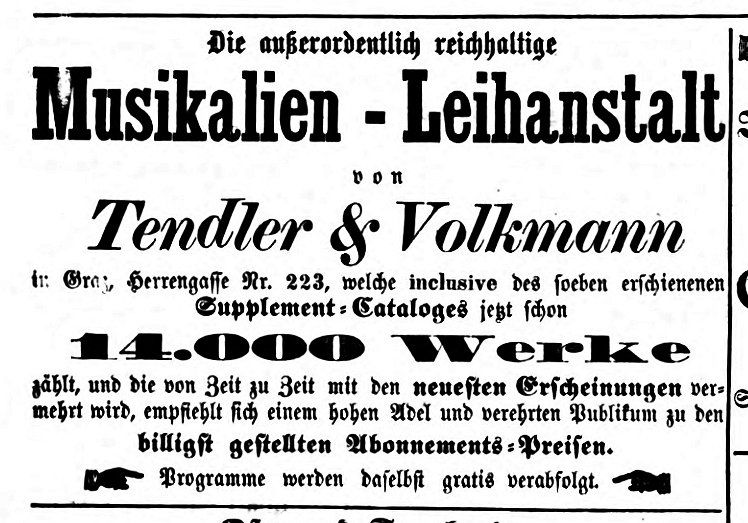
A newspaper ad for Karl Tendler's and Samuel Volkmann's sheet music rental in Graz (Grazer Zeitung, 3 November 1858, 1898)

How Volkmann was able to finance this business enterprise is not clear. Apart from investments of silent partners, he seems to have also used his share of the inheritance of his father Ignaz Volkmann who, on 6 November 1854 (Gumpendorf 22, fol. 112), had died a very successful owner of a house and a linen factory. Samuel Volkmann's addresses in Graz can be traced on the basis of his children's baptismal entries in the Graz parish records. During their stay in Graz (in addition to their first two Vienna-born children Franz and August), Samuel and Anna Volkmann had the following six children.
  1. Aloisia, b. 10 May 1858, Salzamtsgasse 26 (Dom 6, 1373)
  2. Carolina Maria, b. 3 Sep 1859, Salzamtsgasse 31 (Dom 6, 1394)
  3. Maria Anna, b. 8 Sep 1861, Salzamtsgasse 31 (Dom 6, 1431), d. 7 Oct 1861 (Dom 3, 537)
  4. Maria Anna, b. 11 Dec 1863, Salzamtsgasse 31 (Dom 6, 1482), d. 1 Jan 1864 (Dom 3, 6)
  5. Anna Maria, b. 20 Feb 1866, Neuthorgasse 444, (Mariae Himmelfahrt 7, fol. 106) 
  6. Heinrich b. 5 Sep 1869, Neuthorgasse 444, (Mariae Himmelfahrt 7, fol. 157)
On 24 March 1862 (Grazer Zeitung, 8 May 1862, 102 [the  date "12. Jänner 1850" is a typo for 1858]), Karl Tendler applied for the termination of the business relationship with Volkmann and the joint business was ended. While Tendler continued to run the book and art store (which he eventually sold in May 1873), Volkmann founded a Photographie Parisienne studio which proved to be very successful. Soon Volkmann was able to open branches in Marburg and Leoben. The many photos that Volkmann took in Gleichenberg and Rohitsch Sauerbrunn were taken during his spa stays which he needed to relieve increasing symptoms of tuberculosis. During one of these spa sojourns, on 27 June 1874, at 1 p.m., he collapsed and died in the bathhouse in Gleichenberg (Trautmannsdorf 7, 290). He was transferred to Graz to his apartment at Fischplatz 3 (today Andreas-Hofer-Platz 3) and on 30 June 1874, at 3 p.m., was buried in the St. Peter's cemetery (Mariae Himmelfahrt 5, fol. 131). Volkmann's death notice, which was published on 28 June 1874 in the Tagespost, shows that he was survived by five of his eight children.

Samuel Volkmann's death notice (Tagespost Graz, 28 June 1874)

Anna Volkmann continued to run her husband's photo studio until her death on 27 June 1879 (Mariae Himmelfahrt 5, fol. 185).

The studio insignia of Anna Volkmann in 1877. The profiles of Niepce, Daguerre, and Talbot had already graced the backside of her husband's photographs (© Bildarchiv SAGEN.at)


Bibliography
Bianchi, Johanna. 1980. "Vier unveröffentlichte Briefe von Leopold von Sonnleithner", in: Studien zur Musikwissenschaft 31, 49-66, Tutzing: Schneider.
Glossy, Carl. 1891. "Aus dem Grillparzer-Archiv. Briefe von und an Grillparzer", in: Jahrbuch der Grillparzer-Gesellschaft. Erster Jahrgang 1890. Wien: Verlag von Carl Konegen.
Grillparzer, Franz. (no year). Briefe und Tagebücher. Eine Ergänzung zu seinen Werken. Gesammelt und mit Anmerkungen herausgegeben von Carl Glossy und August Sauer. Erster Band: Briefe.
Hubmann, Bernhard. 2000. "Eine glückliche Vereinigung von scharfsinniger Beobachtungsgabe mit schwungvoller Phantasie: Eine biographische  Skizze zum 175. Geburtstag von Carl Ferdinand Peters ", in: Berichte des Institutes für Geologie und Paläontologie der Karl-Franzens-Universität Graz, 1, 2000, 4-17.
–––––. 2001. "Carl Ferdinand Peters (1825-1881). Beitrag zu seiner Biographie". in: Berichte der Geologischen Bundesanstalt, Band 53, Vienna.
Korotin, Ilse. 2016. biografiA. Lexikon österreichischer Frauen, Volume 1, Wien Köln Weimar: Böhlau Verlag
Lorenz, Michael. 2001. Studien zum Schubert-Kreis, Ph. Diss., University of Vienna.
Mailänder Koslov, Elissa. 2005. "Weil es einer Wienerin gar nicht liegt, so brutal zu sein ..." Frauenbilder im Wiener Volksgerichtsverfahren gegen eine österreichische KZ-Aufseherin (1946-1949). Zeitgeschichte 3, Innsbruck: Studienverlag, 128-150. 
Starl, Timm. 2005. Lexikon zur Fotografie in Österreich 1839 bis 1945. Vienna: Album Verlag.
Wurzbach, Constant von. 1870. "Peters, Karl Ferdinand", Biographisches Lexikon des Kaiserthums Oesterreich, 22. Theil, 78-89, Wien: k.k. Hof- und Staatsdruckerei.


© Dr. Michael Lorenz 2020. All rights reserved.

Updated: 8 September 2026


Postscript

On the occasion of a newspaper report about the above discovery, which on 8 June 2020 was published by the Austrian newspaper Der Standard, some uninformed and downright hateful onlookers claimed that the above discovery "cannot have been a discovery, because the photograph was found in a library and therefore must have been catalogued already". This presumption is false. The above photograph (as of 2020) did not appear in the online catalog of the Austrian National Library, and was not listed there as part of the collection "Fotografien, Dokumente und Schriftstücke aus dem Nachlass von Guido Peters bzw. Paula Artner" (A-Wn, Musiksammlung, Misc.31/IV). Even the ONB's staff themselves would not have been able to find it if they tried. The photograph could only be discovered by chance and from inside the library.

Feb 16, 2020

A Mozart Forgery

In the April 1956 issue of the Österreichische Musikzeitschrift (11. Jahrgang, Heft 4, 146f.), Erich Hermann Mueller von Asow published a short article, entitled "Mozart als Zeuge" ('Mozart as witness'). The article presented a document from 1789, held by the Musik- och teaterbiblioteket in Stockholm. It is a receipt, signed by a certain Elisabeth Rothmann, which allegedly bears Mozart's signature. Mueller von Asow's article begins with the following short introduction.
In its collection of autographs, the Royal Swedish Academy of Music in Stockholm holds a document signed by Wolfgang Amadeus Mozart as a witness, concerning a payment made by Martin Rothmann to his sister-in-law Elisabeth Rothmann, widowed Born. The document, of which the librarian Ph. Lic. Gösta Morin has kindly given us a photocopy, reads as follows.


Mueller von Asow sent a research request to the Vienna Municipal Archives (whose original could not be found in the holdings of the Magistratsabteilung 438). His commentary (Österreichische Musikzeitschrift 1956, 147) reads as follows.

 
[translation:]
Nothing can be found about Elisabeth Rothmann (Rottmann?) in the Municipal Archives of Vienna, despite reviewing the probate files of the Schotten and the Vienna magistrate from between 1791 and 1820 (For the arduous search, the author gives thanks to the head of the archive Dr. Geyer, and Dr. Kratochwill).
According to the Hof- und Staats-Schematismus der Residenzstadt Wien from 1791, the following people can be documented: Philipp Rottman, living at Rauhensteingasse 1352 (a new building designed by the civil master mason Franz Jäger), who was an accessist at the department of clerical foundations which was a part of the Royal Hungarian and Transylvanian accounting department, and the council protocolist Ignaz von Rottmann who resided at Preßgasse 464, a house which belonged to a certain Joseph von Weinbrenner. He was born around 1768 in Pilsen, later became privy councilor and president of the Landrechte Court in Lemberg, and died on 26 April 1815 in Venice, leaving behind a daughter Therese who had been born around 1811 (Monatsblatt Adler, vol. XII, 1935, p. 108). It couldn't be cleared up yet if these aforementioned persons had any family relations to Elisabeth Rothmann. The address in Rauhensteingasse could point to a relation to Mozart. On the other hand, that Elisabeth Rothmann signed as "widowed J. A. Born", might suggest that the witnesses von Kunnersdorff and von Spaugk were members of the same Masonic Lodge as Mozart and the well-known geologist and mineralogist Ignaz von Born (1742-1791).
It is to be hoped that the local Viennese historians will be able to uncover more details about the persons that appear in the document and to clarify the reasons for the payment.
Because this receipt was included in the Dokumente (Deutsch 1961, 304f.), a translation of the document was published in the English edition of Mozart documents (Deutsch 1965, 348).


Like those of many other documents in Deutsch's Documentary Biography, the above translation is flawed. For unknown reasons Mozart's name is turned into "Mozard", "Spaugk" became "Spaug", and the abbreviation "K." (meaning "Imperial") is mistranslated as "R." ("Royal"). Furthermore, the "mp." (manu propria) after Mozart's name is missing.

When about 20 years ago, I first became aware of Mueller von Asow's article and read the ominous receipt, it made a strange impression on me right away. What particularly aroused my suspicion back then, were the names "von Kunnersdorff" and "von Spaugk". Noble families by these names never existed. Apart from the lack of clarity in the text of this supposedly significant receipt, several inaccuracies in Mueller von Asow's commentary also caught my attention. First, his research request to the Vienna City Archives had been incomplete. He should have asked the archivists to find documentary traces of the demise of Elisabeth Rothmann's "much-loved" brother-in-law Martin Rothmann who – according to the receipt – must have died in 1789. Mueller von Asow seems not to have realized this crucial circumstance. Second, it is not clear why Geyer and Kratochwill limited their search for Elisabeth Rothmann in the indexes of the registers to 1791–1820. Such a search must always start with the date of the last known trace of life which, in this case, is the date of the receipt. Mueller von Asow's guesses about Mrs. Rothmann's possible family relation to Philipp Rottmann and Ignaz von Rottmann added no relevant information at all.

When in September 2019, at a flea market, I bought the original issue of the 1956 Österreichische Musikzeitschrift (which contains the first publication of the 1789 receipt), my interest was awakened again. I asked the library of the Musik- och teaterbiblioteket in Stockholm to send me a scan of the original document. What I received from Sweden exceeded my wildest expectations.

Elisabeth Rothmann's receipt, allegedly signed by Mozart (S-Skma, Brev B8:14)

Almost nothing about this document makes any sense. The issue at hand is not whether this receipt is a forgery. It is the question who in God's name would have the audacity to produce such a clumsy piece of work, and how it was ever possible to make anybody believe that this is a genuine Mozart document. The written text – in character as well as in content – is rife with ahistorical (or rather pseudohistorical) details that have no place in a handwritten document from Mozart's time. Some details are reminiscent of the legendary forger Josef Kuderna (1886–1952) whose written forgeries were so clumsy that at one of his trials the prosecutor expressed pity with the defendant. With the exception of Mozart, none of the persons appearing in this document ever existed. With the help of archival registers and catalogs, as well as today's vast digital databases, such as genteam, anno, and matricula, it is actually possible to determine if a person lived in 18th-century Vienna. "Kunnersdorf" and "Cunersdorf" are names of several European towns and villages, but not of a noble family. The same goes for the name "von Spaugk" (or, according to a later transcription, "Spaugh") which is completely fictitious.

The two Rottmanns, whom Mueller von Asow introduced in his commentary, had no provable relation to any Elisabeth Rothmann. The first one, the state official Philipp Rottmann, was born in 1758 in Wiener Neustadt, son of the merchant Philipp Rottmann. On 8 May 1787, at the Franziskanerpfarre, he married Maria Anna Melzer (1768–1819) with whom he had three children (of whom only one was still alive in 1819). The couple separated in 1796, when Maria Rottmann began a lifelong relationship with the writer Joseph Schreyvogel with whom she had an illegitimate daughter named Carolina Wölf (1797–1866). Maria Rottmann could afford to leave her husband, because she had inherited a share of the house Stadt 186 from her wealthy father. Her daughter from her marriage, Theresia Rottmann (1788–1855), on 23 September 1810, became the wife of the publisher and art dealer Pietro Mechetti. As witness to the wedding officiated Joseph Schreyvogel whose signature appears in Mechetti's marriage contract (A-Wsa, Serie 2.3.2.A3, Fasz. 3, 1. Reihe, M 104). At the time of his estranged wife's death, Philipp Rottmann was living in St. Pölten (A-Wsa, Mag. ZG, A2, 2781/1819). A Magdalena Rottmann living in St. Pölten is listed as heir of a 50 fl annuity in the 1853 will of Theresia Mechetti, née Rottmann (A-Wsa, Handelsgericht, A51, 36/1856). The second Rottmann, brought up by Mueller von Asow, the president of the Lemberg Landrechte court, Ignaz von Rottmann also had no provable relation to an Elisabeth Rothmann. His first wife, whom he married in Kraków, was Barbara Haller (1767–1805). On 21 July 1810, in Vienna (A-Wd, Tom 82a, fol. 260), Rottmann married again. His second wife was Theresia von Rainer (b. 18 June 1786, in Vienna) who on 5 September 1812, in Lemberg (Slezak, 67), gave birth to a daughter Therese (whom Mueller von Asow mentions in his commentary). Therese von Rottmann married a Count Bobrowski von Bobrówka and died in 1888. Ignaz von Rottmann's probate file (AT-OeStA/AVA Inneres NÖLR Allgemein A 54.5) is currently not accessible due to damage from the 1927 fire at the Vienna palace of justice. Ignaz's brother Vinzenz von Rottmann had died a bachelor on 29 May 1792, in Vienna. The name of their only sister was Josepha (A-Wsa, Akt 3.3.10.FA.791, Haansche Regesten).

Let us consider the legal scenario that is presented in the receipt. A certain Mr. Martin Rothmann has died and (as will be shown below) has left his sister-in-law Elisabeth Rothmann 6,000 gulden which are being paid out by the executors of his will in three installments of 2,000 gulden. Since Mrs. Rothmann must be the wife of Martin Rothmann's brother, it is not clear why she signs as "widowed J. A Born". After all, since she is the widow of a Mr. J. A Born (not "von" Born!), she cannot legally sign as Elisabeth Rothmann. Equally unclear is why her husband – Martin Rothmann's brother – who should be his brother's main heir, does not take over the inherited money from the civil court. Or has he died as well? No Martin Rothmann is documented to have died in Vienna between 1785 and 1789. That the alleged executors of Martin Rothmann's will paid out the money to his sister-in-law, is highly unusual. The law demanded that such high amounts of money should remain in the safekeeping of the court. It was far too risky to leave such assets in the hands of private individuals. The use of three witnesses is also at odds with the customary legal practice at the time. Mrs. Rothmann was the legal heir of her brother-in-law's bequest. The simple process of receiving this bequest did not require three witnesses. Multiple witnesses were only needed for contracts that contained important legal agreements, such as business, purchase of real estate, and wedding contracts.

It comes as no surprise that there is also no member of the Born family that could serve as a candidate of Elisabeth Rothmann's allegedly deceased husband. Ignaz von Born, the famous mineralogist, died but in 1791. His widow, whose maiden name had been Magdalena von Montag, died on 3 April 1818. Ignaz's younger brother Franz Xaver von Born died on 2 April 1821 at the age of 77. The name of his wife, whom he had married in 1768, was Josepha von Bolza. She died on 9 December 1825. The third Born sibling, a captain in the infantry regiment No. 56 of the I. & R. Austrian Army, on 22 August 1767, in Brunn am Gebirge, married Antonia von Rieger, daughter of an I. & R. court councilor. No relation can be established between the von Born family and a person named Elisabeth Rothmann. It is quite obvious that the name "Born" was only put on the receipt to add a touch of Mozart's social environment.

Several passages in the document show a gross ignorance of basic historical and genealogical facts. The use of a single "K." before the names, instead of the usual "K.K." (meaning "Kaiserlich Königlich") is highly unusual. The amount of money in a receipt was always written in numbers, and, if necessary, in additional words. Never in words alone. The term "Floriner harten Geldes" ("Florins in hard cash") did not exist in Mozart's Vienna, because at that time there was no gulden coin. In 1789 Vienna hard cash consisted of Spezies- and Konventionstaler, various types of ducats, and kreuzer whose silver twenty coin was the most frequently used piece of currency. A sum of two thousand gulden would most likely have been paid out in ducats. The word "gegeben" before the date of a document was not used in Vienna; at least I have never seen it being used this way in any of the thousands of historical documents that I have scrutinized.

The constant inclination of the letters, together with the very characteristic and desperately made to look old-fashioned letter "g" are telltale signs that the whole document was written by one single person. The descriptive line "Madame Rothmannins quittierung [...]" at the top, with the ludicrously fake-historical word "fyr" (which actually reads "fgr") already shows the hand of the person that signed as Mrs. Rothmann, and also produced all the signatures of the alleged three witnesses. The letter "g" in "Ignatz" gives away the scribe. The "Mozart" signature was done with a stronger effort of disguise, but to no avail. Not only had the forger obviously never seen a genuine Mozart signature, he also had no idea what the "mp" (manu propria) sign after a signature was supposed to look like. Hence he produced the following curiosity, with an "mp" that looks like a capital "A" enclosed in a "C". The hook of the "z" and the inclination of the letters again give away the same hand.


To illustrate the absurdity of the above forgery, let us look at a genuine Mozart signature from Mozart's letter to Sebastian Winter from 30 September 1786: the "mp" is only a zigzag line below the name, the "ca" at the end of the signature is Mozart's characteristic shortening of the attribute Cavaliere.

Mozart's closing formula in his letter to Sebastian Winter (D-KA, Don Mus. Autogr. 45)

During the 1770s, Mozart's typical "Ca" token was much more distinct. Here is another example, at the end of his signature in the letter of 3 July 1778 to Abbé Bullinger.

Mozart's return address and closing formula in his letter of 3 July 1778 from Paris to Abbé Bullinger in Salzburg (current owner unknown)

The signatures of the witnesses Johann Carl Cetto von Kronstorff, Franz Gilowsky De Urazowa, and Johann Thorwart on Mozart's 1782 marriage contract nicely show how genuine "mp" signs were supposed to look like.

The seals and signatures on Mozart's marriage contract (GB-Lbl, Zweig MS 69). This document once was an integral part of Mozart's Sperrs-Relation (probate file, Magistratisches Zivilgericht, Fasz. 2, 3703/1791) where it had the legal function of Mozart's will (vis testamenti). At some time between 1856, when the Landesgerichts-Directionsadjunkt Joseph Laimegger (1814-1895) made a copy for Otto Jahn, and the death of its first private owner Franz Hauser in 1870, this contract must have been stolen from the archive of the Vienna Landesgericht. That the text and the storage place of the contract on 19 December 1857 were published in the newspaper Die Presse, certainly did not increase the safety of the document. To disguise the criminal origin of the contract, already in the catalog of the 1905 auction, the sellers created a false narrative of "two different versions of the contract, one for Mozart and one for the bride" (Boerner, 1905, 17). Such discrepancies between two contracts, however, would have been against the law. The note in Mozart's Sperrs-Relation proves that there was only one copy of the contract. The dissimilarities between Jahn's edition (Jahn 1856, 474f.) and the original were caused by Laimegger's transcription errors. In 1905, the contract was bought by Edward Speyer from whose collection it went to Stefan Zweig in 1935.

When in 1991 Cliff Eisen's collection New Mozart Documents: A Supplement to O.E. Deutsch's Documentary Biography was published, it became known that there is another copy of Elisabeth Rothmann's receipt. Sven Hansson, a Swedish collector, to whom Eisen gave thanks in his preface (Eisen 1991, XVI), owns the receipt for payment No. 3 to Elisabeth Rothmann, dated 10 August 1789. Eisen's edition of this receipt shows two differences from Müller von Asow's transcription: "Spaugk" is now spelled "Spaugh" and the "mp" after Mozart's name is again missing. The fact that one month later Frau Rothmann had exactly the same three witnesses at hand is yet another quite suspicious circumstance.

The first publication of Sven Hansson's copy of Mrs. Rothmann's receipt (Eisen 1991, 62)

Curiously enough, the German edition of the privately held receipt, which was published in 1997, shows even more discrepancies from Eisen's English edition and the previously published earlier copy of the receipt. "Kunnersdorf" is now again "Kunnersdorff", the name Ignatz is abbreviated to "Ign.", the names Mozart and Spaugh have an "mp" again, and the "J. A." before the name Born is missing. The most significant difference appears in the phrase "a sum of two thousand florins hard cash" which is now "eine summe von zweÿtausend florinern baares[sic] geld", a wording that is also at odds with the text of the receipt published in 1956. Given that meticulous accuracy can be expected from a scholarly edition of primary sources, these discrepancies are astonishing.

The first publication of the original text of Sven Hansson's copy of the receipt (Eisen 1997, 63)

Since this receipt is marked "N° 3", and the one from July 1789 bears the number 2, it can be presumed that there must be a third copy which confirms the first payment of 2,000 gulden in June 1789. This copy, if it exists, has yet to surface.

Since Mueller von Asow had a photocopy of the original receipt and undoubtedly knew what real Mozart signatures look like, he bears the main responsibility for the erroneous attribution of these two documents. The whole matter, as curious as it appears today, should serve as a reminder that we must always remain suspicious. Who knows how many Mozart documents, that have been published in print, also have nothing to do with Mozart?


Bibliography

Boerner, C.G. (ed.). 1905. Katalog der Bibliothek Hauser Karlsruhe, Leipzig.

Deutsch, Otto Erich. 1961. Mozart Die Dokumente seines Lebens. Mozart. Neue Ausgabe sämtlicher Werke, Serie X: Supplement, Werkgruppe 34. Kassel. Bärenreiter.

Deutsch, Otto Erich. 1965. Mozart: A Documentary Biography. Stanford: Stanford University Press.

Eisen, Cliff. 1991. New Mozart Documents: A Supplement to O.E. Deutsch's Documentary Biography. Stanford: Stanford University Press.

–––––––. 1997. Mozart. Die Dokumente seines Lebens. Addenda, Neue Folge. Wolfgang Amadeus Mozart, Neue Ausgabe sämtlicher Werke, Serie X, Werkgruppe 31, vol. 2. Kassel: Bärenreiter.

Mueller von Asow, Erich Hermann. 1956. "Mozart als Zeuge", Österreichische Musikzeitschrift, 11. Jahrgang, Heft 4.

Slezak, Friedrich. 1987. Beethovens Wiener Originalverleger, Forschungen und Beiträge zur Wiener Stadtgeschichte 17, Vienna: Deuticke.


© Dr. Michael Lorenz 2020. All rights reserved.

Updated: 15 June 2022

Dec 22, 2019

The Death of Chopin's Godson Alexander Steinkeller

In the article "A Godson of Frédéric Chopin", which, on 5 September 2015, I published on this blog, I reported the discovery of a godparenthood of Chopin, who took over this duty during his second stay in Vienna, in 1831. In this article I was able to shed new light on the events during Chopin's second Vienna sojourn, a period of the composer's life which previously had been considered completely covered by Chopin scholars. Chopin's godson was Alexander Steinkeller, who was born on 4 March 1831, son of the Polish industrialist Peter Steinkeller and his wife Anielą, née Anthonin, and was baptized three days later in the parish church of St. Johann Nepomuk in the Viennese suburb of Leopoldstadt. On 6 March 1831, the Sunday following Alexander Steinkeller's birth, Frédéric Chopin was scheduled to give a concert at the Vienna Redoutensaal and did not have time to visit the Leopoldstadt before that event. The Sunday concert was eventually postponed, and on the following Monday, the christening could take place with the parish priest Joseph Gorbach officiating.

The entry concerning the baptism of Peter Alexander Steinkeller on 7 March 1831 (St. Johann Nepomuk, Tom. 5, fol. 64)

Anna Bittmann's and Chopin's signatures in the baptismal entry of Alexander Steinkeller. After Chopin had written down his address, but not his profession, the priest Joseph Gorbach crossed out the address and added the words "Privatier alldort, wohnhaft dermalen in Wien, in der Stadt Nro 1151" (St. Johann Nepomuk, Tom. 5, fol. 64).

Alexander Steinkeller's second godparent Anna Bittmann (1803–1854) was chosen, because she was a cousin of the child's father Peter Steinkeller.

Alexander Steinkeller's father Piotr Antoni Steinkeller. Portrait from Henryk Radziszewski's and Jan Kinderski's book Piotr Steinkeller. Dwie Monografie (Warsaw 1905)

After the discovery of Chopin's godparenthood in December 2013, Alexander Steinkeller's life was not a topic of my research. My work was focused on the publication of previously unknown information related to Chopin's circle of friends in Vienna. Only a systematic examination of all wills submitted to the Vienna district courts in the period from 1850 until 1938 brought about the astonishing discovery that Alexander Steinkeller, as if driven by an ominous force of homesickness, returned to Vienna, where in 1906, he put an end to his life by jumping out of a window of his apartment.

The earliest source for Alexander Steinkeller's presence in Vienna is a Meldzettel (certificate of registration), signed by Steinkeller's landlady Marie Münster and dated 27 February 1906, which documents Steinkeller's new address at that time as Dresdner Straße 53, and his previous residence as Volkertplatz 7 in Vienna's second district. Curiously, Steinkeller's notice of departure from this abode is given as 13 April 1906 in this document. A telling note on the right margin of the Meldzettel, however, reveals the circumstances of Steinkeller's exodus: "Mit Selbstmord geendet am 15./4 1906" ("Ended with suicide on 15 April 1906"). The word "geendet" was crossed out and replaced with "gestorben".

Alexander Steinkeller's last certificate of registration which documents his move on 28 February 1906, from Volkertplatz 7 to his last residence Dresdner Straße 53, and his demise by suicide (A-Wsa, BPD Wien: Historische Meldeunterlagen, Serie 2.5.1.4.K1 - B-Antiquariat)

On 27 February 1906, Steinkeller moved from Volkertplatz 7 in the Leopoldstadt to Dresdner Straße 53 in the district of Brigittenau.

Alexander Steinkeller's next-to-last residence, the house Volkertplatz 7 in Vienna's second district

Steinkeller moved into apartment no. 19 on the first floor (second floor American scheme) of the house Dresdner Straße 53 which is located in the right southeastern part of the building facing the Kampstraße.

Alexander Steinkeller's last residence, the house Dresdner Straße 53. The left part of the facade faces the Dresdner Straße, the right one faces the Kampstraße.

Because of a complete renovation of the apartments on the first floor in 2019, which included the merging of two apartments into one, the original door of Steinkeller's last apartment does not exist anymore.

The situation in June 2019 on the first floor of the house Dresdner Straße 53 where the door of Alexander Steinkeller's apartment was previously located. Two apartments have been merged into one and a new wall has been built with a new apartment door.

On 10 April 1906, Alexander Steinkeller wrote a will in which he bequeathed all of his property to his housekeeper Karoline Vetschy. This will was written on the official letter paper of Steinkeller's employer, the Moscow Fire Insurance Company.

The will of Alexander Steinkeller (A-Wsa, BG II, A9, 19/6). The reference number A IX 241/6 refers to Steinkeller's not extant probate file.

The transcription of this document reads as follows.

Administration of the Moscow Fire Insurance Company Moscow, on .... 189 ...
Published on April 18th, 1906, at the Leopoldstadt district court, section I

I declare in full consciousness that after my death I bequeath all objects, without distinction, which are in the apartment no. 19 on the first floor in the house Dresdnerstrasse no. 53, to my maid Karoline Vetschy who took care of me until the end of my life. Nobody else has the right to appropriate something from the apartment after my passing.

Given on April 10th, 1906               Al[exander] Steinkeller
David Münster, janitor, as witness
Aloisie Ognar as witness

I accept this gift
Karoline Vetschy

Karoline Vetschy, Steinkeller's universal heir, was born on 3 February 1881, at Vienna's General Hospital (Alservorstadtkrankenhaus, Tom. 121, fol. 152), illegitimate daughter of Agnes Vetchy. The child's godmother was the midwife Josefine Schemel. Nothing is known about Karoline Vetschy's later fate.

Because probate records from the A9 series of the Leopoldstadt district court are only preserved from the years 1899 to 1905, Alexander Steinkeller's probate file BG II, A9 241/6, which certainly would have provided vital biographical information, is not extant. On 15 April 1906, Alexander Steinkeller committed suicide by jumping from a window of his apartment onto the sidewalk of the Kampstraße. The cause of this act remains unknown. It seems likely, however, that Steinkeller was confronted with severe health issues.

The southeastern side of the house Dresdner Straße 53 towards the Kampstraße. From one of the four windows in the right-hand part of the first floor, Steinkeller jumped to his death.

The entry concerning Alexander Steinkeller's death in the Totenbeschauprotokoll (municipal death register) contains the note "Selbstmord d. Sturz v. I. Stockwerke" ("Suicide by falling from the first floor").

The entry concerning Alexander Steinkeller's death in the municipal death register (A-Wsa, Totenbeschreibamt 775)

On 17 April 1906, Steinkeller's burial was entered in the records of the Zwischenbrücken parish. Since the note in the death register is somewhat contradictory, it is not clear which spiritual ceremony was conducted by the parish priest, and if the deceased received a catholic burial at all. The most significant parts of the entry read as follows: "Steinkellner[sic] Alexander, katholisch, Privat, wohnh. Wien, XX. Dresdnerstrasse 53. Witwer, geboren am Dat[um] unbekannt in Wien, ? zuständig unbekannt. [Gestorben] an Selbstmord durch Sturz vom Stockwerke. Im Zentral Friedhofe. Nicht eingesegnet."

The entry concerning Alexander Steinkeller's obsequies on 17 April 1906. On the far right is the note "nicht eingesegnet" (not consecrated) (Pfarre Zwischenbrücken, Tom. 1, fol. 16).

Alexander Steinkeller was buried in the Zentralfriedhof, in a shaft grave in group 36, row 5, no. 213. These collective graves were provided for a time of 15 years, after which they were abandoned and leveled. In the years thereafter, group 36 was redesigned several times. Today, this group consists of several areas for decedents of different faiths.

That Steinkeller was a Russian citizen – and thus of Polish origin – is proven by the notice of convocation of possible heirs and creditors, issued on 7 May 1906, by the district court, which on 7, 9, and 12 June 1906, was published in the Wiener Zeitung.

The notice in the Wiener Zeitung concerning the convocation of Alexander Steinkeller's possible heirs and creditors (Wiener Zeitung 7 June 1906, 696)

                                   Alexander Steinkeller.
On 15 April 1906 the Russian citizen Mr. Alexander Steinkeller, agent in Vienna, XX., Dresdnerstraße 53, door 19, where he had his regular abode, died with the provision of a last will.
According to § 137 and 138 of the Imperial decree of 9 August 1854, Imperial Law Gazette No. 208, all heirs, recipients of a bequeathment, and creditors who are Austrian citizens or foreigners currently staying in the country, are being requested to file their claims to the estate with the undersigned court until 20 June 1906 the latest, in default whereof the estate, in disregard of these claims, can be released to the foreign authority or individuals legitimized by this authority.
I. & R. Leopoldstadt district court I, section IX, Vienna, on 7 May 1906.  [5541-1]
As far as research about Alexander Steinkeller's life is concerned, much work remains to be done. Several announcements in the newspaper Kurjer Warszawski, published during the late 1850s (for example on p. 751 of no. 144/1859), show that at that time Alexander Steinkeller was a business partner of his uncle Rudolf Steinkeller. According to the useful, but very often unreliable and fragmentary genealogical site www.geni.com, Alexander Steinkeller was married to Karolina Michalina Wojciechowska, daughter of Jan Nepomucen Wojciechowski. This name, of course, suggests a direct family relationship of Alexander Steinkeller's wife with Chopin's friend Tytus Wojciechowsky, a presumption that is also supported by the fact that Alexander Steinkeller had a cousin named Tytus Steinkeller who could well have been a godson of Chopin's friend. A photograph of Tytus Steinkeller, taken in the 1860s by Karol Beyer, is held by the photographic collection of the National Library of Poland.

Alexander Steinkeller's cousin Tytus Steinkeller (photograph by Karol Beyer, Pl-Wn, Ikonografii F.81274/W)

It is to be hoped that Polish researchers will take a closer look at Alexander Steinkeller's life. The reaction to the discovery of Chopin's godchild so far, however, does not suggest that Chopin scholars will soon address this matter.

The coat of arms of the Steinkeller family


Bibliography
Lorenz, Michael. 2015. A Godson of Frédéric Chopin. Internet publication, 6 September 2015.


© Dr. Michael Lorenz 2019. All rights reserved.