
Known Godchildren of Joseph Haydn
The following list of Haydn's known godchildren was compiled from Viennese primary sources and the Haydn literature (C. F. Pohl 1875, Ernst Fritz Schmid 1932 and 1934, Endre Csatkai 1932 and 1960, Janos Harich 1964, Robert von Zahn 1988, and H. C. Robbins Landon 1976-80). Because information concerning Haydn's godchildren is unsystematically distributed in several publications, which in no case provide an exact source, this list (which is the first of its kind) is neither definite nor complete. If necessary it will be corrected or extended in the future. The exact sources are not always given, because they are also missing in the secondary (so-called scholarly) literature.
- Joseph Kapfer (17 September 1763, Eisenstadt)
- Joseph Karl Anton Steinmüller (23 September 1763, Eisenstadt)
- Joseph Weigl (28 March 1766, Eisenstadt)
- Joseph Tomasini (24 April 1767, Eisenstadt)
- Elisbetha Anna Maria Steinmüller (27 April 1767, Eisenstadt)
- Joseph Elßler (7 August 1767, Eisenstadt)
- Anna Maria Josepha Sekier (7 May 1768, Eisenstadt)
- Anton Alois Weigl (15 July 1768, Eisenstadt)
- Joseph Dietzl (30 September 1768, Eisenstadt)
- Joseph Franz Tomasini (19 March 1769, Eisenstadt)
- Johann Florian Elßler (3 May 1769, Eisenstadt)
- Franz Xaver Dietzl (4 December 1769, Eisenstadt)
- Anna Maria Steinmüller (26 June 1770, Süttör)
- Clara Elisabeth Sekier (5 August 1770, Eisenstadt)
- Anton Thaddäus Elßler (27 October 1770, Eisenstadt)
- Joseph Johann Joachim Dichtler (18 August 1771, Eisenstadt)
- Anna Maria Wimmer (20 November 1772, Eisenstadt) (grandniece of Haydn)
- Anna Maria Elßler (1 December 1772, Eisenstadt)
- Maria Anna Dichtler (30 April 1773, Eisenstadt)
- Anna Maria Elßler (13 January 1775, Eisenstadt)
- Franz de Paula Joseph Chorus (7 February 1776, Eisenstadt)
- Maria Eleonora Elßler (10 June 1776, Eisenstadt)
- Alois Elßler (12 June 1778, Süttör) (misread as 12 May by Csatkai)
- Josepha Anna Wimmer (10 December 1778, Eisenstadt) (grandniece of Haydn)
- Anton Alois Wimmer (23 January 1781, Eisenstadt) (grandnephew of Haydn)
- Anna Elßler (14 April 1781, Süttör)
- Josepha Maria Kaufmann (6 September 1781, Süttör)
- Joseph Friedrich de August (Frigyes) (28 November 1783, Süttör) (son of Prince Esterházy's Ethiopian butler, brother of George Bridgetower)
- Theresia Josepha Wimmer (7 November 1784, Eisenstadt) (grandniece of Haydn)
- Josepha Veronica Kraft (4 February 1785, Süttör)
- Joseph Wimmer (29 October 1786, Eisenstadt) (grandnephew of Haydn)
- Elisabeth Anna Tomasini (8 July 1788, Süttör)
- Josepha Kurz (10 October 1788, Süttör) (only the year specified by Csatkai)
- Aloisia Frank (14 April 1789, Süttör)
- Maria Wimmer (16 August 1789, Eisenstadt)
- Josepha Schimenek (30 September 1800, Eisenstadt)
- Joseph Elßler (23 August 1800, Vienna)
- Johann Evangelist Elßler (31 January 1802, Vienna)
- Anna Elßler (14 February 1804, Vienna)
- Aloisia Tomasini (21 May 1804, Eisenstadt)

The entry concerning the marriage of Joseph Molnar and Marianna Tomasini on 28 December 1800, in the Paulanerkirche (Wieden, Tom. 2, fol. 291). Haydn's signature is at the bottom right.
Unknown Godchildren of Joseph Haydn
1) Joseph Peter Rampl
Joseph Peter Rampl was born on 7 May 1793, at 8 p.m., seventh child of the music copyist Peter Rampl and his wife Carolina, née Malat, in the house Rossau No. 110, "Zur grünen Säule" ("The Green Column", today Porzellangasse 4). He was baptized on the following day at Vienna's Servite Church. His godfather Joseph Haydn was unable to attend the ceremony and sent his ward, the sixteen-year-old musician (and son of Luigia Polzelli) Pietro Polzelli in his stead.
[priest] Idem. (Ferdinand M. Schmid) [date] den 7ten geb. 8 Uhr abends getauft den 8ten. [address] Roßau N. 110. [child's name] Josephus Petrus. [catholic, boy, legitimate] [father] Rampl Petrus. Notenkopist. [mother] Carolina, geb. Malat. [godfather] Podschelli Petrus, nomine Josephi Haiden, Capellæ Magistri. [midwife] eodem (La Roche M. Anna.) [number of baptism in this month] 8

The entry concerning the christening of Joseph Peter Rampl on 8 May 1793, at the Servite Church in Vienna: (Rossau, Tom. 2, fol. 82). I found this entry on 30 August 1999.

The entry concerning Joseph Peter Rampl's godfather and his proxy: "Podschelli Petrus, nomine Josephi Haiden, Capellæ Magistri."
Haydn's substitute Pietro Polzelli was the elder son of Haydn's former lover, the singer Luigia Polzelli. After Luigia's return to Vienna, Haydn had become Pietro's guardian, had given him lessons and arranged for him to get a job as violinist at the Theater auf der Wieden. Haydn was also the guardian of his alleged son Anton Polzelli (1783–1855). Pietro Polzelli already died on 14 December 1796, of "Lungenbrand" (tuberculosis) at the house Wieden 426 ("Zur silbernen Kette", today Schleifmühlgasse 11) and was buried on 16 December 1796, in the Matzleinsdorf cemetery. His belongings, which included a violin, a case and some music, only had a value of 22 gulden. His Sperrs-Relation contains the following note:
Nächste Verwandte. 1 leibl[iche] Mutter Loigia Pollzelli Musicus WittweN426 auf der Wieden dann ein zweybändiger Bruder Anton Pollzelli angehender Musikus alt 14 Jahr ebenfallsN426 auf der Wieden dessen ger[ichtlicher] Vormund ist tit[ulo] Herr Joseph Heydn Kappellmeister zu Gumpendorf[sic] in der Steingasse im eigenen Hauß
Closest relatives. A mother, Luigia Pollzelli, widow of a musician at Wieden No. 426, then a full brother Anton Pollzelli, musician-to-be, 14 years of age, whose legal guardian is Mr. Joseph Haydn, capellmeister in Gumpendorf in the Steingasse in his own house.

The passage concerning Pietro Polzelli's relatives in his Sperrs-Relation (A-Wsa, Mag. ZG, A2, 1601/1797)

The signatures of Luigia Polzelli and the actor at the Wiedner Theater Johann Helmbök in Pietro Polzelli's probate records
Joseph Rampl's father, the copyist Peter Rampl, is still a somewhat enigmatic figure. Before his identification by Günter Thomas in 1998, he was known under the name "Anonymous 63", introduced in 1960 by Dénes Bartha and László Somfai, who counted the "Kopist Anonym 63" among the absolutely authentic Haydn copyists. Copies of Haydn's work by Rampl cover a wide range, including the fair copies of the Flute Trios Hob. IV:6*-11*, the Piano Trios Hob. XV:3-5, the Symphonies Nos. 80 and 81, the ouverture to Armida, the orchestral version of The Seven Last Words, the String Quartets Op. 50 and the copies of the Paris Symphonies (Nos. 82-87) which were used by the London publisher William Forster. Furthermore Rampl, together with Johann Elßler, produced the working score of The Creation which today is held by the Staatsbibliothek Berlin. Copies made by Rampl of music by other composers – as shown by Dexter Edge – include Mozart's "Misericordias Domini", K. 222, parts of the "autograph" of the version à 8 of Mozart's Wind Serenade in E flat, K. 375 (probably prepared at the behest of Constanze Mozart and Nissen), and orchestral parts of C. P. E. Bach’s oratorio Die Auferstehung und Himmelfahrt Jesu which were made for the performance of this oratorio in 1788 in Vienna.
Peter Rampl is first referred to in Viennese sources on the occasion of his wedding to Caroline Malat on 14 September 1777, at Vienna's Schottenkirche. From the entry in the parish register we learn that he had been born in Pribislau (today Přibyslav) in the Vysočina Region, had come to Vienna in 1773, had moved to the Rossau in 1775, and was still working as musician at the time of his wedding. It is very likely that at the time of the wedding the bride was already pregnant.
[translation:]Der Peter Rampel L.[edigen] St.[ands] Musikus gebürtig aus Böhmen von Primislau wohn= / haft in der Rossau im Hebischen [i.e. Höferischen] HausTest. Jakob Winter Tischlergesell wohnhaft auf der Wisen[sic!]N° 42. des Johann Rampel Bürgers und / Anna dessen Ehewirthin ehl. Sohn. Nimt zur Ehe die Carolina / Malatin L. St. gebürtig aus Mähren von Augezt wohnhaft in der RossauN° 42 / des Prokop Malat gewesener Herrschafts verwalter und Luzia / dessen Eheweib seel: ehl. Tochter
Aug.[ust] 1. / 24 2. / 31. 3. / Sept. 7.N° 123
Test. Franz Kloger Tischlergesell wohnhaftN° 42 in der RossauSpons.[us] Viennæ 4 ann.[is] in Paroch.[ia] 2 ann.[is] test.[imonium] habit tulit. SponsamajorennViennæ / 1 ann.[o] Viennæ in Paroch. 3 mensib.[us] Sponsus majoren. testimonium Baptismi exhibuit / Sponsa minorenn. parentis consensum tulit. test. habit. tulit.
Copulavit P. Othmarus 14 Sept. 777 [numerus] 216
Mr. Peter Rampel, a bachelor and musician, born in Bohemia in Primislau, residing in the Rossau in Mr. Höfer's house No. 42, son of the citizen Johann Rampel and his wife Anna, takes as wife Carolina Malat, unmarried, born in Augezt in Moravia, living in the Rossau No. 42, legitimate daughter of the former estate manager Prokop Malat and his deceased wife Luzia.
[The banns were published on] August 24th, August 31st and September 7th.
Witnesses: Jakob Winter apprentice carpenter living at Wieden No. 123 and Franz Kloger apprentice carpenter living at Rossau No. 42.
The groom has been living in Vienna for four years and in the parish for two years, for which he presented a certificate. The bride has been living one year in Vienna and three months in the parish. The groom is of legal age and has shown his baptismal certificate. The bride is a minor and brought her parents' declaration of consent. She also has a certificate which she presented.
Pater Othmar united them on September 14th, 1777 [number of the wedding] 216

The entry concerning the wedding of Peter Rampl on 14 September 1777 at Vienna's Schottenkirche (A-Ws, Tom. 34, fol. 179r)
 The signature of Peter Rampl's landlord at Rossau 42, the court carpenter Wilhelm Höfer (A-Wsa, Unterkammeramt, Alte Baukonsense 1867/1775)


Carolina Elisabetha Francisca Malat's baptismal entry (Moravský zemský archiv Brno, Běhařovice 13384, p. 201)
Between 1777 and 1786, Rampl is documented to have been living at the house Rossau No. 42 "Zum Weißen Wolfen" ("At the White Wolf", last CNo. 52, today Rotenlöwengasse 5).

Rossau No. 42 on Huber's 1778 map of Vienna. The Jewish cemetery is visible at the top (W-Waw, Sammlung Woldan).
 A plan of Rossau 42, drawn by Joseph Gerl which was submitted in 1775 in connection with a projected addition of stables and apartments (A-Wsa, Unterkammeramt, Alte Baukonsense 1867/1775)

The house Rossau 42 "Zum Weißen Wolfen" on a photograph by August Stauda dating from 1903 (A-Wn, ST 1470F). This is the only existing photograph of the birthplace of the copyist Wenzel Rampl.

The same view today. The double-winged building Rotenlöwengasse 5-7, which was built in 1904, belongs to the Klosterneuburg Monastery.
In 1786, for a short time, Rampl lived in the Josephstadt which is documented by the birth of his daughter Johanna there on 14 March 1786, in the house Josephstadt 124, "Zum goldenen Einhorn" ("The golden Unicorn", today Lederergasse 15).

The house Josephstadt 124 "Zum goldenen Einhorn" behind the church of Maria Treu where Peter Rampl lived in 1786 (W-Waw, Sammlung Woldan).
In 1788, Peter Rampl is documented in the Steuerfassion as tenant on the second floor of the house Rossau No. 2, "Zum goldenen Hirschen" ("The Golden Stag", today Berggasse 27), where he paid an annual rent of 24 gulden for "1 Zimmer, Küche und Boden" ("one room, one kitchen and one attic"). This amount was less than one tenth of the rent that Mozart paid at the same time for his apartment at Alsergrund 135 in about five minutes walking distance from Rampl's home. This defines a telling relation between the financial status of a composer and a music copyist.

Peter Rampl, listed in Vienna's 1788 tax register as tenant in the house Rossau No. 2 (A-Wsa, Steueramt B34/30, fol. 7)

The houses Rossau Nos. 1 and 2 (Berggasse 25 and 27) on a 1903 photograph (Wien Museum, I.N. 29109). In 1788, Peter Rampl lived in the building on the right which housed the inn "Zum goldenen Hirschen". Both houses were torn down in 1904.
By 1789, Rampl had moved to the house Rossau No. 37, "Zum See", by then also in the Rotenlöwengasse (today Seegasse 23, what was to be the birthplace of Georg Hellmesberger). Between 1789 and 1793, he moved to Rossau No. 110 where his son Joseph was born.

The five currently known Rampl residences in the Rossau suburb: 1) No. 42 (1777–88), 2) No. 2 (1788), 3) No. 37 (1789), 4) No. 110 (1793, Joseph Rampl's birthplace), and 5) No. 68 (also part of 81, last number 145), where from about 1806 until her death on 9 August 1834, Rampl's widow lived with her son Wenzel. The wide street on the left towards the glacis is the Holzgasse (today's Berggasse), the Servite church and convent can be seen in the center (W-Waw, Sammlung Woldan).
Peter and Caroline Rampl had the following seven children.
- Regina, b. 18 April 1778 (Schotten 39, fol. 91r), d. before 1834. On 14 October 1800, she married the Sollicitator (paralegal) Christian Friedrich Höser from Saxony (Maria Rotunda 2, 106f.).
- Josepha, b. 11 February 1780 (Schotten 39, fol. 216r), married to an innkeeper named Mayer, d. after 1834, in Subotica
- Johann Nepomuk Wenzel, b. 1 October 1781 (Schotten 40, fol. 67r), d. 8 January 1782
- Wenzel Thaddäus, b. 12 August 1783 (Rossau 1, fol. 16), d. 13 April 1851, at Altlerchenfeld 95 (today Tigergasse 3) (A-Wsa, Totenbeschreibamt 209, R, fol. 14r)
- Johanna, b. 14 March 1786 (Maria Treu 5, fol. 257), married to a house owner named Schmid, d. after 1834, in Reindorf (today Vienna)
- Johann Nepomuk, b. 10 December 1789 (Rossau 2, fol. 19), d. 2 January 1863, at Lerchenfelder Straße 55, (A-Wsa, Totenbeschreibamt 277)
- Joseph Peter, b. 7 May 1793 (Rossau 2, fol. 82), d. 3 January 1878, in Vienna (see below)
Three of Rampl's other children also had interesting godfathers: the godfather of Johann Nepomuk Wenzel, who was born in 1781, and already died at the age of three months, was the oboist and composer Johann Nepomuk Went (1745–1801).

The entry concerning the christening of Johann Nepomuk Wenzel Rampl on 2 October 1781 at the Schottenkirche in Vienna with Johann Went "Kamer Musicus Beÿm Fürst Schwarzenburg[!]" serving as godfather (A-Ws, Tom. 40, fol. 67r)
The godfather of Wenzel Rampl, who became a noted copyist, was the court violinist Jakob Sukowaty (3 April 1756 – 29 March 1794), a younger brother of the court copyist Wenzel Sukowaty (1746–1810).

The entry concerning the christening of Wenzel Thaddäus Rampl on 13 August 1783 at the Servite Church in Vienna with the violinist Jakob Sukowaty serving as godfather (Rossau, Tom. 1, fol. 16)
The godfather of Johann Nepomuk Rampl was the (at that time still) violinist Johann Nepomuk Tost (1759–1831) who was substituted by Rampl's colleague copyist Johann Elßler (1769–1843).

The entry concerning the christening of Johann Nepomuk Rampl on 10 December 1789 at 3 p.m.at the Servite Church in Vienna with the copyist Johann Elßler substituting for Johann Tost: "Tost Johann, ein Musikus, ejus loco Elsler Johann". (Rossau, Tom.
2, fol. 19). Based on an incorrect age in the death register, in his article about Tost in the Österreichisches Musiklexikon, Uwe Harten supposes that Tost was already born in 1755. But this assumption is of course not tenable. The municipal death register is not a reliable source for the age of deceased persons. Johann Nepomuk Tost was born on 27 April 1759, in Iglau (Moravský zemský archiv Brno, Jihlava - sv. Jakub 6406, p. 119) (in the meantime, the Musiklexikon has lifted Tost's correct date of birth from this essay, without giving me credit).
Time and place of Peter Rampl's death are still unknown. Since his death is not registered in the official Viennese sources, it is obvious that he did not die in Vienna. His sudden disappearance had been completely mysterious, until August 2002, when I was able to find an entry in the Passprotokoll of the Vienna Konskriptionsamt, i.e. the protocol of passports that were issued by the Vienna Magistrate. This entry proves that in 1800 Peter Rampl had given up his job as copyist and left Vienna for Moravia and Bohemia to deliver cloth to the Austrian military. In my opinion, he was hired by his friend Johann Tost who in 1791 had quit his job as musician and, with his wife's money, had established a trading firm for various goods, such as cloth and wine. Rampl left Vienna on 20 December 1800, together with six other men who in the protocol are all described as "Tuchlieferant [cloth supplier] zur kk Armee". This entry in the passport protocol is the only known document that provides Rampl's approximate age.


Appendix: Scheiger Paralipomena
In 1801 rumors began to circulate that Haydn was to be commissioned by Empress Marie Therese to compose an oratorio entitled "The Last Judgement". In October of that year, this project was announced in an article in the Allgemeine Musikalische Zeitung in which Haydn was said to have expressed the intention to have Wieland write the libretto. For two reasons this project was never realized: first, at the age of almost 70 Haydn's health and creative energy were beginning to fail. And second, some of his aristocratic patrons urged him not to accept a commission from the empress. Especially Baron van Swieten decidedly spoke out against this project. On 21 October 1801, Griesinger wrote to Breitkopf & Härtel: "The rumor that Haydn is composing The Last Judgement is completely without foundation, but it is true that the empress wanted to urge him to do it." On 4 November 1801, Griesinger addressed this topic again: "The empress still wants the composition of The Last Judgement, but Swieten is very much against it. In the meantime, a young poet from here is undertaking the arrangement of the text in four parts: Death, Resurrection, Hell, Heaven. Haydn could still give in; he says the idea seems crude, but can be used perfectly for a musical representation on a grand scale." This oratorio never materialized. But a handwritten libretto survives in the Esterházy archive with the title: "Das jüngste Gericht in Musik gesetzt von Herrn Joseph Haydn verfaßt von J. Ignatz Scheiger Pfarrer in Kirchberg am Wagram".
That the priest and poet Ignaz Scheiger was involved in this oratorio project has long been known to Haydn scholarship. What has not been known is the fact that his collaboration could hardly have been a coincidence, because Scheiger was a nephew of Haydn's wife. Joseph Ignaz Scheiger was born on 17 February 1760, in Vienna (A-Wd, Tom. 84, fol. 30r, see the above list of Barbara Scheiger's ten children). He became a priest and at a relatively young age, made a name for himself as a writer of poetry. During the 1780s, he was a regular literary contributor to the Wiener Musenalmanach which was published by Ratschky and Blumauer. The 1786 issue, which contains Mozart's "Lied der Freiheit" (K. 506), and where Mozart found the text of Baumberg's "Als Luise die Briefe ihres ungetreuen Liebhabers verbrannte" (K. 520), also contains poems by Scheiger, for example "Der Löw und der Bär". During the 1780s, Scheiger lived in Graz where he was a member of the Masonic lodge "Zu den gereinigten Herzen". In 1792, when he published his Fabeln und Erzählungen, he was serving as vicar in Laa an der Thaya.

In 1798, Scheiger was appointed minister in Kirchberg am Wagram where he lived for the rest of his life. In 1831, he published a collection of poems, entitled Gedichte von Joseph Ignaz Scheiger, which in its time enjoyed considerable popularity. Joseph Ignaz Scheiger died on 19 August 1835, in Kirchberg am Wagram.

The most prominent bearer of the name Scheiger was the Austrian historian Joseph von Scheiger who was born on 3 February 1801, in Vienna (A-Wstm, Tom. 18, fol. 199), son of the "bürgerlicher Goldarbeiter" (civil goldsmith) Joseph Scheiger (1759–1819). A pioneer of historical topography and the first serious archeologist and historian of Austrian castles, Scheiger was ennobled in 1872 and died on 6 May 1886, in Graz.

© Dr. Michael Lorenz 2014. All rights reserved.
Updated: 10 August 2026
Addendum
The date of death of Haydn's godchild Josepha Disenni was discovered in 2017, and in February 2018, was published on this blog in the article "Josepha Disenni: Haydn's Last Surviving Godchild".

51-year-old Peter Rampl and six other individuals, registered on 20 December 1800, as recipients of passports as "cloth purveyors for the I & R Army to Moravia and Bohemia, alone" (A-Wsa, Konskriptionsamt, B 4/1, fol. 674).
Peter Rampl never returned to Vienna and probably died in Bohemia or Moravia. On a conscription sheet for the house Rossau No. 145, which was drawn up around 1806, his wife is already referred to as widow.

Haydn's godson Joseph Rampl completed a tinsmith apprenticeship, before he was drafted into the Army in November 1812 (Wiener Zeitung, 12 Nov 1812, 703). After his service with the Austrian Landwehr, he was appointed "befugter Spengler" in 1828, and took up a tinsmith business at the house Neustift 102 (today Zieglergasse 78). Joseph Rampl married twice. On 5 February 1829, he married the maidservant Eleonora Rogner, a native of Großgerungs in Lower Austria. His brother Johann, also a "befugter Spengler" (authorized tinsmith), served as his best man.

When Wenzel Rampl – a music copyist of note like his father – got married for the second time in 1830, his younger brother Joseph served as his best man.


Joseph Rampl's first marriage produced no children that reached adulthood. Joseph Rampl's first wife Eleonora died of heart failure on 20 July 1853, at Schottenfeld 378 (today Schottenfeldgasse 38). Rampl's second wedding took place on 27 February 1854 in the Schottenfeld parish church. The bride was Franziska Glaser, née Missauer (born on 5 January 1816, in Dobersberg), widow of the shoemaker Carl Glaser (1811–1849).

On 20 November 1854, sixty-one year old Joseph Rampl and his second wife had a son named Joseph Carl who already died at the age of 15 months of "Zahnfraisen" (toothing cramps).

Joseph Rampl, Haydn's last surviving godson, died on 3 January 1878, of old age at his home at Schottenfeldgasse 38.

Joseph Rampl was survived by his wife Franziska. He was buried on 5 January 1878, in the Schmelz cemetery.

Joseph Rampl's widow Franziska died of tuberculosis on 14 November 1887 at Schottenfeldgasse 53 (Schottenfeld, Tom. 65, fol. 81, and A-Wsa, BG Neubau, A4, 1415/1887).

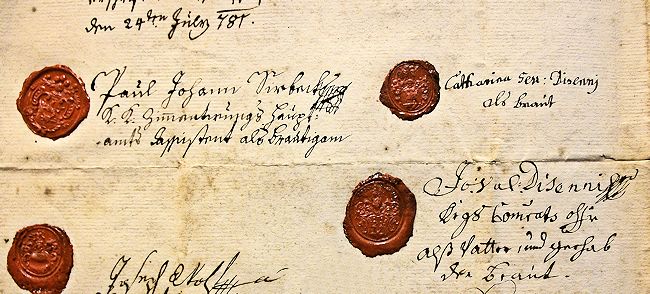

Catharina Sirbeck died on 5 October 1814, and was followed by her husband Paul Johann on 7 October 1815. Since the couple had no children, Franz and Joseph Disenni were Sirbeck's universal heirs.


Karolina Rampl and her sons Wenzel, Johann and Joseph on a conscription sheet of the house Rossau 145 from around 1806. Karolina is already described as "Wittwe", Wenzel is a "Schreiber" and "zu schwach Sckrophulös verh." ("too weak, scrofulous, married"), Johann is a "Spengler L[ehr]J.[ung] Gesell in der Josephstadt garzu klein 7° Feldjäger Batail[lon] mit Reservations Urkunde ent[hoben] Verh." ("tinsmith apprentice in the Josephstadt, much too small 7th courier battalion relieved of military service with a reserve certificate, married") and Joseph is a "Spengler L.J in d Stadt proan[no] 820 als unwissend. per 824 Landwehrmann" ("tinsmith apprentice in the city, location unknown in 1820, member of the territorial army as of 1824"). (A-Wsa, Konskriptionsamt, Rossau 81, 1. Reihe)
Haydn's godson Joseph Rampl completed a tinsmith apprenticeship, before he was drafted into the Army in November 1812 (Wiener Zeitung, 12 Nov 1812, 703). After his service with the Austrian Landwehr, he was appointed "befugter Spengler" in 1828, and took up a tinsmith business at the house Neustift 102 (today Zieglergasse 78). Joseph Rampl married twice. On 5 February 1829, he married the maidservant Eleonora Rogner, a native of Großgerungs in Lower Austria. His brother Johann, also a "befugter Spengler" (authorized tinsmith), served as his best man.
The entry concerning Joseph Rampl's and Eleonora Rogner's wedding in 1829, at the Servite Church (Rossau, Tom. 4, fol. 65). The profession of the bride's witness Joseph Gamper was "Wicktoallihendler" (grocer). The bride had been born on 8 February 1797 in Groß Gerungs No. 62 (A-SP, Groß Gerungs, Tom. 7, fol. 23).
When Wenzel Rampl – a music copyist of note like his father – got married for the second time in 1830, his younger brother Joseph served as his best man.

Joseph
Rampl's signature ("befugter Spengler") as best man of his brother Wenzel on 25 January 1830, in the marriage register of the Schotten parish. The lower three lines are the handwriting of the parish priest Peter Selos (Schotten Tom. 44, fol. 78). The best man at Wenzel Rampl's first wedding on 26 February 1811, had also been a person of interest: Beethoven's copyist Wenzel Schlemmer (1760–1823).
Joseph and Eleonora Rampl on an 1830 conscription sheet of Neubau 102 (A-Wsa, Konskriptionsamt, Neubau 102/2r)
Joseph Rampl's first marriage produced no children that reached adulthood. Joseph Rampl's first wife Eleonora died of heart failure on 20 July 1853, at Schottenfeld 378 (today Schottenfeldgasse 38). Rampl's second wedding took place on 27 February 1854 in the Schottenfeld parish church. The bride was Franziska Glaser, née Missauer (born on 5 January 1816, in Dobersberg), widow of the shoemaker Carl Glaser (1811–1849).
The entry concerning the wedding of Joseph Rampl to Franziska Glaser who was 23 years younger than the groom (Schottenfeld, Tom. 32, fol. 25)
On 20 November 1854, sixty-one year old Joseph Rampl and his second wife had a son named Joseph Carl who already died at the age of 15 months of "Zahnfraisen" (toothing cramps).
The entry concerning the death of Joseph Rampl's last child Joseph Carl on 22 February 1856 (Schottenfeld, Tom. 34, fol. 34)
Joseph Rampl, Haydn's last surviving godson, died on 3 January 1878, of old age at his home at Schottenfeldgasse 38.
The entry concerning the death of Joseph Rampl on 3 January 1878. The cause of death was "Altersschwäche" (Schottenfeld, Tom. 56, fol. 2)
Joseph Rampl was survived by his wife Franziska. He was buried on 5 January 1878, in the Schmelz cemetery.
The cover sheet of Joseph Rampl's probate records from 1878 (A-Wsa, BG Neubau, A4, 44/1878)
Joseph Rampl's widow Franziska died of tuberculosis on 14 November 1887 at Schottenfeldgasse 53 (Schottenfeld, Tom. 65, fol. 81, and A-Wsa, BG Neubau, A4, 1415/1887).
2) Joseph Carl Franz Disenni
Haydn's godson Joseph Carl Franz Disenni was born on 16 October 1801, in the house Wieden 423 ("Maria Empfängnis", today Margaretenstraße 22), first child of the city official Franz Disenni and his wife Ursula Barbara, née Scheiger. Because Joseph Haydn at that time was in Eisenstadt (see his letters to George Thomson and the one written on 18 October 1801, to the Dutch society Felix Meritis), the child's uncle, the silversmith Carl Scheiger, stood proxy for the composer at the ceremony in the Paulanerkirche.

 Joseph Carl Franz Disenni's family relationship to Haydn was similar to the relationship of the six Wimmer children in the above list of godchildren who were grandchildren of Haydn's eldest sister Maria Anna Franziska. The godchild Joseph Disenni was a grandnephew of Haydn's wife. To explain the family connection we have to go back into the first half of the eighteenth century, when Haydn's future father-in-law, the wigmaker Johann Peter Keller (ca. 1691–1771) and his wife Maria (née Seiller), whom Keller had married on 12 November 1722, started a family in the "Fernerisches Haus" on Vienna's Graben (today Graben 21) and the "Leinwandhaus" on the Hoher Markt (today Hoher Markt 4) which at that time also belonged to a member of the Ferner family. Between 1723 and 1744, Johann Peter Keller and his wife had fifteen children (since most of the information in the Haydn literature concerning these children is wrong, I shall deal with them in a future blogpost). Only five of Keller's seven daughters reached adulthood: one became a nun, one married the painter Joseph Bidermann, one became Haydn's wife, and two of them, following their father's professional environment, were married off to wigmakers. According to Albert Christoph Dies, Johann Peter Keller said to his future son-in-law: "Haydn, you should marry my eldest daughter!"

Dies's information is false and so is Griesinger's who, in his Biographische Notizen über Joseph Haydn writes: "Haydn gave music lessons to Keller's eldest daughter and his affection grew as the acquaintance became closer; but she entered a convent and now, because with his fixed salary his livelihood was sufficiently secured, Haydn decided, at the hairdresser's urgent persuasion and out of gratitude, to marry his second daughter." Theresia Helena Keller (1733–1819), whom Haydn allegedly had fallen in love with and who in 1755 joined the order of the Poor Clares, was not Keller's eldest daughter, but his sixth. Keller's eldest daughter was Maria Barbara Helena Theresia who was born on 26 December 1726. Haydn must have had a close relationship to Barbara Keller as well. Maybe she also had received music lessons from him.

In January 1752, Barbara Keller married the "angehenden bürgerlichen Perückenmacher" (soon-to-be civil wigmaker) Carl Scheicher (also Scheiger).

An entry in the prenotation register ("Vormerkungs Buch") of Vienna's wigmakers' guild shows that Carl Scheiger opened his business on 1 February 1752.

Carl Scheicher was the son of the "hofbefreiter" tailor Johann Caspar Scheicher (Scheücher), who had been born on 23 December 1669, also son of a tailor, in Lohnfeld (today Bad Leonfelden) in Upper Austria (A-LIa, Bad Leonfelden, Tom. 1, p. 73). "Hofbefreit" meant that a craftsman enjoyed the permission to work as a master on commission directly from the Imperial Court. Johann Scheicher had come to Vienna prior to November 1707, when he married Catharina Nickl at St. Stephen's (A-Wd, Tom. 37, p. 172).
Haydn's sister-in-law Barbara Scheiger had ten children, of whom four reached adulthood and three (Carl Hippolyt, Joseph Ignaz, and Ursula Barbara) are of interest in connection with Haydn or his godchildren. What follows is a list of the ten Scheiger siblings (with their dates of baptism and their godparents in parentheses):

On the occasion of Barbara Scheiger's marriage to the "Magistratsrathsdiener" Franz Xaver Disenni, Joseph Haydn served as the bride's witness. Based on the date on Franz Disenni's and Barbara Scheiger's marriage contract, H. C. Robbins Landon, in his Chronicle (The Years of The Creation, 1977, p. 557), assumed that the wedding took place on 1 September 1800.
In the Addenda and Errata of his Chronicle (The Early Years, 1980, p. 642) Robbins Landon presented an updated hypothesis, suggesting that Haydn actually went to Vienna in September 1800.


Sixteen days earlier, on 28 December 1800, Haydn had already served as witness at the same parish church, for Luigi Tomasini's daughter Marianna Tomasini at her wedding to the Viennese agent Joseph Molnar (Wieden, Tom. 2, fol. 291)

Franz Disenni's marriage contract was first published on 30 September 1915, by Max Unger in the Neue Zeitschrift für Musik, in an article titled "Musikerbriefe aus Josef Liebeskinds Sammlung". In 1927, the document was sold by Karl Ernst Henrici at the auction of Liebeskind's autograph collection, and in April 1928, it was sold again by the book dealer V. A. Heck in Vienna.

Haydn's godson Joseph Carl Franz Disenni was born on 16 October 1801, in the house Wieden 423 ("Maria Empfängnis", today Margaretenstraße 22), first child of the city official Franz Disenni and his wife Ursula Barbara, née Scheiger. Because Joseph Haydn at that time was in Eisenstadt (see his letters to George Thomson and the one written on 18 October 1801, to the Dutch society Felix Meritis), the child's uncle, the silversmith Carl Scheiger, stood proxy for the composer at the ceremony in the Paulanerkirche.
The baptismal entry of Haydn's godson Joseph Carl Franz Disenni (Wieden, Tom. 3, fol. 401)
Namen des Taufenden. Idem [Joseph Straßer]The child Joseph Disenni already died on 18 February 1802 of "Zahnfraisen" (toothing cramps).
Jahr Monat Tag den 16 Oktbr. 801.
Wohnung und Nro. des Hauses. 423.
Namen der Getauften. Joseph Carl Franz.
Religion Katholisch =
Geschlecht Knab =
Ehelich =
Aeltern.
Vaters Namen und Kondition oder Karakter. Franz Disenni Magistrats Beamter.Mutters Tauf= und Zunamen. Ursula Barbara Scheiger.Pathen.
Namen Stand Carl Scheiger Silberarbeiter im Namen des
H[errn] Joseph Haydn Doktor der Tonkunst.
Anmerkungen. [Hebamme] Anna Weiner.
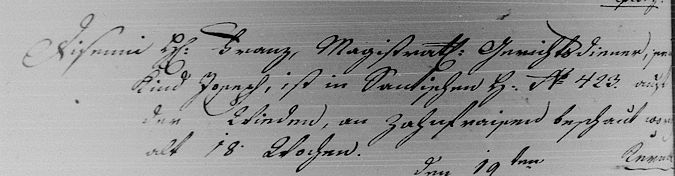
The entry concerning the death of the baby boy Joseph Disenni on 18 February 1802, in the Totenbeschauprotokoll (A-Wsa, TBP 113, DT, fol. 7v)
Disenni Mr. Franz, servant at the court of the Vienna Magistracy, his child Joseph was inspected in the Santi house No. 423 on the Wieden of toothing cramps, 18 weeks of age. Kerndl [coroner]
Dies, Biographische Nachrichten von Joseph Haydn (1810), p. 43
Dies's information is false and so is Griesinger's who, in his Biographische Notizen über Joseph Haydn writes: "Haydn gave music lessons to Keller's eldest daughter and his affection grew as the acquaintance became closer; but she entered a convent and now, because with his fixed salary his livelihood was sufficiently secured, Haydn decided, at the hairdresser's urgent persuasion and out of gratitude, to marry his second daughter." Theresia Helena Keller (1733–1819), whom Haydn allegedly had fallen in love with and who in 1755 joined the order of the Poor Clares, was not Keller's eldest daughter, but his sixth. Keller's eldest daughter was Maria Barbara Helena Theresia who was born on 26 December 1726. Haydn must have had a close relationship to Barbara Keller as well. Maybe she also had received music lessons from him.

The entry concerning the baptism of Johann Peter Keller's first daughter and Haydn's future sister-in-law Barbara Keller on 26 December 1726 at St. Stephen's Cathedral (A-Wd, Tom. 64, fol. 100v). The godmothers were Barbara Osner, wife of a "hofbefreiter" confectioner and Anna Helena Reischmann, née Achamer, wife of the administrator of the St. Joseph Monastery.
In January 1752, Barbara Keller married the "angehenden bürgerlichen Perückenmacher" (soon-to-be civil wigmaker) Carl Scheicher (also Scheiger).

The entry concerning the wedding of the Carl Scheicher (Scheiger) and Haydn's sister-in-law Barbara Keller in February 1752 (the month written on top of the page is an error) at St. Stephen's. The exact date of the ceremony was not registered. Keller's best man, the wigmaker Joseph Fürst, had also married the daughter of a wigmaker (A-Wd, Tom. 55, fol. 91v).
An entry in the prenotation register ("Vormerkungs Buch") of Vienna's wigmakers' guild shows that Carl Scheiger opened his business on 1 February 1752.

The entry concerning Carl Scheiger's opening of his wigmaker's shop in 1752 and the prenotation by his successor Johann Baptist Vöttner (A-Wsa, Innungen 40/1, fol. 117r)
Carl Scheicher was the son of the "hofbefreiter" tailor Johann Caspar Scheicher (Scheücher), who had been born on 23 December 1669, also son of a tailor, in Lohnfeld (today Bad Leonfelden) in Upper Austria (A-LIa, Bad Leonfelden, Tom. 1, p. 73). "Hofbefreit" meant that a craftsman enjoyed the permission to work as a master on commission directly from the Imperial Court. Johann Scheicher had come to Vienna prior to November 1707, when he married Catharina Nickl at St. Stephen's (A-Wd, Tom. 37, p. 172).
Haydn's sister-in-law Barbara Scheiger had ten children, of whom four reached adulthood and three (Carl Hippolyt, Joseph Ignaz, and Ursula Barbara) are of interest in connection with Haydn or his godchildren. What follows is a list of the ten Scheiger siblings (with their dates of baptism and their godparents in parentheses):
- Elisabeth Catharina Barbara (b. 6 Nov 1752, Elisabeth Keller [Haydn's mother-in-law])
- Anna Maria Elisabeth (b. 22 May 1753, Maria Anna Scheiger [née Schmid, wife of the child's uncle, the bookbinder Ignaz Dominik Scheiger])
- Carl Hippolyt Nepomuk (b. 13 Aug 1755, Joseph von Vogt [Directorial-Concipist]). Carl Scheiger was the silversmith, who at his nephew's baptism stood proxy for Haydn. On 10 February 1800 he served as best man at the wedding of Haydn's copyist Johann Elßler and Theresia Prinster (Gumpendorf 13, p. 323f.). Scheiger died on 15 January 1820, his widow Theresia died on 19 August 1836.
- Gottfried Anton Ludwig (b 26 Aug 1756, Gottfried Baumgartner [furrier])
- Maria Anna Thecla (b. 23 Sep 1757, Maria Anna Fürst [wife of the above-mentioned wigmaker Joseph Fürst])
- Franz Seraph (b. 24 Sep 1758, Joseph Fürst [wigmaker])
- Joseph Ignaz (b. 17 Feb 1760, Joseph Fürst) (concerning his biography, see below)
- Maria Barbara (b. 25 Jan 1762, Maria Anna Fürst)
- Joseph Carl Borromäus (b. 6 Jul 1764, Joseph and Elisabeth Bidermann [Haydn's sister-in-law and her painter husband]) Joseph Scheiger was the "blödsinniger Bruder der verheuratheten Düsseni", to whom Haydn in 1801 originally bequeathed 100 fl in his first will. At the time of his father's death in 1803, he lived in the nursing home in Mauerbach (A-Wsa, Mag. ZG, A2, 481/1803).
- Ursula Barbara (b. 15 Dec 1766, Ursula Balarot [K.K. Hof=Kastnerin])

The entry concerning the baptism of Franz Disenni's future wife Ursula Barbara Scheiger on 15 December 1766 (A-Wd, Tom. 86, fol. 271v)
On the occasion of Barbara Scheiger's marriage to the "Magistratsrathsdiener" Franz Xaver Disenni, Joseph Haydn served as the bride's witness. Based on the date on Franz Disenni's and Barbara Scheiger's marriage contract, H. C. Robbins Landon, in his Chronicle (The Years of The Creation, 1977, p. 557), assumed that the wedding took place on 1 September 1800.
On 1 September 1800, while Haydn was still in Eisenstadt, we find his name as a witness to the marriage in Vienna of his[sic] niece, Barbara Scheiger, and the Magistratsdiener[sic] (city government official) Franz Xaver Disenni; from the wording of the document, Haydn must clearly have signed it in absentia or in anticipation before he left the city.
[The document] shows beyond doubt that Haydn was physically present at the wedding; he probably took two days off from his duties at Eisenstadt.The actual entry concerning this wedding in the records of the Paulanerkirche on the Wieden (for which Haydn scholars never showed any interest) proves that Haydn did not go to Vienna in September 1800 to attend the wedding. The contract was drawn up on 1 September 1800, but the wedding ceremony itself took place only on 13 January 1801, when Haydn was already in Vienna (on 16 January 1801 he conducted a benefit performance of Die Schöpfung in the Vienna Redoutensaal). On 13 January 1801, he must also have signed the marriage contract.

The entry concerning Franz Disenni's and Barbara Scheiger's wedding on 13 January 1801 at the Paulanerkirche with Haydn's signature as witness of the bride (Wieden, Tom. 2, fol. 293). This entry, which I discovered on 16 April 2010, is not listed in Herbert A. Mansfeld's book Index Nominum ex libris copulatorum Vindobonensibus and therefore does not appear in the digital database of Viennese weddings.
Jahr 1801
Monat Täge Joseph Straßer Coop[era]t[o]r. den 13 Jänner 801.
Bräutigam.
Namen und Stand. Franz Disenny ma= gistratischer Raths= diener.
Wohnung.
Nro. des Hauses und des Ortes. auf der Wieden 184. [today Mittersteig 20]
Religion Katholisch //
Altersjahre 39
Unvereheligt /
Braut.
Namen und Stand. Barbara Scheiger Perückenma= chers Tochter.Wohnung.
Nro. des Hauses und des Ortes. auf der Wieden 423.
Religion Katholisch //
Altersjahre 35
Unvereheligt /
Beistände. Paul Johann Sihrbekmp O.[ber] B[eamter] Zimentirungs Beamter
Joseph Haydnmpia Fürst Esterha= zischer Capell Meister als Beÿstand.
Anmerkungen. 6[th wedding of 1801]

Paul Johann Sirbeck's and Joseph Haydn's signatures as witnesses to the wedding of Franz Disenni and Barbara Scheiger on 13 January 1801. Sirbeck wrote "O. B Zimentirung" under his name to which Haydn added the "s", the word "Beamter" and the horizontal line (Wieden, Tom. 2, fol. 293).
Sixteen days earlier, on 28 December 1800, Haydn had already served as witness at the same parish church, for Luigi Tomasini's daughter Marianna Tomasini at her wedding to the Viennese agent Joseph Molnar (Wieden, Tom. 2, fol. 291)

The entry concerning Joseph Molnar's and Marianna Tomasini's wedding on 28 December 1800 at the Paulanerkirche with Joseph Haydn's signature as the bride's witness (Wieden, Tom. 2, fol. 291)
Franz Disenni's marriage contract was first published on 30 September 1915, by Max Unger in the Neue Zeitschrift für Musik, in an article titled "Musikerbriefe aus Josef Liebeskinds Sammlung". In 1927, the document was sold by Karl Ernst Henrici at the auction of Liebeskind's autograph collection, and in April 1928, it was sold again by the book dealer V. A. Heck in Vienna.

The first publication of Franz Disenni's and Ursula Barbara Scheiger's marriage contract (Neue Zeitschrift für Musik, Leipzig, 82. Jahrg. [1915], p. 307). The missing word, marked "unleserlich" in Paul Johann Sirbeck's signature, reads "Zimentirungs".
When in 1980 Robbins Landon published a translation of the contract in his Addenda and Errata of Haydn: The Years of The Creation, he was unaware of Unger's earlier publication. He had received the text of the document through the offices of Otto Edwin Albrecht (1899–1984) from the owner, "a collector in New Jersey, who wanted to remain anonymous". What follows is Robbins Landon's translation with the mistranscriptions and mistranslations corrected. Robbins Landon, for instance, misunderstood the words "gewesener Perückenmacher" and, ignoring the words "so noch in Leben", assumed that the bride's father was already deceased. One sentence of the contract is missing altogether in Robbins Landon's edition and the witness Paul Sirbeck was misread as "Siebert".
In the name of the Most Holy Trinity, God the Father, Son and Holy Spirit.
Today on the date given below, between the well born Mr. Franz Xav:[er] Disenni, servant at the City Council in Vienna as the groom and first party and the honorable and virtuous maiden Barbara Schaiger, daughter of the retired and stil living civil wigmaker Karl Schaiger and his wife, the late Barbara Keller, as second party, the following marriage contract has been concluded.
Firstly, the maiden bride brings to the aforesaid bridegroom and future husband, apart from the endowment she has acquired, a true dowry from her own assets consisting of hundred and fifty gulden, which
Secondly, the groom matches according to the local custom with a counter sum of three hundred gulden which together with the dowry is to be regarded as a mutual heritage of four hundred and fifty gulden. What both of them
Thirdly, will acquire and inherit or gain in any other legal way during their marriage in addition to their current assets, which are recorded in a special inventory, should be their joint property, thus in case one party should pass away and there are legitimate children, one half of the joint assets should go to the children, the other half to the surviving party. If there are no children the entire property should belong to the surviving party. Everything in confidence and without risk.
In verification of this two identical copies were drawn up and handed to both parties with their and the gentlemen witnesses' signatures and seals. Vienna, on September 1st, 1800.
Franz Disennimp Ursula Barbara
servant at the Magistracy Scheiger
as groom as bride
Paul Johann Sirbeckmp Joseph Haydnmpa
I. & R. assistant at the main Fürst: Esterhazyscher
gauging office as witness Capell Meister as witness
Who were Franz Disenni and his best man Paul Johann Sirbeck? Franz Xaver Disenni was born around 1760, in Görz (today Gorizia in Friuli-Venezia Giulia), son of Joseph Valentin Disenni (1711–1785) and his wife Cäcilia, née Spruck. The Disennis hailed from the Pustertal where Franz Disenni's grandfather had been "Obereinnehmer" (head tax collector) (A-Wd, Tom. 57, fol. 331v). Franz Disenni was born in Görz, because his father was stationed there as "General-Kriegs-Commissariats Officier". Franz Disenni had three siblings: Joseph Disenni (1763–after 1815), who in 1793 was a "Frauenputzhändler" (dealer of women's finery) and by 1805 worked as usher at the Court Theater. Maria Helena Disenni, who on 23 May 1784, married the "K.K. Hofkriegsraths=Registrant" Johann Joseph Thomas (A-Wd, Tom. 75, fol. 204v) and Catharina di Siena[!] Anastasia Disenni (1763–1814), who, on 24 July 1781, became the wife of the "K.K. Zimmentirungs Hauptamts Assistent" Paul Johann Sirbeck, thus establishing the connection between the two families. Sirbeck had been born around 1732 in the Hungarian town of Szentgotthárd and had moved to Vienna in 1769.

The 1781 marriage entry of Paul Johann Sirbeck and Catharina Senensis Disenni (A-Wd, Tom. 74, fol. 61v)
The seals and signatures on Paul Johann Sirbeck's and Catharina Disenni's 1781 marriage contract. Joseph Valentin Disenni signed "alß Vatter und Gerhab der Braut" ("as father and guardian of the bride") (A-Wsa, Mag. ZG, A10, 585/1814). In 1790 Sirbeck was also the best man of his brother-in-law Joseph Disenni (Wieden, Tom. 1, fol. 163).
On 25 June 1783, Sirbeck and his father-in-law bought the small house Stadt No. 1231 on the Neuthorbastei, "nächst dem Fischmarkt", which, after Joseph Valentin Disenni's death on 25 May 1785 (A-Wsa, Totenbeschreibamt 85, lit. DT, fol. 17r), went to Sirbeck and his sister-in-law Helena Thomas. In 1787, Sirbeck and his wife bought the other half, and in 1815, Franz and Joseph Disenni inherited the whole building (at that time valued at 6,300 gulden) and immediately sold it.

Paul Johann Sirbeck's 1786 request to the Vianna Magistrate to have his house Stadt 1231 appraised, "because he had bought this house with Joseph Valentin Disenni, but now could not agree with his daughter Helena Thomas regarding its use and therefore no longer wishes to remain co-owner" (A-Wsa, HReg. Fasz. 5, 34/1786).
Catharina Sirbeck died on 5 October 1814, and was followed by her husband Paul Johann on 7 October 1815. Since the couple had no children, Franz and Joseph Disenni were Sirbeck's universal heirs.

Franz and Joseph Disenni, signing as Paul Johann Sirbeck's universal heirs on 7 December 1815 (A-Wsa, Mag. ZG, A2, 4609/1815)
3) Josepha Barbara Disenni
In 1803, Franz and Barbara Disenni had a second child whose godfather was also Joseph Haydn. Josepha Barbara Disenni was born on 1 January 1803 and also baptized at the Paulanerkirche. This time the prominent godfather was in Vienna and could take part in the ceremony.


Owing to a number of missing sources, the following events in the Disenni family are a little difficult to ascertain. On 22 April 1803, the retired wigmaker (and grandfather of Haydn's two Disenni godchildren) Carl Scheiger died at an age of 88 at the home of his son-in-law at Wieden 423 (A-Wsa, Totenbeschreibamt 116, S, 51r). At some time between January 1803 and February 1808, Barbara Disenni, née Scheiger passed away. She must have died outside Vienna, because I have not been able to find any traces of her death in the records of the Viennese authorities. Searches in the Totenbeschauprotokoll, the church records, and the indexes of the civil court of the Vienna municipal court were all unsuccessful. This is a pity, because Barbara Disenni's will, had she died under the jurisdiction of a Viennese court, would have consisted of the second copy of her marriage contract which also bears Haydn's autograph signature. On the other hand, this proves that the copy, which now belongs to a private collector, was not stolen at some time from the holdings of a Vienna court archive. On 8 February 1808, Franz Disenni married again (Wieden, Tom. 3, fol. 164). His second wife was the 49-year-old widow of a glass cutter, Theresia Hofmayer, née Hofmann.


Franz Xaver Disenni died on 10 July 1827, of consumption at the age of 67, in the house Wieden 260 ("Zum Blauen Wolf", last CNo. 473, today Schleifmühlgasse 5). From his will, signed on 9 April 1827, we learn that in 1815 Paul Johann Sirbeck had bequeathed 1,900 fl to his wife's niece Josepha Disenni: "6th I declare that the claim deposited with Leopold Wagner and his wife Katharina consisting of 1,900 gulden in Court Chamber bonds from 1815 with 2,5% interests in C. M. (Assimilated Coinage) belongs to my daughter Josepha Disenni as an asset bequeathed to her by my brother-in-law Johann Paul Sirböck and should remain with her as her property."

At the time of her father's death, Josepha Disenni was working as "Marchand des Modes" (fashion saleswoman) and lived at the "Kleines Königsklosterhaus" on the Windmühle (Windmühle No. 69, today Gumpendorfer Straße 14). In her father's Sperrs-Relation she once is also addressed as "Stubenmädchen" (parlour maid).

I have not yet been able to shed light on Josepha Disenni's life after her father's death and to determine her date of death. The fact that she inherited 1,900 gulden in 1827 makes it very likely that she got married at a later time which – owing to the change of her name – makes it difficult to pick up her trace again. She turns up in the sources in 1830 as living with her stepsister and her stepmother Theresia Disenni at Wieden No. 473.

In August 1830 the Vienna Magistracy, which had been unable to determine Josepha Disenni's whereabouts, published a citation in the Wiener Zeitung in which Disenni was requested to come forward on the occasion of the upcoming auction of the house Landstraße 159 (today Schimmelgasse 2-8/2). That Disenni was listed as "Satzgläubiger" (hypothecary creditor) of this house shows how she had invested her inheritance. It is not yet known if Disenni showed up at the auction, but future research in the Landstraße land registers will probably yield more information on what became of her after 1830.

Josepha Disenni's stepmother Theresia Disenni died on 19 February 1847 at the age of 92. Her probate records (A-Wsa, Mag. ZG, A2, 653/1847) reveal that she had received an annual pension of 233 fl 33 x which was one third of her late husband's salary of 700 gulden as Landrechtskanzlist. In her Sperrs-Relation her stepdaughter Josepha is not mentioned anymore which of course does not necessarily mean that in 1847 she was already deceased.

Tasks of Future Research
A number of issues concerning Haydn's godchildren still need additional research.
In 1803, Franz and Barbara Disenni had a second child whose godfather was also Joseph Haydn. Josepha Barbara Disenni was born on 1 January 1803 and also baptized at the Paulanerkirche. This time the prominent godfather was in Vienna and could take part in the ceremony.

The baptismal entry of Haydn's goddaughter Josepha Barbara Disenni (Wieden, Tom. 4, fol. 51)
Namen des Taufenden. Joseph Schießlingstraßer Coop[e]r[a]torBecause the years 1802–06 are covered by two separate volumes of baptismal records at the Wieden parish, there is a second copy of Josepha Barbara Disenni's baptismal entry:
Jahr Monat Tag den 1 Jäner 803.Wohnung und Nro. des Hauses. 423.
Namen der Getauften. Josepha Barbara.
Religion Katholisch =
Geschlecht Mädchen =
Ehelich =
Aeltern.
Vaters Namen und Kondition oder Karakter. Franz Xaver Diseni Magistrats= Beamter.Mutters Tauf= und Zunamen. Ursula Barbara Scheiger.
Pathen.
Namen Stand Joseph Haydn Doktor der Tonkunst.
Anmerkungen. [Hebamme] Anna Weiner.
The second copy of Josepha Barbara Disenni's baptismal entry (Wieden, Tom. 4a, fol. 28)
Owing to a number of missing sources, the following events in the Disenni family are a little difficult to ascertain. On 22 April 1803, the retired wigmaker (and grandfather of Haydn's two Disenni godchildren) Carl Scheiger died at an age of 88 at the home of his son-in-law at Wieden 423 (A-Wsa, Totenbeschreibamt 116, S, 51r). At some time between January 1803 and February 1808, Barbara Disenni, née Scheiger passed away. She must have died outside Vienna, because I have not been able to find any traces of her death in the records of the Viennese authorities. Searches in the Totenbeschauprotokoll, the church records, and the indexes of the civil court of the Vienna municipal court were all unsuccessful. This is a pity, because Barbara Disenni's will, had she died under the jurisdiction of a Viennese court, would have consisted of the second copy of her marriage contract which also bears Haydn's autograph signature. On the other hand, this proves that the copy, which now belongs to a private collector, was not stolen at some time from the holdings of a Vienna court archive. On 8 February 1808, Franz Disenni married again (Wieden, Tom. 3, fol. 164). His second wife was the 49-year-old widow of a glass cutter, Theresia Hofmayer, née Hofmann.

The seals and signatures on the contract of Franz Disenni's second marriage on 8 February 1808 (A-Wsa, Mag. ZG, A10, 384/1827)
Franz Disenni, "Rathsd[iene]r b. d. Landrechten verh[eiratet]", and his two wives (with the first, Barbara, already crossed out) on a conscription sheet of the
house Wieden 770 (formerly 423). Although this document dates from 1805, Josepha Disenni's name is missing. (A-Wsa, Konskriptionsamt, Wieden 770/16r)
Franz Xaver Disenni died on 10 July 1827, of consumption at the age of 67, in the house Wieden 260 ("Zum Blauen Wolf", last CNo. 473, today Schleifmühlgasse 5). From his will, signed on 9 April 1827, we learn that in 1815 Paul Johann Sirbeck had bequeathed 1,900 fl to his wife's niece Josepha Disenni: "6th I declare that the claim deposited with Leopold Wagner and his wife Katharina consisting of 1,900 gulden in Court Chamber bonds from 1815 with 2,5% interests in C. M. (Assimilated Coinage) belongs to my daughter Josepha Disenni as an asset bequeathed to her by my brother-in-law Johann Paul Sirböck and should remain with her as her property."
The last paragraph of Franz Disenni's will where he declares his daughter (Haydn's godchild) Josepha Disenni his universal heir ("Zu meiner UniversalErbin ernenne ich erstgedacht meine Tochter Josepha Disseni.") (A-Wsa, Mag. ZG, A10, 324/1827)
At the time of her father's death, Josepha Disenni was working as "Marchand des Modes" (fashion saleswoman) and lived at the "Kleines Königsklosterhaus" on the Windmühle (Windmühle No. 69, today Gumpendorfer Straße 14). In her father's Sperrs-Relation she once is also addressed as "Stubenmädchen" (parlour maid).
Josepha Disenni given as Franz Disenni's only child and "l.[edigen] St.[andes] Marchand des Modes an der Wien im kleinen König Klosterhause" in her father's probate records (A-Wsa, Mag. ZG, A2, 2820/1827). The handwriting is that of Anton Slabe (1787–1860) who in 1828 was the Sperrskommissär of Franz Schubert's estate.
I have not yet been able to shed light on Josepha Disenni's life after her father's death and to determine her date of death. The fact that she inherited 1,900 gulden in 1827 makes it very likely that she got married at a later time which – owing to the change of her name – makes it difficult to pick up her trace again. She turns up in the sources in 1830 as living with her stepsister and her stepmother Theresia Disenni at Wieden No. 473.

The Disenni family on an 1830 conscription sheet of Wieden 473: "[Apartment] 4 Theresia Dißennin [born] 754 Beamtensgattin Witwe / Diesseny / Tochter Josepha / 803 / St:[ief] T:[ochter] Theres: Hofmayr / 795". As a matter of fact, Theresia Hofmayr was the daughter and Josepha Disenni the stepdaughter (A-Wsa, Konskriptionsamt, Wieden 473/34r).
In August 1830 the Vienna Magistracy, which had been unable to determine Josepha Disenni's whereabouts, published a citation in the Wiener Zeitung in which Disenni was requested to come forward on the occasion of the upcoming auction of the house Landstraße 159 (today Schimmelgasse 2-8/2). That Disenni was listed as "Satzgläubiger" (hypothecary creditor) of this house shows how she had invested her inheritance. It is not yet known if Disenni showed up at the auction, but future research in the Landstraße land registers will probably yield more information on what became of her after 1830.

The citation of Josepha Disenni that the Vienna Magistrate published three times in August 1830 (Wiener Zeitung, 23 August 1830, p. 360)
Josepha Disenni's stepmother Theresia Disenni died on 19 February 1847 at the age of 92. Her probate records (A-Wsa, Mag. ZG, A2, 653/1847) reveal that she had received an annual pension of 233 fl 33 x which was one third of her late husband's salary of 700 gulden as Landrechtskanzlist. In her Sperrs-Relation her stepdaughter Josepha is not mentioned anymore which of course does not necessarily mean that in 1847 she was already deceased.

Josepha Disenni's last known residence: the house Wieden 473, "Zum Blauen Wolfen", today Schleifmühlgasse 5, on a photograph from 1905 (Wien Museum, I.N. 30069). The photographer August Stauda took this picture of the house, because he had his studio there.
Tasks of Future Research
A number of issues concerning Haydn's godchildren still need additional research.
- The source studies of Schmid and Csatkai were not extensive enough and were sometimes carried out in an almost occasional manner. The church records of Eisenstadt and Süttör need to be browsed systematically. Likewise the records of the Gumpendorf parish in Vienna have also not been subjected to the necessary research.
- The geneological research on Haydn's relatives, that Ernst Fritz Schmid did for his book Joseph Haydn, ein Buch von Heimat und Vorfahren des Meisters (Kassel, 1934), needs to be extended and updated. Especially those members of Haydn's family whom Schmid did not consider relevant for his proof that Haydn was "a purely Aryan composer" received a rather cursory treatment. One of several examples is the following: according to Schmid Haydn's niece Anna Katharina Frölich "in 1800 was already married to the shoemaker Kaspar Loder in Vienna" and "Anna, the only daughter from this marriage, was born in 1800". The truth is, this shoemaker's name was not Loder, but Loderer, and his wedding to Haydn's niece took place only on 1 March 1802 at St. Florian's in Matzleinsdorf. The fact that on 5 May 1801, in paragraph twelve of his will, Haydn already takes his niece into consideration with the words: "Der Schusterin Anna Loderin in Wien 200 fl" ("To the shoemaker's wife[!] Anna Loder in Vienna") proves that he was lied to by Loderer and his future wife who told Haydn that they were already married so that Haydn would give Loderer the promised start-up capital of 1,000 gulden (Griesinger 1810, 110) more than one year earlier.

The 1802 marriage entry of Caspar Loderer and Haydn's niece Anna Katharina Lugmayr (St. Florian, Tom. 7, fol. 16)
- To figure out the exact date of Peter Rampl's birth would need the baptismal records of Přibyslav to be put online. So far only the marriage records of this town are digitally available. As far as Peter Rampl's still unknown date of death is concerned, I have unsuccessfully browsed the death records of several towns, such as Znojmo, Brno, Jihlava and Bratislava.
- Three biographical dates of members of the families Scheiger and Disenni still need to be determined: a) the date of death of Haydn's sister-in-law Barbara Scheiger, née Keller, b) the date of death of her daughter Barbara Disenni, née Scheiger, and c) the date of death of Haydn's goddaughter Josepha Disenni.
- Finding out when and where Barbara Disenni passed away could shed some light on a rift that seems to have occurred after 1803 between Haydn and the Scheiger/Disenni families. My experience has taught me that when a wife of a minor state official, who is leading a peaceful life on the Wieden, suddenly disappears and dies outside of Vienna (and not during a sojourn in some spa town, like Baden), something out of the ordinary must have happened. In his first will, dated 5 May 1801, Haydn bequeathed 300 gulden "der verheuratheten Düsseni gebohrner Scheigerin" and the surprisingly high amount of 900 gulden to the silversmith Carl Scheiger and his wife. When Haydn drew up his second and final will in 1809, the first amount of course was cancelled, but the Scheiger couple also was taken from the list of heirs. Especially surprising is the fact that Haydn – who in his final will took several marginal figures into consideration – failed to transfer some of Barbara Disenni's inheritance to her daughter Josepha, who after all was his godchild.
The bequests to the members of the Disenni and Scheiger families in Haydn's first will from 1801
Appendix: Scheiger Paralipomena
In 1801 rumors began to circulate that Haydn was to be commissioned by Empress Marie Therese to compose an oratorio entitled "The Last Judgement". In October of that year, this project was announced in an article in the Allgemeine Musikalische Zeitung in which Haydn was said to have expressed the intention to have Wieland write the libretto. For two reasons this project was never realized: first, at the age of almost 70 Haydn's health and creative energy were beginning to fail. And second, some of his aristocratic patrons urged him not to accept a commission from the empress. Especially Baron van Swieten decidedly spoke out against this project. On 21 October 1801, Griesinger wrote to Breitkopf & Härtel: "The rumor that Haydn is composing The Last Judgement is completely without foundation, but it is true that the empress wanted to urge him to do it." On 4 November 1801, Griesinger addressed this topic again: "The empress still wants the composition of The Last Judgement, but Swieten is very much against it. In the meantime, a young poet from here is undertaking the arrangement of the text in four parts: Death, Resurrection, Hell, Heaven. Haydn could still give in; he says the idea seems crude, but can be used perfectly for a musical representation on a grand scale." This oratorio never materialized. But a handwritten libretto survives in the Esterházy archive with the title: "Das jüngste Gericht in Musik gesetzt von Herrn Joseph Haydn verfaßt von J. Ignatz Scheiger Pfarrer in Kirchberg am Wagram".
That the priest and poet Ignaz Scheiger was involved in this oratorio project has long been known to Haydn scholarship. What has not been known is the fact that his collaboration could hardly have been a coincidence, because Scheiger was a nephew of Haydn's wife. Joseph Ignaz Scheiger was born on 17 February 1760, in Vienna (A-Wd, Tom. 84, fol. 30r, see the above list of Barbara Scheiger's ten children). He became a priest and at a relatively young age, made a name for himself as a writer of poetry. During the 1780s, he was a regular literary contributor to the Wiener Musenalmanach which was published by Ratschky and Blumauer. The 1786 issue, which contains Mozart's "Lied der Freiheit" (K. 506), and where Mozart found the text of Baumberg's "Als Luise die Briefe ihres ungetreuen Liebhabers verbrannte" (K. 520), also contains poems by Scheiger, for example "Der Löw und der Bär". During the 1780s, Scheiger lived in Graz where he was a member of the Masonic lodge "Zu den gereinigten Herzen". In 1792, when he published his Fabeln und Erzählungen, he was serving as vicar in Laa an der Thaya.

In 1798, Scheiger was appointed minister in Kirchberg am Wagram where he lived for the rest of his life. In 1831, he published a collection of poems, entitled Gedichte von Joseph Ignaz Scheiger, which in its time enjoyed considerable popularity. Joseph Ignaz Scheiger died on 19 August 1835, in Kirchberg am Wagram.
The entry concerning Ignaz Scheiger's death on 19 August 1835, "nachdem er durch 36 Jahre alhier Pfarrer gewesen" (Kirchberg am Wagram, Tom. 10, fol. 7)
The most prominent bearer of the name Scheiger was the Austrian historian Joseph von Scheiger who was born on 3 February 1801, in Vienna (A-Wstm, Tom. 18, fol. 199), son of the "bürgerlicher Goldarbeiter" (civil goldsmith) Joseph Scheiger (1759–1819). A pioneer of historical topography and the first serious archeologist and historian of Austrian castles, Scheiger was ennobled in 1872 and died on 6 May 1886, in Graz.
Joseph von Scheiger (A-Wn, PORT_00025787_01)
Scheiger published a number of significant works, among them the priceless handbook Der Fußreisende in Österreich which was published in 1827.

Joseph von Scheiger's second wife was Katharina Prato, one of the most widely read authors of cookbooks of the nineteenth century. I have not been able to conclusively prove a family relationship between Joseph von Scheiger and Carl Scheiger, the brother-in-law of Haydn's wife. But the fact that von Scheiger's father Joseph and his elder brother Karl were goldsmiths, and Karl Scheiger jr. (Frau Haydn's nephew) was a silversmith, suggests a family connection. That Joseph von Scheiger and Haydn's goddaughter Josepha Disenni were cousins, depends on the still unanswered question, whether Joseph's grandfather, the gardener Leopold Scheiger, was a brother of the wigmaker Carl Scheiger who in 1752 married Haydn's future sister-in-law.

Joseph von Scheiger's second wife was Katharina Prato, one of the most widely read authors of cookbooks of the nineteenth century. I have not been able to conclusively prove a family relationship between Joseph von Scheiger and Carl Scheiger, the brother-in-law of Haydn's wife. But the fact that von Scheiger's father Joseph and his elder brother Karl were goldsmiths, and Karl Scheiger jr. (Frau Haydn's nephew) was a silversmith, suggests a family connection. That Joseph von Scheiger and Haydn's goddaughter Josepha Disenni were cousins, depends on the still unanswered question, whether Joseph's grandfather, the gardener Leopold Scheiger, was a brother of the wigmaker Carl Scheiger who in 1752 married Haydn's future sister-in-law.
© Dr. Michael Lorenz 2014. All rights reserved.
Updated: 10 August 2026
Addendum
The date of death of Haydn's godchild Josepha Disenni was discovered in 2017, and in February 2018, was published on this blog in the article "Josepha Disenni: Haydn's Last Surviving Godchild".


.JPG)


