Oct 8, 2012

An Unknown Grandmother of Liszt

The genealogical basics of Franz Liszt's family tree have been established decades ago. This may have been caused by the debated question whether Liszt was a German or a Hungarian composer and by the fact that having been Richard Wagner's father-in-law, his ancestry simply was an important issue in the eyes of purebred Wagnerites and a ministry of propaganda that used Liszt's "Les Preludes" as signature tune of its regular reports from the theater of war. The essential literature on Franz Liszt's ancestry consists of the following four publications:
  • Heinrich E. Wamser: "Abstammung und Familie Franz Liszts", Burgenländische Heimatblätter 1936, vol. 2, 24-33.
  • Eduard Ritter von Liszt: Franz Liszt. Abstammung, Familie, Begebenheiten, (Vienna-Leipzig: Braumüller, 1937).
  • Josef Beatus Klingohr and Wolfgang Huschke: "Zur Herkunft Franz Liszts. Neue Forschungen über die Ahnen seiner Mutter (Lager, Laager)", Genealogie 14, 1965, 422-28.
  • Heinz Schöny: "Neues zu Franz Liszt", Adler. Zeitschrift für Genealogie und Heraldik, (Vienna: Heraldisch-genealogische Gesellschaft Adler), vol. 21, 2001-02, 28-30.

The young Franz Liszt, anonymous oil painting  (Ernst Burger: Frédéric Chopin. Eine Lebenschronik in Bildern und Dokumenten. München: Hirmer 1990, 99)

While the details of Liszt's family's roots have been covered quite extensively back to Liszt's great-grandfather Sebastian List (~1703–1793), including the identification of the complete fourth generation of ancestors, ten of Liszt's sixteen great-great-grandparents still remain unknown. Three generations of the Liszt family are given in the following table by Heinrich Wamser.


The date of the marriage of Liszt's parents, given by Wamser, is wrong. The correct date is 17 January 1811. At times the genealogical literature is a little messy. Liszt's four grandparents ("Generation III"), on whose identity the literature agrees unanimously, are given as follows in Heinz Schöny's 2001 article in the genealogical journal Adler.


It is easy to see that a few things are gravely amiss in the above list and one wonders, who served as editor at the Gesellschaft Adler back in 2001. Liszt's grandfather Georg Adam List was not born on 14 January, but on 14 October 1755. He did not marry in 1715, but in 1775. His first wife Barbara Schlesak was, of course, born in 1753, not in 1853. Mathias Lager was not born in 1815, but 100 years earlier. Lager did not get married in Kirchberg am Wagram on 26 May, but on 27 May 1777 (with Ludwig von Köchel's grandfather Georg Heinrich Köchel serving as his best man), his bride's name was Schuhmann, not Schihmann and the place of her birth was not "Öttinger", but Oettingen in Bayern.

The entry concerning the wedding of Liszt's grandparents Mathias Lager and Franziska Schumann on 27 May 1777 in Kirchberg am Wagram ("ex Kremß dimissa") (Kirchberg am Wagram, Tom. 2/7, p. 51)

At least, Franziska Lager's date of death (9 June 1797) is correct in Schöny's chart, whereas Wamser gives it one month too early. It is also interesting to note that Georg Adam List was not only an organist, but, up into the 1830s, was also in charge of rehearsing the boys' choir in the chapel of Pottendorf Castle.

Liszt's grandfather Georg Adam List (1755–1844), anonymous oil paintig from around 1820

According to the literature, Franz Liszt's grandfather Georg Adam List (he always signed his name just "Adam List") was married three times, namely  to 1) Barbara Schlesak (1753–1798) (Liszt's supposed grandmother), 2) Barbara Weninger (1778–1806) and 3) Magdalena Richter (1780–1856). His late third marriage in 1807 led to his last son Eduard (1817–1879) being actually six years younger than his first grandson, the famous pianist Franz Liszt.

A few days before, on 11 January 1811, in the Hungarian village of Unterfrauenhaid, Franz Liszt's father Adam married Maria Anna Laager. The banns for this wedding had to be published in the two Viennese home parishes of the bride. The sources in Vienna's parish archives concerning Adam List's wedding were previously not acknowledged by Liszt scholarship. The information in these documents regarding the mother of the groom is starkly at odds with what is documented in the genealogical literature. According to the entries in the marriage records of St. Stephen's and the Schottenkirche, which were made on 7 and 8 January 1811 respectively, Adam List's mother was not Barbara Schlesak, but a certain Katharina Baumann.

The section pertaining to the groom in the entry concerning the publication of the banns on 7 January 1811, for Adam List's wedding (A-Wd, Tom. 82b, fol. 325)
d[en] 7t[en] Jänner [1811] / Tit[ulo] H[err] Adam \List/ Rechnungs= / führer beÿm Fürst / Esterhazy zu Raiding / in Hungarn, geb. von / Matterstorf[sic] in Hung= / garn, des Tit. H[errn] / Adam List, Schaf / fers zu Matterstorf / beym Fürst Esterhazy / leb[end] u. der Fr. Kathar[ina] / geb. Baumann, sel[ig] / ehel[icher] Sohn.
January 7th, [1811] Mr. Adam List, head accountant with Prince Esterházy in Raiding in Hungary, born in Mattersdorf in Hungary, legitimate son of Adam List, workman in Mattersdorf at Prince Esterházy's, alive, and of Mrs. Katharina [List], née Baumann deceased.
As a matter of fact, Adam List was not born in Mattersdorf, but in Edelstal. And the fact that List's age is given as 30 (instead of 35, as given in the Edelstal records) might also be of interest, considering his unknown mother that appears nowhere in the Liszt literature. The duplicate entry from 7 January 1811 (A-Wd, Rapular 1810-13, fol. 220) concerning the publishing of the banns at St. Stephen's also presents "Katharina, née Baumann" as mother of the groom.

The duplicate entry in the Cathedral's Rapular concerning the publishing of the banns at St. Stephen's (A-Wd, Rapular 1810-13, fol. 220). This source has never been digitized.

The above-quoted later and definite copy of the "Verkündeintragung" in the Cathedral's records (A-Wd, 82b, fol. 325) also contains new information about the bride: we finally learn for whom Liszt's mother had worked as parlourmaid in Vienna.

The previously disregarded entry in the marriage records of St. Stephen's concerning Anna Laager's employer (A-Wd, 82b, fol. 325)
J[un]gf[er] Mar[ia] Anna / Laager, Stu= / benmagd gew[esen] / beÿ der Frau / v. Kurzbeck, / geb. von Krems, / des H. Mat= / thäus Laager / Bürgers da= / selbst sel[ig] u. / der Fr. Fr[an]z[is]ka / geb. Schuchmann / sel., ehel[iche] Tochter.
Derzeit / Pfarr= / ort zu / Matter= / storf / in Hungarn, / vordem / Pfarr St. / Steph. / Nro 1139. / dann vordem / Pf. Schotten / Nro 235.
22 / d[en] 9t Maÿ 788
The maiden Maria Anna Laager, formerly parlourmaid with Frau von Kurzbeck, born in Krems, legitimate daughter of Matthäus Laager, deceased citizen in said town, and Mrs. Franziska, née Schuchmann deceased. [Her] current parish is Mattersdorf in Hungary, formerly in St. Stephen's parish No. 1139, then in the Schotten parish No. 235. [years of age] 22, [born] 9 May 1788
Unlike the groom, the bride was underage and therefore had to present a birth certificate and a marriage license from the Krems magistrate. On 10 January 1811, the couple also received a dispensation from the other two publications of the banns.

Liszt's mother Anna Liszt, née Laager around 1860 (photography by Sabatier-Blot)

Maria Anna Laager's employer "Frau v. Kurzbeck" was Katharina von Kurzbeck, née Gerold (b. 15 November 1748 in Vienna, d. 19 August 1821 in Baden bei Wien), widow of the printer, merchant and estate owner Joseph von Kurzbeck (1736–1792). The Kurzbeck family is of particular interest because of seven very musical daughters who were acquainted with Mozart and Haydn. These daughters are listed in the 1788 Taschenbuch für den weiblichen Adel in Wien as living at Stadt 1152 (today Bräunerstr. 1), a house that had been owned by Joseph von Kurzbeck since 1775.

The Kurzbeck daughters listed in the 1788 Taschenbuch für den weiblichen Adel in Wien

The most prominent member of the family was of course Magdalena von Kurzbeck (1767–1845), pianist, composer and student of Clementi, Haydn and Andreas Streicher. For a long time she was regarded as Vienna's finest female pianist. Haydn dedicated the printed edition of his piano sonata in E flat major (Hob. XVI/52) and the piano trio (Hob. XV/31) to her. Johann Nepumuk Hummel wrote his Piano Sonata op. 20 for her. Soon after the death of Joseph von Kurzbeck on 18 December 1792 (Wiener Zeitung, 26 December 1792, 3493), his widow Katharina sold the house in the Untere Bräunerstraße for 46,000 gulden, and moved into the so-called Hasenhaus at Kärntnerstraße 8 (then No. 1082, from 1795 until 1821 No. 1139), where about fifteen years later, Liszt's mother was to work as parlourmaid.

Catharina Edle von Kurzbeck ("Großhandl[er]s Wittwe gestorben"), listed together with three of her daughters on a concription sheet from the so-called Hasenhaus, Stadt No. 1073, dating from about 1805 (A-Wsa, Konskriptionsamt, Stadt 1073/3r)

Shortly before the marriage of her maid, Katharina von Kurzbeck must have moved to the house Stadt 235 (today Tiefer Graben 22). Similar records from other Viennese parishes prove that on 7 January 1811, Maria Anna Laager also had to submit a testimony by her employer to the government and the parish priest, regarding her good moral conduct during her service as maidservant.

Katharina von Kurzbeck's seal and signature from 1795 (A-Wsa, Merkantilgericht, Fasz. 3, 1, Reihe, litt. CK, Nr. 4)

There are three different copies of the entry concerning the publication of the banns for Adam List and Maria Anna Laager in Viennese parish archives: a) the entry in the records of St. Stephen's quoted above, b) a slightly shortened copy of this entry (without the the information regarding the Kurzbeck connection) in the series of duplicate marriage records of St. Stephen's, and c) the entry in the marriage records of the Schotten parish which was made one day later, on 8 January 1811. The entry related to Adam List is basically identical with the earlier ones, and Katharina Baumann is given again as Adam List's mother. Only the dates referring to the dispensation from two publications of the banns and the delivery of the certificate ("Ist der Braut den 13. Jänner [1]811 der Verkündschein gegeben worden") have been added. This note and the date "12 [January]" above the entry show that the bride was still in Vienna on 13 January 1811, because (contrary to the information in the Liszt literature) Adam List's wedding in Hungary took place only on 17 January 1811.

The entry concerning the publication of the banns for Adam List's wedding in January 1811 in the Schotten parish (A-Ws, Tom. 41, fol. 109)

Who was Adam List's mother Katharina List, née Baumann? The following explanatory scenarios come to mind.
  • Heinrich Wamser's genealogical chart is flawed, because Wamser overlooked one of Georg Adam Liszt's wives. Adam List the elder did not marry three, but four times. The age given by his son at the time of his marriage in 1811, pointing to 1780 as his year of birth, could be a clue in favor of this hypothesis.
  • Liszt's father Adam List was an illegitimate child and this family secret was already covered up by Liszt's early biographers.
  • Adam List had been provided with false information regarding his ancestry. In times when many people did not even know their own date of birth, such a situation was quite common. On the other hand, the fact that his father was still alive and he was in regular contact with his relatives makes such a lack of information unlikely.
  • Liszt's official paternal grandmother Barbara Schlesak and Katharina Baumann are one and the same person. Different first names bear little significance in 200-year-old sources that sometimes are fraught with errors, caused by faulty readings and flawed transmission. And yet, it is hardly conceivable that the name "Katharina Baumann" as mother of the groom does not appear in the 1811 marriage records of Unterfrauenhaid.
  • The whole "Schlesak-construct" is a fabrication by the fervent Nazi Heinrich Wamser, who discovered that Liszt had a baptized, but originally Jewish grandmother by the name of Katharina Baumann and decided to erase her from the family tree. The Johann Strauss forgery is ample proof that the Nazis did not shy away from falsifying the sources for the sake of "preserving" a composer for the German nation.
Katharina Baumann's existence could remain undetected for over 200 years, because Viennese genealogists, who obviously considered the marriage of Liszt's parents in Unterfrauenhaid an exclusively Hungarian affair, never did any research in Vienna. Based on the newly discovered documents, I consider it very likely that Liszt's father did not make the acquaintance of his bride in Mattersdorf, but actually first met her in Vienna and then made her move to Hungary with his proposal of marriage. A lot of research still remains to be done on a topic that seemed to be covered so exhaustively.

The handwriting of Franz Liszt's grandfather Adam List the elder

© Dr. Michael Lorenz 2012. All rights reserved.

Updated: 21 February 2023

Additional research in the church records of Edelstal has already been conducted, but the results can only be published as soon as somebody is willing to fund this project.


Addendum

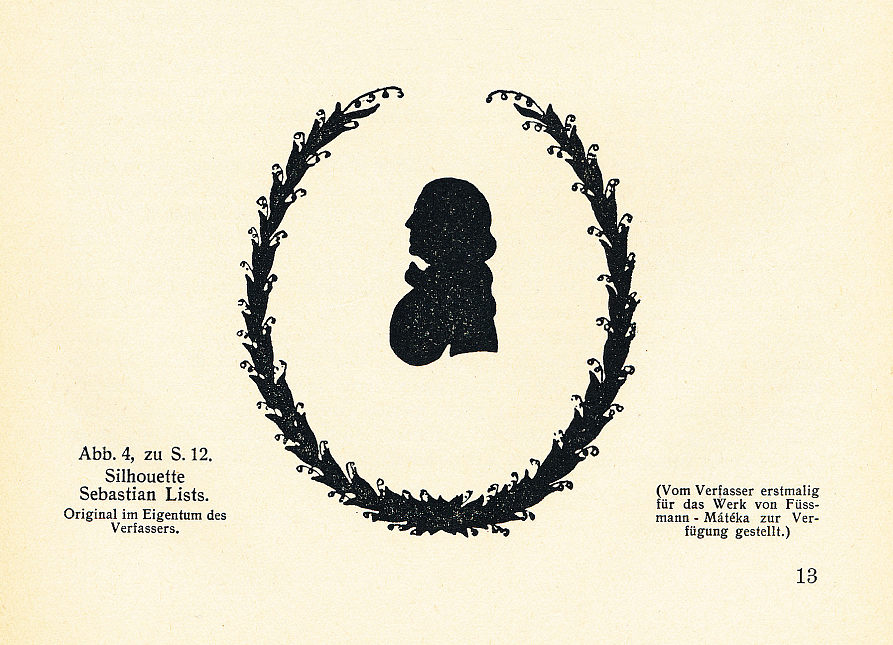
In his 1937 book Franz Liszt. Abstammung, Familie, Begebenheiten, Dr. Eduard Ritter von Liszt proudly presented a silhouette of Franz Liszt's great-grandfather Sebastian List (1703–1793) that had already been published in 1936, in Werner Füssmann's and Béla Mátéka's book Franz Liszt. Ein Künstlerleben in Wort und Bild (Julius Beltz: Langensalza, Berlin, Leipzig, 1936). This silhouette has nothing to do with Sebastian List. It is a classic forgery from the workshop of the serial fraudster Josef Kuderna (1886–1952).


Oct 1, 2012

Martines, Maron, and a Latin Inscription

On 27 May 1773, the composer Marianna Martines was appointed member of the renowned Accademia filarmonica of Bologna. Following Padre Martini's favorable judgment of her work and being aware of Pietro Metastasio's interest in her musical career, a committee of eighteen members voted unanimously to grant Martines the title Accademia filarmonica Onorata. A diploma of honor on parchment was prepared explicitly for her to be dispatched to Vienna and a report of the meeting was published on 13 July 1773, in the Gazzetta di Bologna. In the 108 years of the academy's existence since 1666, Martines was the first woman composer to receive this honor. Only five more women would earn this distinction by the end of the eighteenth century. Soon after she had received the exquisite academic accolades, Martines must have commissioned a portrait of herself to be painted by the renowned artist Anton von Maron, who in 1772 had returned to Vienna after having spent seventeen years in Rome.


The inscription on this painting, which today is held by the Wien Museum (Inv. No. 158.809), was first published in 1995, by my friend the late Irving Godt (1923–2006), as follows.


This flawed transcription ("METASTASIO", "VINDIBO") was then also mistranslated by Godt thusly: "Marianna Martines, Pupil of P. Metastasio; born in Vienna, 4th day of May 1744, Member Academia Filarmonica."

When Melanie Unseld was working on her book Mozarts Frauen. Begegnungen in Musik und Liebe, and spent time in Vienna "to make original sources the basis of her book" (as she proudly claimed in a press interview), she visited the Wien Museum's deposit to take a look at the Martines portrait. Her "on-site inspection in Vienna" (as she described this excursion) yielded rather modest results: although her book contains a nice color picture of Maron's painting on which the Latin inscription is perfectly legible, Unseld simply copied the flawed transcription from Godt's article "Marianna in Italy" in the 1995 Journal of Musicology. In a review of Unseld's book, which in 2007 I wrote for the Mozart-Jahrbuch 2007/2008 (and which was published only in November 2011), I pointed out this mistake and noted that Unseld should have copied the inscription from the painting itself instead of using Irving Godt's old transcription. It turned out that Unseld was able to even go one better. In the February 2011 issue of the Schweizer Musikzeitung, she published a short article about Martines in which she not only repeated Godt's misreading of the Latin text, but also presented a new translation in which she turned the poet Pietro Metastasio into a "Padre Metastasio".


When in February 2012 Sony Music published the CD Marianna Martines: Il Primo Amore with cantatas and concertos by Martines, in the booklet of this CD, Unseld not only repeated her "Padre Metastasio" gem, but also redated Maron's portrait to the year 1780.


We can safely presume that neither Irving Godt (who only received his Ph.D. at the age of 46, after having been a postal worker for decades) nor Melanie Unseld ever studied Latin. Otherwise, they would have realized that the first transcription and its translation were already flawed. The missing genitive in "Metastasio alumna" is a gross mistake, and the translation of the date with "4th day of May" reveal a certain unfamiliarity with the Roman calendar. Maron's Latin inscription on the Martines portrait reads as follows.

MARIA ANNA. MARTINES. P[ETRI]. METASTASII. ALUMNA
NAT[A]. VINDOBO[NÆ].[ANTE DIEM] IV. NON[AS]. MAI[AS]. MDIIXLIV. ACAD[EMIÆ]. PHIL[HARMONICÆ]. SOC[IA].

Maria Anna Martines. Pupil of Pietro Metastasio
Born in Vienna, on the fourth day before the Nones [the 7th] of May 1744, member of the Philharmonic Academy.

On 23 January 1774, together with her four brothers Joseph, Dionys, Johann Baptist, and Karl Borromäus, and her sister Antonia, Marianna Martines was ennobled by Maria Theresia. In the patent of nobility the coat of arms of the Martines family is described as follows.
Namely an upright blue escutcheon with an erect golden cadeuceus, across which in the the middle a black fess is drawn, which again is overlaid with a broad silver band. On the shield, rest two open knights' jousting helms facing each other, with pendent decorative mantling, crowned with golden coronets artfully intertwined in gold and blue on the right, and in black and silver on the left. Above the helm in the front, between two black eagle wings facing each other, the front part of a silver greyhound, looking to the left, stands displayed with a red collar bordered in gold and furnished with a golden ring; on the back helm, facing left, stands a simple golden eagle with outspread wings, open beak, and outstretched claws.
The coat of arms of the Martines siblings (AT-OeStA/AVA Adel HAA AR 573.1, fol. 7r). The fact that the State Archives' description of the certificate of nobility states "Brüder, Ritterstand" seems to be the reason why Marianna von Martines has recently been denied the title of nobility. The sisters' names are implied in the certificate of nobility, but not named, because their legitimate heirs would not have borne the name Martines.

Seal impressions of the Martines coat of arms appear in the 1775 probate file of Theresia Martines where a list of assets bears the signatures of four of her children. The custodian of the I. & R. Court library, Joseph von Martines signed on behalf of his absent brothers Dionys and Johann Baptist von Martines.

The seals and signatures of Joseph, Carl, Maria Anna, and Antonia von Martines in their mother's Sperrs-Relation (A-Whh, OMaA, 21-4)

And since he somehow caused the whole confusion, Anton von Maron gets the final word with his signature and seal from 1764.

Anton Maron's signature in the probate file of his wife Josepha (A-Wsa, AZJ 210/9)


Updated and expanded: 26 March 2025 (with thanks to John Rice)

© Dr. Michael Lorenz 2012. All rights reserved.

Sep 22, 2012

A Review of Stanley Sadie's Last Book

In the 2009/2010 issue of the Mozart-Jahrbuch, Daniel Brandenburg reviews the late Stanley Sadie's book Mozart: The Early Years, 1756-1781. It is by itself a minor absurdity that, owing to the MJb's perpetual tardiness, a book is being reviewed six years after its publication. On p. 252, Brandenburg addresses the (supposed) deficiencies of Sadie's book as follows:
Die einschlägige Sekundärliteratur wird bis zum Jahr 2005 erfasst, allerdings mit ein paar schmerzlichen Lücken: Dexter Edges Dissertation zu Mozarts Kopisten von 2001 ist von Sadie ebenso wenig rezipiert worden wie etwa Michael Lorenz' Untersuchung zu dem sogenannten Jeunehomme-Konzert oder auch die neuen Erkenntnisse zur Licenza KV 36 (33i).

The relevant secondary literature is being covered until the year 2005, but with a few painful gaps: Dexter Edge's 2001 dissertation on Mozart's copyists has been noted by Sadie just as little as Michael Lorenz's research on the so-called Jeunehomme concerto, or the new findings on the Licenza K. 36 (33i).
Apart from the fact that a part of Brandenburg's review seems to be heavily inspired by a review of the same book by David Black, published in Music and Letters in 2007, the following question comes to mind: did Brandenburg really read Sadie's book with the necessary attention? If he had looked on p. 410 of Sadie's final opus (or had at least checked Google Books on this issue), he would have come across the following text concerning my work and the Jeunehomme/Jenamy topic:


It is surprising that Brandenburg's gaffe was overlooked by the editors of the Mozart-Jahrbuch. Not only did Sadie take my research on the identity of the dedicatee of Mozart's piano concerto K. 271 into account, (apart from giving a wrong year of Jenamy's wedding) he also was one of the very few colleagues who actually understood how the misnomer Jeunehomme Concerto came to be: the name Jeunehomme is a total fabrication, a figment of the imagination of Wyzewa and Saint-Foix. This basic fact seemed easy to understand after I had explained it in several publications. And yet, according to a review by Ulrich Leisinger in the Mozart-Jahrbuch 2007/2008 (p. 139), the name Jeunehomme Concerto "is based on a misunderstanding". In the book Mensch Mozart!, published in 2005 by the Internationale Stiftung Mozarteum (and reperpetrated in 2011, in English under the title Next to Mozart), we surprisingly are being told that the name Jeunehomme was caused by a "Verballhornung", i.e. a corruption.


It is to be noted, by the way, that not at any price the solver of the Jeunehomme puzzle is to be named.


Updated: 21 July 2017


Update (January 2025)

In the new Köchel-Verzeichnis, which was presented with delay, but all the greater fanfare in 2024, in the commentary on K. 271 (p. 310), Ulrich Leisinger's "Verballhornung" nonsense actually reappears, along with a wrong first name for Mrs. Jenamy. This disgrace will be discussed in more detail in an upcoming blog post.


Sep 19, 2012

Joseph Lange's Mozart Portrait

Joseph Lange's unfinished portrait of Mozart is one of the most popular and best known images of the composer. Its somber coloring and its unfinished state have made it a visual icon of Mozart in his Vienna years. Mozart's life, being tragically cut short, is hauntingly paraphrased by the  incompleteness of the painting.


And yet, Mozart scholarship does not even know for sure when Mozart's brother-in-law painted this portrait. In 1913, Edward J. Dent claimed that it originates from 1791. After having met sharp criticism from Téodor de Wyzewa in a review in the Revue des Deux Mondes, and Edward Speyer, Dent, in a later edition of his book Mozart's Operas, corrected the dating to 1782. In an article in the 1926 Salzburger Museumsblätter, art historian Julius Leisching assigned the Lange portrait to 1790. This dating did not gain acceptance either, and in 1931, Roland Tenschert, in his book Mozart. Ein Künstlerleben in Bildern und Dokumenten, presented the portrait as having been painted in 1782. Otto Erich Deutsch seems to have pondered for several decades over a possible dating of  Lange's work. In 1956, he dated the portrait with "winter of 1782-83", curiously describing it as "a sketch in oils, unfortunately never completed". This dating was influenced by the assumption that Lange's portrait of Mozart was somehow related to his portrait of Constanze Mozart which, since 1931, belongs to the University of Glasgow as part of the Zavertal Collection, and is presumed to have been one of the two small portraits that Mozart sent to his father on 3 April 1783: "Auch folgen die 2 Portraits; – wünsche nur daß sie damit zufrieden seyn möchten; mir scheint sie gleichen beyde gut, und alle die es gesehen sind der nemlichen Meynung." ("The two portraits will follow; – I only wish that you will be pleased with them. I think they are both good likenesses and all who have seen them are of the same opinion."). Within the next five years, however, Deutsch changed his opinion again, and in his 1961 book Mozart und seine Welt in zeitgenössischen Bildern (published as part of the NMA), he assigned the Lange portrait to 1782/83. Since then, this dating has been revised by Mozart scholarship to 1789, based on Mozart's remark in a letter to his wife from 16 April 1789: "ich möchte gerne wissen ob schwager Hofer den Tag nach meiner Abreise gekommen ist? ob er öfters kommt, so wie er mir versprochen hat; – ob die Langischen bisweilen kommen? – ob an den Portrait fortgearbeitet wird?" ("I want to know if brother-in-law Hofer visited the day after my departure? If he is visiting more often, as he promised me; – Whether the Langes come by now and then? – If work on the portrait is being continued?")

I have been studying Joseph Lange's life and work for over ten years and I assume in all modesty that I have seen more of Lange's paintings than anybody else. Lange's Mozart portrait has been the object of my scrutiny for a long time and I have always been intrigued as to how its appearance and its state of preservation have changed during the last 60 years. Moreover, I was always sceptic regarding its supposed "state of incompleteness", which, owing to the unusually straight edges of paint on Mozart's body, is at odds with many other unfinished paintings I know. Could it be that the painting was not unfinished, but represents an enlargement of an orignal small portrait which then was never completed? There is a model for this particular procedure: Lange's portrait of Constanze Mozart which today is on display in Glasgow. That this painting is an enlarged version of a small portrait (previously 18 x 13 cm, now 32,3 x 24,8 cm) has long been known and has been pointed out several times in the literature, most recently in the catalog of the 1991 Mozart exhibition in Salzburg. The irregular size of the original portrait (as shown approximately in the following picture) was caused by cutting and the obviously bad state of canvas quality on the lower left corner of the original painting. The enlargement was either sewn or glued to the original painting after it had been turned about eleven degrees to the right.


The difference of color between the old and the new canvas becomes visible with the picture's histogram being modified.


It is not known when the Constanze portrait was enlarged. Old black and white photographs, taken before a very intensive restoration of Mozart's portrait in the early 1960s, show that the painting underwent a similar treatment as the painting in Glasgow: a miniature, showing only Mozart's head, was turned about four degrees to the right and inserted into a bigger canvas which was supposed to show Mozart's upper body and the shape of a piano, but later remained unfinished. A photograph of the unrestored painting (in deplorable state of conservation), taken in 1946, eerily shows the distinct contour of the original small painting:

Lange's painting in 1946 (photograph by David E. Scherman)

The pre-restoration state of the painting is also documented in Roland Tenschert's article entitled "Wie Mozart wirklich aussah", which in 1941 was published in the Austrian journal Die Bühne.

Die Bühne, Heft 24/1941, 7

The original miniature, about 19 x 15 centimeters in size, looked like this (in exact size relation to the colored picture above):


In March 2009, I realized that the portrait is an enlargement, a discovery whose date can be attested by several colleague musicologists. On 29 June 2010, I visited Mozart's birthplace and examined the Lange portrait, which at that time, had been taken from the exhibition to be scrutinized by the museum staff. I told Dr. Großpietsch and Dr. Ramsauer about my hypothesis and had to realize that there was no scholarly documentation on the 1963 restoration of the painting, and the Mozarteum had never X-rayed the portrait. The restoration, of course, has rendered the visible distinction between the original minature and the enlargement almost imperceptible. Not only was the gaping horizontal crack, which is visible on old photographs, filled with putty, the edge of the brown paint at the lower end of the painted area on Mozart's chest was also horizontally adjusted, as if to hide the tilted original miniature.

Lange's portrait of Mozart before and after the restoration (which, according to a personal communication by Dr. Ramsauer, was done in 1963).

Given the current state of the painting, the different canvas of the small original portrait is only discernible as a slightly lower rectangular area, when looked upon in a very flat angle in backlight. Therefore I concluded that in the course of the enlargement the small painting was mounted from behind to the larger canvas. The Mozart portrait by Joseph Lange is not an unfinished painting of "Mozart at the Piano", but an unfinished enlargement of an original miniature of Mozart's head.

What are the implications of this discovery? The original miniature portraits of Mozart and his wife, painted by Lange, both of which were later enlarged, could well be the two small paintings that Mozart sent to his father in April 1783. The Mozart miniature portrait from 1782/83 is "lost", because for over 200 years, it has been hidden in plain sight in the supposedly unfinished painting of Mozart at the piano. Constanze's small portrait was successfully resized, while the enlargement of Mozart's portrait – at some time sent back to Vienna – was never completed. That Lange had not finished the work by 1812 may well have been caused by the fact that at this time he had long separated from Constanze's sister and had started a third family with a woman 30 years his junior. The enlargement with the addition of the piano could have been the work Mozart was referring to in his 1789 letter from Dresden ("an den Portrait fortgearbeitet"). Recently, some pseudo-scholars tried to cast doubt on the authenticity of the Lange portrait. Their aim was twofold: first, to boost the credibility of the so-called Hagenauer Mozart which simply does not resemble the man on Lange's painting. And second, to add probability to the absurd idea that "the man in the red frock" could have been the small portrait that Mozart sent to Salzburg in 1783. One proponent of this crude hypothesis even went so far as to visualize Mozart wearing a pigtail on the Lange portrait, which (original quote) "can't be seen because of the chiaroscuro[sic!]".

An engraving by Carl Pfeiffer after a self-portrait by Lange from around 1820

As a portraitist Joseph Lange was one of the best eighteenth-century amateur painters I have come across. He enjoyed a first rate education at the Vienna Academy of Arts and his technique, his shading, his mixture of skin tones was (considering his amateur status) highly professional. I have never seen any reproduction of the Salzburg Mozart portrait that really does justice to the artistry of color and glazing technique of the original. Contrary to a wide-spread misconception, caused by an entry in Joachim Daniel Preisler's diary, Lange did not give up painting in 1788, but diligently pursued this activity into his old age. Many of Lange's paintings, such as the group portrait of his mistress Therese Koch (1780–1851) and her three daughters, are still extant in the possession of Lange's descendants. Among the many amazing portraits by Lange, the following is my favorite. P. Maurus (Franz Borgius) Stützinger (b. 6 January 1775, in Gmunden, d. 7 August 1842, in Salzburg) was elected abbot of Lambach Abbey in 1812. In 1820, he was deposed owing to the abbey's complete bankruptcy. Joseph Lange's life-sized portrait of Pater Maurus Stützinger was painted in 1815:


Joseph Lange's official seal and signature

Joseph Lange's private seal

© Dr. Michael Lorenz 2012. All rights reserved.

Updated: 20 July 2019


Postscript (January 2013)

In January 2013, the Mozarteum issued a press release regarding "sensational discoveries" in Mozart portraiture which is fraught with misinformation and grossly false statements. 1) The "Boy with the Bird's Nest" (attributed to Zoffany) "does not show Mozart and is a fake". The truth is: that it does not show Mozart had been known to art historians for ages. The painting is not a fake, but a misattribution by wishful "experts" who already existed at the Mozarteum back in 1925. 2) "The 'Unfinished Lange portrait' had been already finished before it was enlarged which has been proven by X-ray analysis." The truth is: this fact was uncovered by me back in March 2009, without the use of X-ray, and the analysis was done following my suggestion to Dr. Ramsauer on 30 June 2010. To nobody's surprise, my name and my breakthrough discovery is now being ignored by the Mozarteum. 3) "The miniature on ivory on a tobacco box definitely shows Mozart" (quote: "Nun ist es sicher!"). The truth is: this miniature has already been dealt with by the Munich historian Dr. Richard Bauer in 2008, in his excellent book Das rekonstruierte Antlitz. Scrutinizing the sources, Bauer came to the conclusion that the portrait is posthumous and "is meant to show Mozart". Of course, Bauer's prior achievement is not mentioned by the Mozarteum experts, and half of their comments on the genesis of this portrait is simply inaccurate. And finally, 4) "Boßler's silhouette of 'Signor Mozart' was done in Mozart's lifetime." Yes, but we knew that already.

Wolfgang Amadeus Mozart, engraving by Heinrich Philipp Boßler after an own silhouette (Beethoven-Haus Bonn, B 2275)


Sep 16, 2012

An Unknown Mozart Work


In November 1828, Carl Mozart, "Translator beÿ der Maÿländer Central-Staats-Buchhaltung" in Milan, received a fee of 170 gulden from the I. & R. Court Chamber in Vienna for his translation of Joseph von Szarka's Lehrbuch der Comptabilitäts=Wissenschaft into Italian.

The entry in the Court chamber's 1828 protocol, concerning Carl Mozart's fee for the translation of Szarka's text book (OESTA, FHKA, NHK, Kamerale Ö Bücher 211)

The order from the I. & R. Court Chamber, dated 6 November 1828, to pay Carl Mozart a remuneration of 170 gulden for his translation (OeStA, FHKA, NHK, Kamerale Fasz. 10 – 70/Dez. 1828)

Vol. 2 of the 1823 edition of Szarka's text book

The title page of vol. 1 of Carl Mozart's translation which was published in 1831 in Milan

In his official Tavola di qualificazione (table of qualification), which he wrote on 30 April 1839, Carl Mozart listed his translation of Szarka's book among his professional activities.

A page from Carl Mozart's 1839 autograph Tavola di qualificazione in the holdings of the archive of the Austrian ministry of finance (OeStA, FHKA SuS Pers ORH 7081)

Avendo in seguito coadjuvato alla traduzione dal tedesco in italiano dell' Opera del Professore Szarka intitolata "La Scienza dei Conti", gli fù accordata nel 1828 dall' eccelso Direttorio aul.[ico] dei Conti la rimunerazione di fiorini 170
Having subsequently assisted with the translation from German into Italian of the work of Professor Szarka titled "La Scienza dei Conti", in 1828, I was granted by the high directorate of the chamber a remuneration of 170 florins.

From this table of qualification we also learn that in 1815 Carl Mozart was commissioned to translate the regulations of the Austrian military from German to Italian. In 1839, he submitted a written statement to the I. R. Contabilità centrale dello stato in Milano that the documents concerning his civil service career had been verified by the same accounting department.

Carl Mozart's autograph statement concerning the documents that in 1833 he had submitted to his superiors (OeStA, FHKA SuS Pers ORH 7081)

The documents proving the exhibitions were presented in 1833 by the writer, together with the resigned qualification table, and were verified by this I. & R. Directorate.
                                                                    C. Mozart

© Dr. Michael Lorenz 2012.

Updated: 22 March 2025

Sep 7, 2012

Johann Mayrhofer's Real Date of Birth

Opinions concerning the quality of the work of the Austrian poet Johann Baptist Mayrhofer (1787–1836) may be divided, but one thing is a fact: among all the poems Franz Schubert set to music, Mayrhofer's rank second only to Goethe in numbers and some of the results of this particular cooperation, such as "Nachtstück" or "Lied eines Schiffers an die Dioskuren", belong to the greatest achievements in the art of Lieder. Mayrhofer's fascinating and somewhat tragic life has repeatedly been the object of scholarly studies, and I have delved into this particular topic myself in an article titled "Dokumente zur Biographie Johann Mayrhofers", in: Schubert durch die Brille 25, (Tutzing: Schneider, 2000), 21-50.


With the exception of Josef Bindtner, all authors who have written on Mayrhofer agree on 3 November 1787 as Mayrhofer's date of birth: from Ernst von Feuchtersleben in his 1843 edition of Mayrhofer's poems to Constant Wurzbach von Tannenberg in his Lexikon; from Anton Schlossar in Allgemeine Deutsche Biographie, Valerie Hanus in the Österreichisches Biographisches Lexikon, and Walburga Litschauer in Neue Deutsche Biographie, to Gerrit Waidelich in Bärenreiter's 2012 Schubert Liedlexikon. The source that is curiously at odds with this long-held information is a commemorative plaque on Mayrhofer's birthplace in the Upper Austrian town of Steyr.


What is the reason for this odd discrepancy of almost two weeks? It turns out that Mayrhofer's baptismal entry in the records of the Stadtpfarre Steyr was never consulted by any of the above-mentioned authors, and that the date 22 October given on the plaque on the house Pfarrgasse 12 is correct. The false date "3 November 1787" was put into existence by Mayrhofer's friend Ernst von Feuchtersleben in his "Biografische Skizze" in the Beilage zu den Sonntags-Blättern of 15 October 1843.


Feuchtersleben had obviously received flawed information from somebody in Steyr. This anonymous researcher (or Feuchtersleben himself) only checked a separate index (begun in 1785) and not the Taufbuch itself. In this index he came across the following wrong entry (which in the meantime has been corrected with pencil).


The original entry in the baptismal register is of course very clear, and it shows that Mayrhofer was indeed born on 22 October 1787, at 9 p.m., son of the court procurator Mathias Remigius Mayrhofer and his wife Magdalena, née Heitzinger.

The entry concerning the baptism of Johann Baptist Mayrhofer (Stadtpfarre Steyr, Tom. 8, 16). Susan Youens's claim that the confusion about the poet's birthday "was apparently caused by two different baptismal registers" is false.

As can be seen in the above document, the wrong date "3ten November" belongs to the following entry referring to Maria Josepha Widal whose name in the index analogously stands beside the date of Mayrhofer's birth: 


Mayrhofer's godfather was Johann Baptist Göppel (1763–1827), apothecary and owner of the renowned Löwenapotheke in Steyr. This may be seen as a kind of omen, since in his later life Mayrhofer was known as a notorious hypochondriac. On 8 September 1818, Franz Schubert wrote: "Lieber Mayrhofer [...] Höre auf zu Kränkeln, wenigstens zu mediciniren, so gibt sich das andere von selbst." ("Dear Mayrhofer [...] stop ailing, at least medicating, then the other will be resolved by itself".)

Seal and signature of Mayrhofer ("k.k. B.[ücher] R.[evisor] als erbet.[ener] Zeuge.") as witness in the 1815 marriage papers of his friend Heinrich Joseph Hölzl (A-Wsa, Mag. ZG, A3, 365/1815)

© Dr. Michael Lorenz 2012

Updated: 22 April 2025

Sep 1, 2012

Mozart Documents "transcribed" (follow-up)

I recently pointed out that money is being spent in Salzburg on the copying of flawed 50-year-old transcriptions of Mozart documents. It turns out that the web-based project "Mit MOZARTs Worten", which in the future is supposed to present the complete Mozart family correspondence on the Internet, is also using copy work from the old Bauer/Deutsch edition of the Mozart letters. Because the experts involved in this edition obviously lack the necessary palaeographical expertise and experience, they are unaware of the eighteenth-century use of what was called "Fahnen-h", i.e. a letter resembling a Kurrent "h" that was used to double the following consonant, if it was an l, m, n, r, or s (except where the known elongation of the preceding vowel indicated otherwise). For sheer lack of archival practice, Bauer and Deutsch never became aware of this custom which slowly fell into oblivion in the second half of the nineteenth century, and still survives in Austrian family names such as "Weihs", "Lahner" and "Muhm" (and especially exemplary in the name of the Lower Austrian town of Gföhl which was once a "Gföll", i.e. a customs station). The same goes for the special "f" which was often used at the end of words, especially after diphtongs. Since it resembles a regular double-f, it is still repeatedly being mistranscribed, even by renowned historians. The stubborn dragging along of old flaws in Bauer's and Deutsch's edition of the Mozart letters results in digital publications being fraught with countless embarrassing mistranscriptions, such as "genohmen" and "gefahlen". And I am completely sure that Nannerl Mozart's entry in her diary from 10 April 1764 will forever be transcribed with "[...] wie das mer ablaufet und wieder Zunihmt[sic!]".


© Dr. Michael Lorenz 2012. All rights reserved.

Updated: 6 November 2021