Jan 30, 2015

Joseph Lanner in Grove Music Online

The first paragraph of the article "Lanner, Joseph", written by Mosco Carner and revised by Herbert Krenn, in the online edition of The New Grove Dictionary of Music and Musicians reads as follows:


Where to begin in the face of so many mistakes in one single paragraph?

Lanner's first name was just Joseph. There is not a single source that corroborates the additional names "Franz Karl". These names were a fabrication by Franz Weidinger, head of the Lanner-Strauss-Kommitee, that organized the reburial of Lanner's remains on 13 June 1904 on Vienna's Zentralfriedhof. Lanner was not born on 11 April, but on 12 April 1801 (Krenn's claim, published in 1993, that Lanner "was baptized during a Sunday High Mass in St. Ulrich" is complete nonsense. Private baptisms during masses have only been permitted since the Second Vatican Council). The baptismal entry in the records of St. Ulrich (St. Ulrich 39a, fol. 61) proves Lanner's date of birth and so does his baptismal certificate (based on the very same entry) which in 1879 Lanner's daughter, the ballerina Katti Lanner, copied for the Viennese writer Josef Wimmer (1834–1903).
Baptismal certificate
I, the undersigned, herewith certify that by Martin Lanner, I. & R. privileged glove manufacturer living at St. Ulrich No. 10 and his wife Anna, née Scherhauf, both catholic,  a son was produced during their marriage who on the twelfth of April in the year one thousand eight hundred and one (12 April 1801), on the day of his birth, received the Christian baptism from the reverend Franz von Salazar, parish cooperator in the presence of Mr. Joseph Stey, glove manufacturer as godfather according to the Christian rite and was given the name Joseph. In witness whereof my personal signature, Vienna St. Ulrich's parish on 26 June 1843, the parish priest Heinrich Münzer.

Katti Lanner's transcription of her father's birth certificate ("Taufschein") in her letter to Josef Wimmer of 26 January 1879 (Wienbibliothek, H.I.N. 20137/3)

For someone familiar with all existing Lanner documents, there is no need to cite Lanner's baptismal certificate. In his application for marriage consent to the Schotten Abbey Court in November 1828, Lanner himself confirmed his date of birth. He had to obtain permission from the Schotten court because he was born in St. Ulrich, insice the jurisdiction of that court.

The first page of Lanner's application to the court of the Schotten Abbey to be allowed to marry Franziska Jahns. This document, which I was able to find in 2013, had never been seen since 1828.

                            Löbliches Stiftgericht Schotten!
Der gehorsamst Unterzeichnete laut beiliegenden Taufschein den 12 April 801 zu St. Ullrich geboren k.[atholisch] l.[edig] hat bereits von einem löbl:[ichen] Wienermagistrate als Conscriptionsobrigkeit die Bewilligung zur Ehe mit der großjährigen Franziska Jans gegen dem erhalten, daß er sich bei der betreffenden Pfarre auch mit jener seiner Geburtsobrigkeit gehörig ausweise.
[translation:]
                   Honorable Court of the Schotten Abbey!
The undersigned, according to the enclosed baptismal certificate, born on April 12, 1801, in St. Ulrich, Catholic and unmarried, has already received permission from a laudable Viennese magistrate, as the conscription authority, to marry the full-aged Franziska Jans, on the condition that he also duly identifies himself to the parish in question with that of his birth authority.

Already on Lanner's 100th birthday, there was no dicussion in Vienna about Lanner's exact date of birth (Illustrirtes Wiener Extrablatt, 12 April 1901, 3-6). Lanner's wrong date of birth was created by the New Grove article's co-author Herbert Krenn, who felt short of new information in his weak 1992 dissertation on Lanner and therefore decided to create a piece of artificial news concerning the composer's biography. The correct date was published in print several times, the last time in 2001, by Thomas Aigner. By making up a new date, Krenn just wanted to appear smarter than all his predecessors.

The commemorative plaque with Lanner's correct date of birth on his place of birth, the house Mechitaristengasse 5. The New Grove is not afraid to contradict dates that are carved in stone.

The name of Lanner's mother was not "Maria Scherhauff". It was Anna Scherhauf which is proved by several sources, not just the entry concerning the wedding of Lanner's parents on 7 April 1801, in the marriage records of Vienna's Piarist Church (Maria Treu 5, fol. 5),


but also the entries concerning Anna Lanner's death on 15 January 1823, in the burial records of St. Ulrich (St. Ulrich 29, fol. 97),


and the municipal death register (A-Wsa, Totenbeschreibamt 153, L, fol. 2v):

Lanner Martin, befugt. Handschuhmacher, seine Gattin Anna gebohrne Scherrhauf, hier gebürtig, beim weißen Kreuz N. 68. am Neustift, an der Auszehr[ung] alt 46 Jr. Vormittag 11. Uhr. Dallinger.
Joseph Lanner was not "largely self-taught as a violinist". Archival sources suggest that Lanner was a pupil of the violinist and court musician Zeno Menzel (1757–1823). Lanner did not marry on 28 November 1828, but on 24 November of that year. His wife's name was not "Franziska Jahn", but Franziska Jahns. She was not born in 1800, but on 15 September 1799, in the house Laimgrube No. 68 (today the area in front of Linke Wienzeile 48).

A section of Franziska Seraphika Jahns's baptismal entry of 15 September 1799 (St. Josef ob der Laimgrube 7, fol. 35). The dash above the "n" is a mistake which was corrected in the father's name. Franziska Jahns's godmother was Franziska Perin, née Huber, wife of Jean Perin, a Paris-born make-up manufacturer. Krenn's claim in his dissertation that Franziska Jahns's "real first name was Rosalia" was caused by Franziska Jahns being mistaken for her younger sister Rosalia (b. 15 Aug 1800).

The entry concerning Joseph Lanner's wedding on 24 November 1828 (St. Josef ob der Laimgrube 9, fol. 66). Lanner's best man was the owner of the inn "Zum Sperl" in the Leopoldstadt, Johann Georg Scherzer. Lanner's other close friend, the innkeeper Martin Hartl (1788–1835), could not serve as witness, because he knew too much about the groom's premarital love life. It seems that Herbert Krenn misread the date at the upper left of this entry, but the date of the wedding also appears in several baptismal entries of Lanner's children. The correct date of Lanner's wedding was already published by Fritz Lange in an article series ("Josef Lanner Gedenkblätter"), on the occasion of Lanner's 100th birthday (Ostdeutsche Rundschau, 10 April 1901, 1), but Krenn erroneously "corrected" this date.

A reference to the date of Lanner's wedding on the occasion of the christening of his son August Joseph on 24 January 1835 (St. Josef ob der Laimgrube 21, fol. 23)

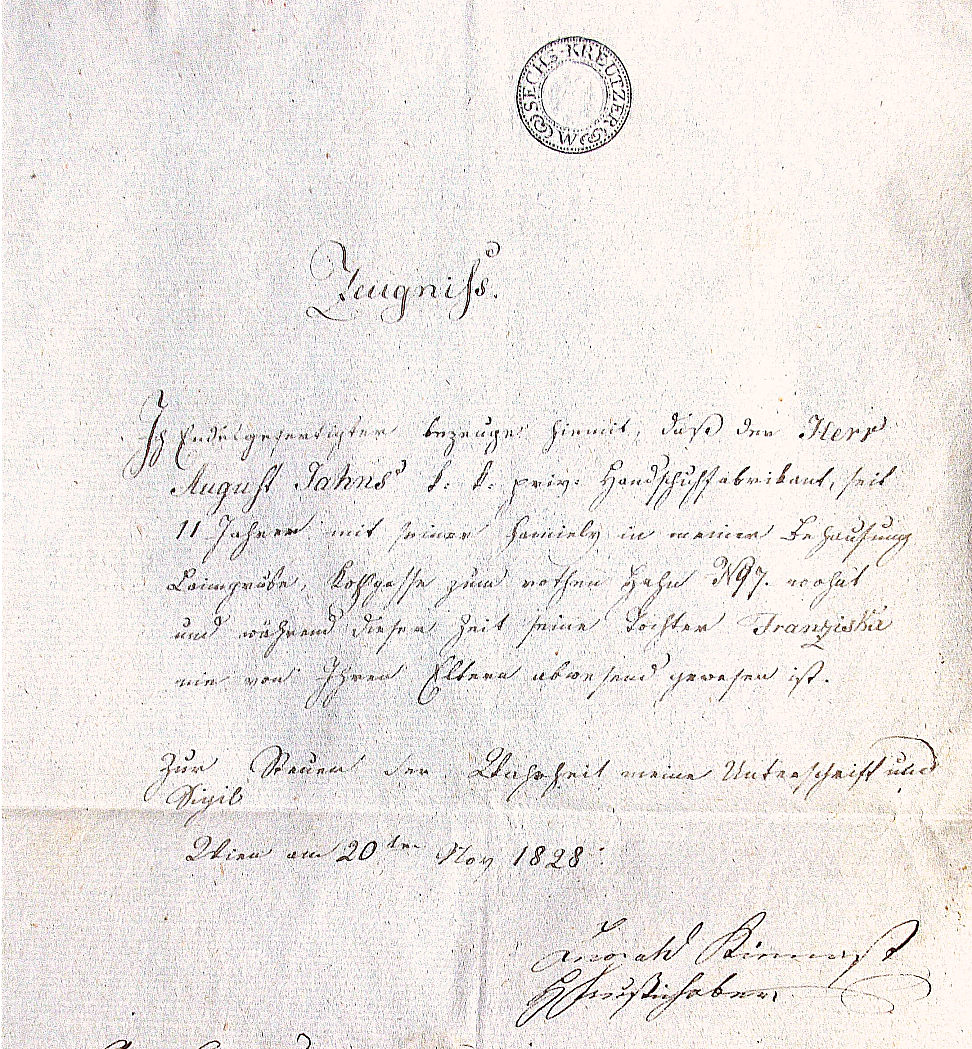
Lanner's marriage to Franziska Jahns – who had been a friend of her future husband since their days of childhood – seems to have been the result of a resolute decision by Lanner's father, who, after his son had already fathered two illegitimate children with two other women (one of whom he almost married), obviously had enough of his son's escapades and forced him to marry the daughter of his old glove-making colleague August Jahns from Halberstadt. On 20 November 1828, Jahns's landlord Leopold Kienast, the owner of the inn "Zum rothen Hahn", wrote the following testimony, thereby confirming the flawless moral reputation of Lanner's bride (this document is only one of many unknown Lanner documents that Herbert Krenn was unable to find).

Testimony.
I, the undersigned, herewith testify that Mr. August Jahns I. & R. privileged glove manufacturer has been living with his family for 11 years in my house, Laimgrube, Kothgasse, At the Red Rooster No. 97, and that during this time, his daughter Franziska was never absent from her parents.
As confirmation of the truth my signature and seal
     Vienna, November 20, 1828
                              Leopold Kienast
                              house owner
These are just the mistakes in the first paragraph of New Grove's current Lanner article. This poses the question: why was Herbert Krenn chosen to write it? One should assume that having written a dissertation about a composer, should qualify an author to write a short article about this composer for New Grove. But Krenn got his PhD in musicology in Vienna, and – as I have repeatedly pointed out – in Vienna things are a little different.


The online edition of The New Grove seems to be a cursed enterprise which is especially annoying considering the fact that Oxford University Press charges a fee for the online access. In 2001, after the encyclopedia had gone online, musicologists were promised "regular updates" and "time stamps for articles" by the then editor of grovemusic.com Laura Macy:
As of our next update (October 2001) grovemusic.com will have a system of 'date stamping' of articles, so that you will be able to indicate exactly which version of an article you are citing. We will also have a consultable archive of previous versions of articles. So: If there is no date on online article, then you are essentially looking at the article as it appears in the printed book. (AMS-list, 19 July 2001)
In January 2001, Macy announced a "mission update" concerning the policy for revisions to be posted in April 2001 which never appeared. On 18 September 2002, I told Macy about the most glaring mistakes in The New Grove's Lanner entry, but no correction was made. In 2001, I published a review of Robert Winter's New Grove Schubert article (which is more or less a train wreck) in the journal Schubert durch die Brille, which in 2013 I translated and published on this blog. None of the countless mistakes in Winter's article has so far been corrected. Since I have been asked by the editors to revise my own articles in New Grove, OUP's current policy seems to be that articles can only be revised and corrected by their original authors. In October 2012, I made the offer to completely overhaul Winter's Schubert article, but there is obviously no budget to pay writers for such extensive correction work, and thus the online version of The New Grove is forced to be stuck with flawed material forever. Why should Herbert Krenn ever want to correct his own work? To have his wrong Lanner dates printed, copied, and preserved for ages, was why he came up with them in the first place!

Joseph Lanner's seal on his marriage contract


I have spent several years of paid (and much more unpaid) research on the biography of Joseph Lanner and can say without arrogance that I know more about this man's life than anybody else. But my research cannot be published, because there is no funding available for such an enterprise in Lanner's hometown. There is currently no medium for this kind of publication. The Wiener Institut für Strauss-Forschung has ceased the publication of its journal, and the editors of the Wiener Geschichtsblätter have repeatedly shown themselves to be completely incompetent.

© Dr. Michael Lorenz, 2015. All rights reserved.

Updated: 18 August 2026

Jan 19, 2015

News, Reactions and Responses

Some of my blog posts have lead to responses and reactions that are too interesting not to be published. The many cases where my posts have already been referred to in print compensate the fact that some journalists (and musicologists) think that digital publications "do not really count" and can either be ignored or copied at will. Some comments added greatly to my amusement, because some readers seem to think that on this blog – like on countless others – material is being rehashed that can be found somewhere else on the internet. They soon realize that this is not a blog like any other and my research can rarely backed up by information that has already appeared elsewhere.

The Mysterious Grassi Document

Shortly after the opening of the exhibition Mozart-Bilder Bilder Mozarts in January 2013 the Mozarteum Foundation launched an article in The New York Times to drum up public interest in the exhibition and a "newly identified Mozart portrait". The article, titled "Wolfgang, Is That You?", presented a miniature on a snuffbox as the work of "Joseph Maria Grassi" that the Salzburg researchers had supposedly been able to identify as Mozart after the surprising discovery of a hitherto unknown document:
A rummage through the archives found a document showing the object's provenance. The document said Mozart had owned the snuffbox for 10 years and gave it as a gift to Anton Grassi, a sculptor friend in Vienna. Letters from Mozart indicate that Grassi's brother Joseph, also an artist, painted a miniature of Mozart. Joseph acquired the snuffbox from his brother and attached the miniature.
That the important newly discovered document was not mentioned in the exhibition catalog came as a slight surprise. On 6 February 2013 in my blogpost "'The Newly Discovered Mozart Portrait': Back to Reality" I referred to this disappointing fact as follows:
What we read here, quickly takes us down from the spheres of "sensationally new discoveries" to the low grounds of only too well-known dull speculation. The "certainty" that the press release has been bragging about is gone and the shadow of "we don't really know anything for sure" is lying heavily on the the portrait's supposed authenticity. [...] This mysterious "document" (which could not be located by the Mozarteum experts in the course of the yearslong preparation of their current exhibition) is still unpublished. Since (as stated by Dr. Großpietsch) "Mozart owned several tobacco boxes", its provable[!] connection to the box in question remains doubtful. There is no proof at all that Anton Mathias Grassi (b. 26 June 1755 Vienna, d. 31 December 1807 Vienna) was a "sculptor friend" of Mozart's (as a matter of fact he was a model sculptor at the Imperial Vienna Porcelain Manufactory). To establish a close connection between Anton Grassi and Mozart is an even bigger stretch than the inflation of Joseph Grassi's dancing activities in 1783 into an intimate friendship with the composer.
It seemed that the new document that proved that Mozart had owned the snuffbox for ten years and gave it as a gift to Anton Grassi had simply been found too late to be included in the exhibition catalog. It was to be expected that the Mozarteum would publish this important source as soon as possible to make it available to scholars interested in Mozart portraiture. But nothing happened. The mysterious document remained secret. Thus in January 2014 I added the following postscript to my blogpost:
The document that according to the 2013 article in the New York Times, "said Mozart had owned the snuffbox for ten years and gave it as a gift to Anton Grassi, a sculptor friend in Vienna" has still not been published by the Mozarteum.
One year later the situation remains unchanged. The document that according to the New York Times was found during "a rummage through the archives" has still not been published. It has by now acquired the taint of a canard.

The Reaction of the Haydn-Institut

On 26 September 2014 my articles "Three Unknown Godchildren of Joseph Haydn" and "Joseph Haydn's Real Wife" led to the following reaction from the Haydn-Institut in Cologne:
Congratulations, that's a minor sensation! On one hand we are thrilled by your new research results, on the other hand ashamed, because Haydn research for so many decades has simply copied what had been carelessly published. I think it would be wonderful - and an honor for us – if you would be willing to publish this research in our Haydn-Studien, in whatever form. Would it be possible to just do a German version of the blog? We would be delighted to hear from you in this regard!
On 22 November 2014 I asked the Haydn-Institut what fee they could imagine to pay for a German article covering my recent Haydn research. I have not heard back from them since and therefore I assume that the Haydn-Institut expects me to provide unpaid work. Given the financial resources of its sponsors, the Haydn-Institut can only be congratulated for being blessed with a staff that can afford to work for free. I am not in such a lucky position.

A Letter From Elbie Lebrecht

In my article on the notoriously misattributed portrait of the "young Schubert" I referred to the fact that the CD producer's decision to use this picture was based on a misattribution in the database of the Lebrecht Music & Arts picture library. My pointing out this mistake in the picture database lead to the following response from Elbie Lebrecht:
Dear Michael Lorenz,

My husband has forwarded your letter to me.  I am really grateful to you for pointing out the error about incorrectly identifying an image as being of Franz Schubert. I have amended our website accordingly. And you are absolutely correct about our source of information. It is very beneficial to have someone who is so knowledgeable pick up on these slips. We obviously do our best to try and have two sources confirming information but there will, inevitably, be errors.
I set up the photo library in 1992 with just a few images. We now have over 300,000 -  many of which are from other photo libraries. Obviously the higher the number the greater the chance of errors creeping in. Please do keep in contact with me as your input is very much appreciated.

Kind regards,
Elbie Lebrecht
Director Lebrecht Music & Arts
This response, which is a model of true professionalism, makes one wish that all institutions would react this way when made aware of an error. The falsely attributed portrait of "young Schubert" has been removed from the Lebrecht database.

Concerning "Beethoven's Elise"

Following my letter to the editor of The Musical Times, I was invited to explain my hypothesis concerning the identity of "Beethoven's Elise" in an article for the Winter 2014 issue of this journal which would be published together with letters to the editor from Barry Cooper and Rita Steblin. I decided not to make use of this invitation, because I think my hypothesis is of minor importance and, for the time being, the "Elise" issue has reached a dead end. As I have stated repeatedly, as long as the autograph of the Albumblatt WoO 59 remains lost, the dedicatee of the piece cannot be identified. My explicit criticism of Kopitz and Steblin was not primarily motivated by my rejection of their "Elise" theories. The identity of this lady is in my opinion far too unimportant. What prompted me to criticise Kopitz were his dubious methods, namely the publication of an untenable, not sufficiently researched theory in the press and the following shameless propaganda with sockpuppets on Wikipedia. In Steblin's case it was the irrepressible urge to get her name into the press, followed by a belated publication with a yawning gap in the chain of evidence. In his article "Eine Bagatelle und andere Kleinigkeiten", which in 2014 he published in volume 11 of the Bonner Beethoven Studien, Jürgen May, an employee of the Richard Strauss Institut in Garmisch-Partenkirchen, brought research on "Beethoven's Elise" to a temporary standstill. He showed that Elise Schachner, the daughter and heiress of the owner of the autograph of WoO 59 Rudolph Schachner, died childless in February 1951. He suggested that the autograph of the Albumblatt may have been put into Schachner's coffin in 1896, together with Therese von Droßdik's letters. Beethoven's manuscript obviously did not end up with Elise Schachner's friend, the painter and collector of Beethoveniana Gustav Lörincz de Baranyai who, for some time, was in possession of material from Therese von Droßdik's estate. In the conclusion of his article, May, in my opinion, makes an important point: the owner of the autograph Babette Bredl (Rudolph Schachner's mother) had every reason to keep her relation to Elise Schachner a secret. Therefore, in return for her permission to publish the Albumblatt, she may have requested unconditional discretion from Nohl who may have had no permission to publish completely correct information concerning the inscription on the autograph and the identity of the mysterious "Elise". More entertaining "new solutions" concerning the Elise mystery will surely be presented in the future. After all, each Elisabeth who ever knew Beethoven deserves to have her turn.

A page of Therese von Droßdik's will which I first published in 2001. The last sentence in the next to last paragraph reads: "[...] ferners mein Nußbaum Magohani Flügel nebst allen Musikalien vermache ich Freund Rudolph Schachner Tonkünstler, aus München". (A-Wsa, Landesgericht f. Zivilrechtssachen, 1121/1844)

Mozart According to Baur

Eva Gesine Baur, who after the publication of her Mozart biography in 2014, apparently craved a little more media attention, commissioned the German graphic designer Daniela Gattinger to draw a portrait of "Mozart as he really looked like" which was published by several newspapers.


This amusing portrait confronts the public with the sensationally new and shocking fact that Mozart was not handsome. Who would have thought that he did not look like the guy on the Mozart ball? Even the Swiss free daily Blick am Abend (which is really not known for its high standards) filed this portrait under "Neues aus Absurdistan":


One can only hope that in the future Baur will put her money into the production of other, equally priceless Mozart curiosities.

© Dr. Michael Lorenz 2015.

Dec 6, 2014

An Interpretation Issue in the Slow Movement of Mozart's String Quintet K. 516

Mozart's String Quintet in G minor, K. 516 is one of the greatest pieces of chamber music ever written. Its slow movement in E flat major has been described by Alfred Einstein as "the prayer of Jesus while the apostles are asleep". On 16 March 1878, concerning the Adagio ma non troppo of this quintet, Pyotr Ilyich Tchaikovsky wrote the following to his patron Nadezhda von Mec.
In his chamber music, Mozart charms me with his purity and distinction of style and his exquisite handling of the parts. Here, too, are things which can bring tears to our eyes. I will only mention the adagio of the D [sic] minor string quintet. No one else has ever known as well how to interpret so exquisitely in music the sense of resigned and inconsolable sorrow. Every time Laub played the adagio, I had to hide in the farthest corner of the concert hall, so that others might not see how deeply this music affected me. [...] Previously I had only known the Italian Opera. It is thanks to Mozart that I have devoted my life to music. All these things have probably played a part in my exclusive love for him―and perhaps it is foolish of me to expect those who are dear to me to feel towards Mozart as I do. But if I could do anything to change your opinion―it would make me very happy. If ever you tell me that you have been touched by the adagio of the D minor quintet I shall rejoice.
The manuscript of K. 516, which today is held by the Biblioteka Jagiellońska in Kraków (Pl-Kj, Mus. ms. autogr. W. A. Mozart 516), is not completely written in Mozart's hand. Four leaves (folios 9, 10, 19 and 20) have been replaced with a copy written by Mozart's friend and pupil Franz Jakob Freystädtler, a fact that was first revealed in my article "Franz Jakob Freystädtler. Neue Forschungsergebnisse zu seiner Biographie und seinen Spuren im Werk Mozarts", in: Acta Mozartiana 44, vol. 3/4 (1997), 85-108. In the foreword of the pocket score of K. 516 (Taschenpartitur 159), which in 2001 was published by Bärenreiter, Manfred Hermann Schmid (then a subscriber of Acta Mozartiana) did not cite my article, but presented the information concerning Freystädtler's copying in the manuscript of K. 516 as if he had discovered it himself. In the NMA's critical report, published in 2003, Schmid repeated this plagiarism and clumsily tried to cover it up by only referring to the foreword of his own earlier edition of the Bärenreiter pocket score. When in 2005, in the second edition of this Bärenreiter score, he ignored my article for the third time, I submitted a formal protest to the management of Bärenreiter and requested an apology. Schmid did not even think of apologizing, and the excuse he presented was so lame that it made his behavior look even worse. He claimed that the information concerning Freystädtler's copying "had come from Ms. Ferguson of the NMA". Apart from the fact that it had been myself who in summer of 1997, at the then NMA office in Salzburg, had told Faye Ferguson about Freystädtler's copying, Schmid hereby admitted that in his critical report, vital information concerning the autograph of K. 516 was not based on bibliographical research, but on hearsay and unverified verbal communication. Schmid also asked me to share information concerning some details he had overlooked in his report, but for obvious reasons, I decided not to tell him anything about my research.

There must be space here to briefly shed light on Manfred Hermann Schmid's dubious working method in editing K. 516 for the NMA. In the cello part in the Adagio ma non troppo, Schmid transcribed the second half of bar 18 as follows.

The second half of bar 18 of the cello part in the Adagio ma non troppo (in Freystädtler's hand) on p. 52 of Pl-Kj, Mus. ms. autogr. W. A. Mozart 516. Below is the same passage in the NMA as edited by Schmid.

How the "fort[e]" mark became a "sf[orzando]" in the NMA, is a mystery. In his 2003 critical report (Kritische Berichte, Serie VIII, Werkgruppe 19, Abteilung 1, 58), Schmid writes the following about the volume signs in this bar of the cello part: "p bereits zur 2. 16tel-Note" (p[iano] already at the second 1/16 note). If we look at the musical text in the manuscript, this remark makes absolutely no sense. There is no piano sign at the second 1/16 note. It turns out that what Schmid is describing is not the manuscript of K. 516 in Kraków, but the faulty edition of the AMA (Alte Mozart Ausgabe) from 1883! Schmid seems to have never actually checked Mozart's autograph manuscript.

The second half of bar 18 of the cello part in the Adagio in the Alte Mozart Ausgabe of 1883 which (erroneously) has the "p already at the second 1/16 note" (Mozarts Werke, Serie XIII, Leipzig: Breitkopf & Härtel, 1883. Plate W.A.M. 516, 12)

Freystädtler's copywork on folios 9 and 10 of the manuscript consists of bars 86-90 of the Trio of the Menuetto and bars 1-65 of the Adagio. In 1956, the original two leaves of the manuscript – according to Ernst Fritz Schmid  – were allegedly held by the Collection Pleyel in Paris. They supposedly had come from the estate of Johann Anton André who, in 1800 had received them from Constanze Mozart. It seems, however, that Schmid never was able to personally scrutinize this autograph fragment and in his article "Neue Quellen zu Werken Mozarts", Mozart-Jahrbuch 1956 (Salzburg 1957), he had to base his elaboration on a microfilm of this source whose original turned out to be unaccessible to Alan Tyson and the NMA. The original leaves, which allegedly once were held by the Collection Pleyel in Paris, now cannot be located anymore. According to information, retrieved in 2015 by violist Steve Machtinger from librarian François-Pierre Goy, they were never owned by the Bibliothèque Nationale de France in the first place.

In the autograph of K. 516, Freystädtler's handwriting begins on folio 9r with the last five bars of the trio and ends at first leaf 11r, where at bar 66 of the Adagio, Mozart's handwriting sets in again. Freystädtler inserted another six bars in the fourth movement. Mozart had already begun the Allegro on folio 12v, when he realized that on 12r there was not enough space for the ending of the Adagio introduction. Beginning at bar 33, Freystädtler by hand extended  the notation system by three bars. Next to the lowest stave he wrote "vide 0 13" and added the remaining three bars at the end of the third movement on folio 11v (i.e. the previous page). There, on the right margin of the page, he wrote "Volta sub[ito] 6/8 pag 14", referring to the beginning of the fourth movement. The foliation of the leaves copied by him is also written in Freystädtler's hand, and so are the last 16 bars of the fourth movement. The original leaf of this ending once belonged to Clifford Curzon and was sold at Christie's after 1982.

The nine bars presenting the Adagio's second theme in B flat major (which is related to the upward figure in bars 32ff. of the first movement), are usually performed as follows:


Bars 24-36 of the Adagio ma non troppo of K. 516 in Ernst Hess's and Ernst Fritz Schmid's 1967 edition for the NMA (VIII/19/Abt. 1, p. 77)

The Nash Ensemble's 2010 recording presents a similar (albeit slightly faster) interpretation of this passage.

The Nash Ensemble (2010): K. 516, 3rd movement, bars 24-33

The musical detail deserving special attention in the above passage is the upward phrase in the first violin in bar 27 which is subject of a downward sequence in the following bars and is then answered by the first viola:

Bars 27-32 of the first violin in the Adagio ma non troppo of K. 516 (NMA)

Bars 27-28 of the first violin in the Adagio of K. 516 (NMA)

There are three slurs in the first half of bar 27. The second one, which connects the quarter note d''' to the following dotted sixteenth, is usually played as a long note on one stroke, as if Mozart had written a quarter note with three dots. This is obviously not how Mozart wanted this passage to be executed. The second slur is a score notation, not a performance notation. The separate third slur in bar 27 means that the quarter and the dotted sixteenth d''' ought to be separated from the preceeding quarter by a stop of the bow. Every classically trained string player should realize this. Analogous to this passage, the third slur in the next bar also demands a separation of the quarter and the following dotted sixteenth. This is what Mozart had in mind when he applied a distinct third slur.

Bars 25-31 of the Adagio ma non troppo in Mozart's autograph (formerly [allegedly] in F-Pn, Collection Pleyel)

Bars 16-31 of the Adagio ma non troppo in Freystädtler's handwriting on fol. 9v of the manuscript of K. 516 (P-Kj, Mus. ms. autogr. W. A. Mozart 516)

In bar 27 of the first violin part, Freystädtler's copy omits the second slur which is obviously an oversight.

Bars 27-28 of the first violin part in the Adagio (fol. 9v) in the handwriting of Franz Jakob Freystädtler whose copy replaced a missing part of the autograph. In bar 28, Freystädtler erroneously wrote two e'''s and a d''' which he corrected with three small letters into c''' and b'''.

The perceptible distinction between the two notes – instead of the long maudlin single note that is usually played – should also be applied in the three analogous passages in the parts of the first violin (bars 66f. in the recapitulation) and the first viola (bars 30f. and 69f.).

Bars 66 and 67 in the violins of the Adagio of K. 516 (P-Kj, Mus. ms. autogr. W. A. Mozart 516, fol. 11r). After the four pages, which were copied by Freystädtler, Mozart's handwriting begins again with this passage in bar 66.

Played this way, the two-bar-sequence suddenly acquires a different and much more logical rhetoric whose gesture homogenously corresponds with the series of similar upward figures in bars 30 and 31. Some  editions of K. 516 actually follow this different reading. For example, Johann André's edition from 1825 (plate no. 4793).


In the repeat of the second theme, André's 1825 edition surprisingly has no slurs in the second upward figure in the first violin and the first viola which means that the slur was obviously considered to have no effect at all on the bowing of this phrase.

Bars 65-73 of the Adagio in André's 1825 edition with an unexpected second slur in the violin in bar 67 and a second one in the viola in bar 71

In his pocket score edition for Eulenburg (E. E. 1113), Rudolf Gerber quite naturally relied on André's edition and did not apply a second slur in bar 27 (and 66) of the first violin part (and in the analogous passages in the first viola). It seems to have been quite obvious to Gerber how this passage should be executed.

Bars 25-31 of the Adagio on p. 24 in Rudolf Gerber's edition for Eulenburg. Note that Mozart's "mfp" is turned into into "sfp".

Arthur Grumiaux, who in 1972 recorded K. 516 for Philips, realized that in bars 27 and 28 (and the analogous passages) the third note has to be audibly separated from the second one. Grumiaux (and Georges Janzer on first viola) achieved this by reducing the bow pressure after the quarter notes in bars 27 and 28 respectively.


When the original LP was released in 1973, no critic noticed this important detail. I know of only one recording of the quintet K. 516 that dares to follow the composer's true intention. In December 1991, the British chamber ensemble Hausmusik, led by violinist Monica Huggett, recorded the quintets K. 515 and 516 for EMI Classics. The CD was released in 1992.


Monica Huggett and Roger Chase, who, according to the booklet of the recording, used the Neue Mozart Ausgabe, play the aforementioned two bar phrase in the Adagio as it is printed in André's 1825 edition.


The repeat in E flat major in bars 61-71 is played analogously.


Bars 61-73 of the Adagio in the NMA

Hausmusik's complete recording of K. 516 is available here on YouTube (the ridiculous "Mozart portrait" must be ignored). In spite of slight intonation problems, Hausmusik's performance of the third movement of K. 516 fundamentally changes the quality of a classic "beautiful Mozart passage". The correct interpretation of the second theme in the Adagio is, in my opinion, so much better and more logical that it completely changes the listening experience and makes the traditional (wrong) version completely unacceptable.


Postscript (November 2016)

I have recently become aware of the recording of K. 516 by the Budapest String Quartet with Walter Trampler on second viola which was released in 1957, on the Columbia Masterworks Records label (ML 5192). The musicians performing on this recording were Josef Roisman, Alexander Schneider, Boris Kroyt, Mischa Schneider and Walter Trampler.


This recording is an early document of the third movement of K. 516 being performed as it is written in the score: with the third note in bars 27 and 28 (and the analogous passages) audibly separated from the second one.


What is surprising is not that these legendary chamber musicians instinctively understood the implied meaning of the written musical text. It is the fact that their interpretation was not taken as a model by musicians of later generations.


Postscript (March 2026)

A recent check on YouTube has shown that already in their 1941 recording, the Budapest String Quartet (with Milton Katims on 2nd Viola) played the correct musical text in the Adagio ma non troppo of K. 516.


© Dr. Michael Lorenz 2014. All rights reserved.

Updated: 17 August 2026

Nov 19, 2014

A Portrait Miniature of "virtually unparalleled" Importance

On 2 October 2014 the British newsaper The Guardian published an article that began as follows:


Contrary to the opinion of some commentators, who claimed that this painting was "never seen in public before", this miniature is well-known. It has been a long-time on loan exhibit at the Augsburg Mozarthaus and has been published many times, the last time in 1999 on p. 27 of Johannes Jansen's book Mozart (Köln: Taschen).


Sotheby's description of this miniature, which will be auctioned on 20 November 2014 at an estimated price of 200,000 - 300,000 GBP, indulges in unbridled hyperbole:
PROBABLY THE MOST IMPORTANT LIKENESS OF THE COMPOSER EVER TO BE OFFERED AT AUCTION.
ONE OF ONLY A DOZEN OR SO AUTHENTIC PAINTINGS AND DRAWINGS OF THE COMPOSER.
ONE OF ONLY TWO AUTHENTIC PAINTINGS OF THE COMPOSER ENNUMERATED BY THE MOZART ICONOGRAPHER OTTO ERICH DEUTSCH REMAINING IN PRIVATE HANDS.

The appearance at auction of this portrait by an anonymous artist of the twenty-one-year-old Mozart, a present to his first serious dalliance, his eighteen-year-old cousin (the Bäsle) Maria Anna Thekla Mozart, represents an opportunity to acquire a Mozart object of stunning and virtually unparalleled significance.
The portrait is of touching simplicity and freshness. Wearing a red coat similar to that in the famous della Croce family portrait of 1780, his fine blond hair powdered and tied fashionably with a large black bow (one recalls a later letter from Vienna, that of 22 December 1781, relating how the fastidious composer's day would begin with a visit at six o'clock in the morning from his hairdresser), Mozart gazes directly at the viewer with intelligent, large blue eyes, a playful and open expression on his features. No other portrait of the composer perhaps conveys as this does what might be called Mozart's most defining characteristic, above and beyond his feeling for form and beauty: his genius for humour.

IT IS PROBABLE THAT THE QUALITIES OF THE MINIATURE ARE NOT AS WIDELY KNOWN OR APPRECIATED AS THEY SHOULD BE, ON ACCOUNT OF THE FACT THAT THE PORTRAIT HAS NEVER BEEN REPRODUCED IN COLOUR IN THE STANDARD MOZART LITERATURE
Some of these statements are so absurdly exaggerated that they barely deserve a comment. Especially telling (and funny) are the  phrases "one of only a dozen or so[sic] authentic paintings", "a Mozart object of stunning and virtually[sic] unparalleled significance", "the portrait is of touching simplicity and freshness" and especially, "no other portrait of the composer perhaps conveys as this does what might be called Mozart's most defining characteristic". The last statement which claims that "the portrait has never been reproduced in color in the standard Mozart literature", is a lie that is supposed to mislead the customers. The portrait has been reproduced in color in 1999 in the aforementioned book by Jansen which is certainly part of the standard Mozart literature.

The continuing presentation of new supposed "Mozart portraits" on a strange flea market of vanities has led to a situation where the experts of one of the world's leading auction houses do not know the exact number of authentic Mozart portraits. It does not strengthen the credibility of these experts that they present a list of twelve portraits – which they call "the canon according to Deutsch" –  but fail to mention that in his 1956 article "Mozart Portraits" (in The Mozart Companion, H. C. Robbins Landon & Donald Mitchell eds., London: Faber and Faber) Deutsch counted the 1777 miniature among the "spurious anonymous portraits". Deutsch described it as "formerly in the possession of Mozart's cousin, 'Bäsle', Mannheim, November 1777", and yet, he considered it spurious. To anybody with a training in history of art the reasons for Deutsch's judgement are perfectly obvious. The 1777 Mozart miniature – even if it is genuine – is not of "virtually unparalleled importance". Neither is it "the most important likeness of the composer ever to be offered at auction". The miniature is of almost no iconological value at all. It is a classic eighteenth-century "porcelain doll head miniature", a stylized type of portrait of which huge numbers were produced in Mozart's time. Similarity with the sitter was not the purpose of these pictures. Some authors who described the 1777 miniature realized and acknowledged this simple fact. In his biography of Mozart Robert W. Gutman writes: "It stands within the bounds of possibility that the portrait of Mozart he himself commissioned for her survives as the miniature in Augsburg's Mozarthaus. Yet, the physiognomy troubles: if it is Mozart's, the artist has much refined the cast of the features; but Mozart may have insisted on an idealized image." Of course the people at Sotheby's have to boost the sale price and thus cannot afford to assume the more restrained perspective of impartial art historians. How they describe the lack of technical quality in a poorly executed mass product as "the portrait is of touching simplicity and freshness", is very amusing. The "genius for humour as Mozart's most defining characteristic" that these experts claim to see, simply results from the slight smile which was supposed to always appear on these standardized portraits.

Here is another "never before seen Mozart portrait of virtually unparalleled importance. Mozart gazes directly at the viewer with intelligent, large blue eyes, a playful and open expression on his features. No other portrait of the composer perhaps conveys as this does what might be called Mozart's most defining characteristic, above and beyond his feeling for form and beauty."


Of course this is not a Mozart portrait. It is a portrait of Joseph II in the popular tradition of Joseph Ducreux which recently was on sale at an auction at the Salzburg Dorotheum. I am using it here, because it is the same type of a stylized mass product as the doll-like face on the Mozart miniature.

Sotheby's overblown marketing campaign for the sale of this miniature is an embarrassment for the company. The owner of the painting deserves to get a reasonable sale price. But the methods that were applied in this case cannot be counted among the more glorious chapters of art-dealing.

"Don't worry, ivory Mozart portraits are not affected by gravity!" (a picture published in the Salzburger Nachrichten on 20 October 2014)

© Dr. Michael Lorenz 2014.

Update: 30 December 2019


Update (20 November 2014): The miniature did not reach the lowest estimate price and was sold for 180,000 GPB (218,500 GBP with buyer's premium).

Nov 16, 2014

"The Young Franz Schubert": An Ineradicable Misidentification

In June 2014, Sony Music Japan released the following recording of music by Franz Schubert:


The source for the picture on the cover of this CD is the following curiosity from the database of the Lebrecht Music & Arts picture library:


The misspelling of Leopold Kupelwieser's name already shows that, as far as the attribution of this portrait is concerned, Lebrecht's database is not to be trusted. This picture is not a portrait of Franz Schubert. It is one of two existing portraits of the Austrian physician Karl Joseph Maria von Hartmann (1793–1876).

The misidentification has been revealed decades ago in several scholarly articles all of which have been thoroughly ignored by Schubert scholarship and, even more consistently, by the general public. When you publish an article in German in the journal of the International Schubert Institute, you might as well not publish anything at all, because 95 percent of Schubert scholars do not understand Schubert's language. So much for the "proper dissemination" of scholarly work by publishing articles in print. The essential literature concerning the false Schubert portrait consists of the following articles:
  • Deutsch, Otto Erich. 1961. "Zum angeblichen Schubert-Bildnis von 1813". In Mitteilungen der Österreichischen Galerie 49. Vienna: Österreichische Galerie Belvedere 1961, 24.
  • Barchetti, Theodor. 1981. "Die Familien v. Hartmann und v. Barchetti. Eigentümer des Hauses Wels, Pfarrgasse 15, im 19. Jahrhundert". In Festschrift Kurt Holter. 23. Jahrbuch des Musealvereines Wels. Wels: Verlag Welsermühl, 247-269.
  • Steblin, Rita. 1992. "Die Atzenbrugger Gästelisten - neu entdeckt". In Schubert durch die Brille 9 (Mitteilungen des Internationalen Schubert Instituts 9). Tutzing: Schneider, 65-80.
  • Steblin, Rita. 1993. "Nochmals die Atzenbrugger Gästelisten". In Schubert durch die Brille 10. Tutzing: Schneider 1993, 35-41.
  • Worgull, Elmar. 1996. "Zwei Fehlzuschreibungen in der Schubert-Ikonographie". In Schubert durch die Brille 16/17. Tutzing: Schneider, 158-171.
  • Worgull, Elmar. 1999. "Kunsthistorische Untersuchungsmethoden als ein interdisziplinärer Aspekt in der Schubert-Ikonographie". In Schubert und seine Freunde. Eva Badura-Skoda (ed.), Wien-Köln-Weimar: Böhlau, 343-360.
  • Worgull, Elmar. 2001. "Schuberts unbekannter Nachbar in Kupelwiesers Aquarell 'Der Sündenfall'". In Schubert durch die Brille 26. Tutzing: Schneider, 101-108.
  • Lorenz, Michael. 2001. "Erwiderung auf Elmar Worgulls Replik". In Schubert durch die Brille 26. Tutzing: Schneider, 109f.

The Origin of the Misidentification

The false Schubert portrait was first published by Otto Erich Deutsch in 1913, as "Angebliches Schubert-Bildnis von Leopold Kupelwieser [?] aus dem Jahre 1813" (supposed Schubert portrait by Leopold Kupelwieser [?] from 1813) in the book Franz Schubert. Sein Leben in Bildern.


The basis for the identification of this drawing, which in 1891 was bought at an auction by Prince Johann von Liechtenstein, is an inscription on its back which, between 1888 and 1891, was applied by two of Schubert's half-brothers. Its translation reads as follows: "Franz Schubert in the 16th year of his life. Original chalk drawing by the friend of his youth Leopold Kuppelwieser (anno 1813). P. Hermann Schubert mp Curate and preacher at the Schottenstift. Andreas Schubert mp Senior accountant in the I. & R. Ministry of Finance as Franz Schubert's brother". Deutsch was very sceptical concerning the viability of this testimony. After all, at the time of Schubert's death, his half-brothers Eduard (the future Pater Hermann) and Andreas had only been two and five years old. The attribution to Kupelwieser was dubious as well, because Schubert became acquainted with the painter only around 1820. In spite of Deutsch's doubts and the fact that it had never been reliably attributed, the drawing was accepted as Schubert portrait by the general public. This error was also promoted by several authors of popular books – such as Kurt Pahlen in his book Die Große Geschichte der Musik – where the portrait is described as "Porträtskizze[sic] des jugendlichen Franz Schubert von dem Wiener Maler Leopold Kupelwieser".

The Man at the Piano

The opinion regarding the supposed Schubert portrait experienced a fundamental change, when in 1996 the German painter and art historian Elmar Worgull, in his article "Zwei Fehlzuschreibungen in der Schubert-Ikonographie", pointed out that a man with the face of the supposed "young Schubert" appears on another painting connected with Schubert's circle: on Leopold Kupelwieser's 1821 watercolor "Der Sündenfall" (The Fall of Man), which shows a game of charades being played by Schubert and his friends in Atzenbrugg, this man is sitting on the far left at the piano, resting his arm on the instrument and putting his left hand to his chin.

Leopold Kupelwieser: Gesellschaftsspiel der Schubertianer in Atzenbrugg 1821 (Wien Museum, I.N. 18752)

The man sitting at the piano on the far left of Kupelwieser's 1821 watercolor

Who is this man? In his 1913 book, Otto Erich Deutsch, who obviously knew only one sentence of an entry in Franz von Hartmann's family chronicle, made a hasty and uninformed guess. He identified the "Hartmann" at the piano with the only Hartmann, who, according to Deutsch's knowledge, could have been present in 1821 in Atzenbrugg: the German physician Dr. Philipp Karl Hartmann (1773–1830) who was acquainted with Ernst von Feuchtersleben, and at some time, was involved in the medical treatment of Johann Mayrhofer and Franz von Spaun.

The physician Dr. Philipp Karl Hartmann (A-Wn, PORT_00076771_01)

The other Hartmann among Schubert's friends, Franz von Hartmann, could be ruled out, because he was born only in 1808. In his 1964 edition of the Schubert Dokumente, Deutsch repeated this misidentification which is a classic example of Deutsch's way of jumping to an unfounded conclusion without a bit of scientific evidence and repeating it as if he were an infallible oracle.

The false identification of the man at the piano as Philipp Karl Hartmann in Deutsch's 1913 book Franz Schubert. Sein Leben in Bildern. The name of Kupelwieser's dog was Drago.

Franz von Hartmann's Testimony

Deutsch took the information concerning the name of the man sitting at the piano from a passage in the first volume of Franz von Hartmann's "Familienchronik" (A-Wst, Jc 73234). But Deutsch – who in the preface of the first edition of the Dokumente claimed that "he had in all cases gone to the sources proper" – obviously never consulted the original of Hartmann's chronicle, because he published only one sentence of Hartmann's entry and failed to include the subsequent important information concerning the mysterious "Welser v. Hartmann". Summarizing and commenting his original diary from 1826, in his Familienchronik, Franz von Hartmann wrote the following.

The passage in Franz von Hartmann's "Familienchronik" dealing with his visits to the Burgtheater and to Franz von Schober's apartment on 13 December 1826 where he saw Kupelwieser's watercolor from 1821 (A-Wst, Jc 73234, vol. 1, 339-40)
     Den 12. [Dezember 1826] führte uns Pepi Spaun ins Burgtheater, wo wir "Der Erbvertrag" sahen, am 19. ins "Käthchen von Heilbronn" wo das Anschützsche Ehepaar so herrlich spielte.
    Am 13. besahen wir bei Schober Bilder, darunter ein schönes Aquarell von Kuppelwieser, wo Schubert am Klavier, einige Freunde, darunter Kuppelwieser selbst, dann über das Klavier gelehnt, der Welser v. Hartmann, Professor der Naturgeschichte in Olmütz, welcher später irrsinnig wurde. Als derselbe im Sommer 1825 im Irrsinn aus Olmütz fort gegangen war, kam zu mir in die Wohnung in der Jägerzeile ein Vertrauter der Polizei, und wollte von uns, da wir den gleichen Namen trugen, wissen wohin sich dieser Hartmann gewendet habe. Diese Welser Hartmann stammten aus Bayern, ihr Vater oder Großvater war ein Protomedicus in Linz gewesen u. in der Vorstadt in Wels war das schöne Haus der Familie mit großem von der Stadtmauer eingerahmten Garten, wohin ich während meiner Welser Dienstzeit 1854-1865 oft kam, zu Bar.[on] Pilati u. zum Kreisingenieur Hackher.

[translation:]

On December 12th, 1826, Pepi Spaun led us into the Burgtheater where we watched "Der Erbvertrag", on the 19th, to "Käthchen von Heilbronn" where the Anschütz couple acted so marvelously.
       On December 13th, at Schober's, we looked at paintings, among them a beautiful watercolor by Kupelwieser, where Schubert is at the piano, a number of friends, among them Kupelwieser himself, then, leaned over the piano, von Hartmann from Wels, the professor of natural history in Olmütz, who later went insane. After in summer of 1825 this man had left Olmütz in insanity, a police confidant came to my apartment on the Jägerzeile and, because we had the same family name, wanted to know from us, where this Hartmann had gone. These Hartmanns in Wels hailed from Bavaria, their father or grandfather had been a protomedicus in Linz and the family's beautiful house with a garden surrounded by the town wall was located in the suburb in Wels, where, during my service in Wels between 1854 and 1865, I went many times, to Baron Pilati and to the county engineer Hackher.

Moritz von Schwind: Franz von Hartmann (sketch for one the lunettes in Schwind's illustrations of "Die Sieben Raben")

In 1981, the judge, amateur historian, and genealogist Theodor Barchetti (1931–2006) published an article in the Jahrbuch des Musealvereines Wels, entitled "Die Familien v. Hartmann und v. Barchetti. Eigentümer des Hauses Wels, Pfarrgasse 15, im 19. Jahrhundert" ("The Families von Hartmann and von Barchetti. Owners of the House Wels, Pfarrgasse 15 in the 19th Century"). Barchetti, whose ancestors had once owned the house in Wels which Franz von Hartmann referred to in his chronicle, drew up a detailed history of the house and a meticulous genealogy of the von Hartmann family in Wels. Being aware of Kupelwieser's watercolor and the entry in Hartmann's Familienchronik (as published by Deutsch), Barchetti easily identified "the man at the piano" as the physician Karl Joseph Maria von Hartmann (1793–1876). This major achievement was ignored by Schubert scholarship until 1992, when Rita Steblin referred to Barchetti's research in her article "Die Atzenbrugger Gästelisten - neu entdeckt" in Schubert durch die Brille 9. Steblin pointed out Deutsch's misidentification. She noted that the man at the piano cannot be Philipp Karl Hartmann, because not only does he look much too young, he also shows no resemblance to any of Philipp Karl Hartmann's known portraits. In one point Steblin was wrong, however, namely when she wrote that "Hartmann died in madness". Hartmann became a taciturn recluse, but the lawsuit he filed in 1870 against his brother's estate proves that he was still in possession of his mental powers.

Karl Joseph Maria von Hartmann

Karl von Hartmann's father Dr. Johann Baptist Hartmann was born on 19 June 1752, in Reichenau an der Knieschna (today Rychnov nad Kněžnou). In 1777, he received his medical doctorate from the University of Vienna and moved to Wels, where he was appointed "landschaftlicher Physikus" (public health officer). On 24 July 1786, in the chapel of Feyregg Castle, Dr. Johann Hartmann married Maria Anna Alterdinger with whom, between 1787 and 1805, he would father nine children.

The entry concerning the wedding of Johann Baptist Hartmann on 24 July 1786 at Feyregg (Wels Stadtpfarre, Tom 6, 25). Joseph Wirsing, one of the witnesses, got married on the same day at Feyregg Castle.

On 10 February 1789, Dr. Hartmann bought the house Pfarrgasse 15 in Wels, the building which is referred to as "das schöne Haus" in Franz von Hartmann's Familienchronik. In 1792, Dr. Hartmann made use of the vacancy of the Imperial throne after the death of Leopold II and sucessfully applied for a hereditary knighthood to Charles Theodore, Elector of Bavaria, who until the accession of Francis II ran a profitable business, passing out titles without any serious examination of merits. For a fee of 450 gulden Dr. Johann Hartmann earned the right to call himself "Hartmann Edler von Sternfeld".

Karl Joseph Maria von Hartmann – the man whose portrait gained coincidental prominence and was to grace many CD covers – was born on 29 March 1793, in Wels, fifth child of Dr. Johann Baptist von Hartmann. His godfather was his father's best man Anton Schlossgängl von Edlenbach.

The entry concerning the baptism of Karl Joseph von Hartmann on 29 March 1793 (Wels Stadtpfarre, Tom. 10, 10)

Since Theodor Barchetti's excellent research on Karl Joseph von Hartmann (in spite of having been "disseminated properly") is still completely unknown, I hereby present a translation of the chapter in Barchetti's article which deals with Karl Joseph von Hartmann's life.
Karl Josef María [von Hartmann] is probably the most interesting, but also most tragic figure of the family. Like his brother Anton, he apparently also suffered from a psychopathic disposition which must have been hereditary in the Hartmann family. From 1806 until 1810, he attended  the gymnasium at Kremsmünster Abbey, where he lived in the seminary; There he met Franz von Schober, who from 1808 until 1812, also was a student in Kremsmünster. When in 1810 Karl von Hartmann began studying medicine at the University of Vienna, he met Schober again, who at that time also lived in Vienna. This acquaintance lead to Karl von Hartmann becoming a member of the circle of "Schubertians" where Schober, as one of Franz Schubert's closest friends, played an important role. Thus, Karl von Hartmann – who by now, on 30 August 1817 [actually, Hartmann passed his final exam on 27 June 1817, Vienna University Archive, Med9, 5-256], had received his doctorate of medicine in Vienna – took part in the "Atzenbrugg festivals" of this circle of friends, where in July 1821, he was captured in the famous watercolor by Leopold Kupelwieser "Charades in Atzenbrugg" which now is on exhibition at Schubert's birthplace. As a part of a game of charades, the Schubertians reenact the Fall of Man. At the left Schubert is sitting at the piano and melodramatically accompanies the scene with his left hand. To his left, at the very edge of the picture, Dr. Karl von Hartmann sits leaning against the piano, the left hand on the chin. It is very likely the only surviving portrait of a member of this family.
      After receiving his doctorate in 1817, Dr. Karl von Hartmann – he had also trained as an ophthalmologist – worked as assistant at the chair for special natural history at the University of Vienna under Professor von Scherer; in 1818, he had applied unsuccessfully for professorships in Innsbruck and Olomouc and in 1819, in Prague. Finally, on 15 September 1821, by Imperial decree, based on unanimous recommendation by the University of Vienna, he was appointed professor for general natural history and technology at the Lyceum in Olomouc which at that time, however, did not have university status. But already with Imperial decree of 9 December 1824, he was relieved of this teaching position, because "it had become apparent right after the start of the term that he lacked all gifts of communication and the ability of ordinary lecture, because of reticence and seclusion from all company of such a high degree that there is doubt whether he is still in command of his mental powers". The University of Vienna was reprimanded as to why it had proposed Dr. Karl von Hartmann primo loco, although his uncommon shyness, taciturnity, and the traces of mental disturbance must have been recognizable.
      Dr. Karl von Hartmann never recovered from this blow, and like his brother Anton, he now led the life of an unmarried man of private means. He showed querulative inclinations when he – as Aspernig reports in 1831 – refused to transfer his eighth of his mother's house like his siblings, and did so only shortly before her death on May 1st, 1846; that he was not on good terms with his family in other matters as well, can be seen from his mother's codicil of 10 November 1839, where his inheritance was reduced to the statutory share, if he would not acknowledge the maternal will, not treat his mother and his siblings with the deserved respect or get involved in a legal dispute with the latter. After the death of his brother Ludwig, he tried to use a provision in Ludwig's will that after Ludwig's death the known children of his brother Karl should receive the securities from the estate, to achieve a substitution by an entailed estate in his favor. But he lost the case that he had brought to the supreme court in 1870.
      At first, Dr. Karl von Hartmann seems to have returned to Wels. But in 1854 and 1869, he also lived in Steyr in the former Capuchin monastery, outside of the city. He spent his final years at Pochendorf No. 22 near Kremsmünster where he died on 13 January 1876, of old age. He was buried in the family vault in Wels which in 1887 fell victim to the closing of the old Wels parish cemetery. With him the family became extinct.
In the death records of the Kremsmünster parish Karl Hartmann Ritter von Sternfeld is listed as having died at the age of 83 in 1876, at Pochendorf 22. But on 25 May 1875, an Antonia Hartmann ("led.[ige] Private") also died at Pochendorf 22 at the age of 67. Was she Karl von Hartmann's housekeeper?

The entry concerning Karl von Hartmann's death on 13 January 1876, at Pochendorf 22. The deceased is described as "Dr. der Medizin, pens. kk. Lycenal Proffessor in Olmütz". The given cause of death is marasmus (Kremsmünster, 306/1876, 1).

The entry concerning the death of Antonia Hartmann ("led. Private") on 25 May 1875 at Pochendorf 22. (Kremsmünster, 306/1875, 3).

Discoveries and Delayed Insights

After the publication of Theodor Barchetti's research and its introduction to Schubert scholarship by Steblin, the most important progress that was to be made, was to realize the resemblance between the portrait of Karl Joseph von Hartmann on Kupelwieser's Atzenbrugg watercolor and the face on the supposed "young Schubert in 1813" drawing in the Liechtenstein collection. The merit of having established this pathbreaking connection belongs to Elmar Worgull who, in his 1996 article "Zwei Fehlzuschreibungen in der Schubert-Ikonographie" (Schubert durch die Brille 16/17), dealt with the authenticity of the supposed portrait of "young Schubert". Worgull pointed out the fact that the only person on a painting from Schubert's circle that resembles the supposed portrait of "young Schubert", is the man who is leaning on the piano in Kupelwieser's watercolor of the charades at Atzenbrugg. As a matter of fact, the resemblance between these two faces is so strong that it is surprising that it had not been noticed much earlier. Worgull writes: "When the two portraits which are to be compared are reduced to outline drawings, juxtaposed and then projected over each other, the congruences between the two heads are unmistakable, in spite of different drawing techniques and original sizes. To assess them as (almost) identical, will hardly provoke contradiction." Worgull called this method "isoproportional picture analysis".

Elmar Worgull's outline drawings of the two heads juxtaposed and projected over each other (Schubert durch die Brille 26, 108.)

Worgull continues: "Since on Kupelwieser's watercolor Schubert is unquestionably sitting at the piano and the person that is portrayed on the chalk drawing appears beside him, the chalk portrait [i.e. the "young Schubert"] cannot be a portrait of Franz Schubert. Otherwise Schubert would be sitting opposite his own dissimilar portrait." Worgull was able to prove that the supposed "young Schubert" is not a portrait of Schubert. He also presented credible arguments for a redating of this drawing from 1813 to a much later date. As far as the identity of the person on this portrait was concerned, Worgull was unable to expand our knowledge. He could not proceed further in this regard, because he had obviously not read Barchetti's 1981 article, where the man at the piano opposite Schubert had been conclusively identified as Dr. Karl Joseph von Hartmann. Therefore, Worgull still indulged in random speculations concerning the identity of the man on the Atzenbrugg painting and presented various "Lösungsmöglichkeiten" (possibilities of a solution). He claimed that "a trace leads to Karl-Philipp Hartmann" which is of course a mistaken perspective, because an old error by O. E. Deutsch is not a trace that deserves to be followed. Based on a suggestion from Eva Badura-Skoda, Worgull considered it possible that the man at the piano may be the young Moritz von Schwind and included Johann Mayrhofer and even Kupelwieser into the circle of candidates. But of course, Kupelwieser can be ruled out, because he is the man in the background who personifies the tree in the ongoing game of charades.

In his 1999 article "Kunsthistorische Untersuchungsmethoden als ein interdisziplinärer Aspekt in der Schubert-Ikonographie", Worgull more or less republished his findings regarding the resemblance between the supposed "young Schubert" and the man at the piano in Atzenbrugg. He also repeated his suggestion concerning the identity of this individual: "We could argue splendidly about the identity of the witness of the well-known Schubertiade which is leaning on the piano. My working hypothesis proposes (among others) Philipp Hartmann." In 2000, in my article "Dokumente zur Biographie Johann Mayrhofers" (Schubert durch die Brille 25), I took issue with Worgull's persistent error and pointed out that "his presumption (based on Deutsch) that the man at the piano on Kupelwieser's 'Fall of Man' is Philipp Hartmann, is wrong." This led to a response from Worgull in Schubert durch die Brille 26. Worgull was unwilling to admit that he had never read Barchetti's article and claimed that "he had been aware of Steblin's research concerning the Atzenbrugg guest lists". He also retracted his long-standing "Philipp Hartmann working hypothesis" and presented the following tortured excuse: "I was aware of the fact that the young man beside Schubert cannot be Philipp Karl Hartmann, because his biographical dates are already at odds with this presumption that can be found in the Schubert literature. That in my later text the name [Karl] Philipp Hartmann still appears, instead of for example Karl Josef Maria Hartmann, can be explained by a regrettable oversight of an error that can now be easily corrected. Because my primary concern in 1997 was not to definitely identify Schubert's neighbor on Kupelwiesers group picture, I restricted my published lecture to the aforementioned working hypothesis which included the overlooked careless mistake." In my reply to Worgull's response in Brille 26, I cast doubt on Worgull's excuse and reminded the readers that Worgull had ignored Steblin's and Barchetti's research in three of his earlier publications. I also pointed out that there is absolutely no reason to doubt the testimony of Franz von Hartmann who conclusively identified his namesake, the medical doctor from Wels, on Kupelwieser's painting.

Karl Joseph von Hartmann is the only one of Schubert's friends who made it on CD covers without having written the words to a single Schubert song. Hyperion Records contributed even two releases to (what I chose to call) The Dr. Karl Joseph von Hartmann Memorial Project. It must be noted that these CDs were issued after Dr. von Hartmann had been identified as the man on the misattributed "young Schubert" portrait.


In 1997, Karl Joseph von Hartmann even appeared on a German stamp which was issued on the occasion of Schubert's 200th birthday.


© Dr. Michael Lorenz 2014. All rights reserved.

Updated: 26 May 2022