Joseph Bähr
After the death of Joseph Bähr, a retired clarinetist in the service of the Princes of Liechtenstein on 9 August 1819, it turned out that the major share of his estate consisted of an investment into Stauffer's business that was considered totally uncollectible by the civil court of the Vienna City Council. Owing to the 1,500 gulden dowry that Bähr still owed his wife and the high costs of his medical treatment, his estate settlement was closed with a deficit of 1,070 gulden in Vienna Currency. The list of assets im Bähr's probate records contains the following item.

Activstand. [...]Vermög Gesellschaftsvertrag zwischen dem Erblaßer und den bürg[erlichen] Lauten und Geigenmacher Johann Georg Staufer dann seiner Gattin Josepha dd° 14. 9br 816. schulden dieselben, an zu verfertigenden Quitaren im Gelde pr " ― " 2910 f ―
Anmerkung. Diese Post ist ganz uneinbringlich, zumahl den Stauferschen Eheleuten erst kürzlich Schulden halber ihr ganzes Mobilar-Vermögen mit gerichtlicher Pfändung belegt wurde.
The sources show that Bähr – who in 1800 had taken part in the premiere of Beethoven's septet op. 20 – could afford to give most of his assets to Stauffer, because his wife Susanna had inherited a significant sum from her father Paul Prem. When Prem, a wig-maker from Sellrain in Tyrol, died on 21 September 1796, his estate was estimated at 10,269 gulden and some of these assets still appear (albeit massively reduced by the 1811 state bankruptcy) in the probate records of his daughter Susanna Bähr who died on 12 June 1821 at an age of thirty-nine. The preservation of Susanna Bähr's inheritance was possible, because she had no children and received a pension from the Tonkünstler-Sozietät. The lifetime savings of Joseph Bähr however were lost to the predatory debtor Johann Georg Stauffer.Assets [...]By virtue of a company agreement between the testator and the citizen lute and violin maker Johann Georg Staufer and his wife Josepha, dated 14 November 1816, these two owe 2,910 gulden in guitars that are to be produced.Note. This asset is totally uncollectible, especially since all movable assets of the Staufer couple were recently seized by the court.

Joseph Bähr's exquisite seal from 1802, showing a bear and a clarinet
Neither Pisarowitz nor Grünsteudel were able to locate Joseph Bähr's baptismal entry in the Wallerstein church records. Pisarowitz writes: "Here his baptismal entry was evidently immatrikuliter forgotten!". Grünsteudel states: "There is no son named 'Franz[sic] Joseph' among the nine baptisms of children of the baker Andreas Beer." The entry in the minutes of the Tonkünstler-Sozietät concerning Joseph Bähr's joining on 12 May 1803 (the date given by Pohl is wrong), shows that Bähr was not born in Wallerstein, but on 19 February 1770, in Deiningen. Since on 27 January 1858, the Deiningen church records from before 1835 were destroyed in a fire, this entry is the only source concerning Bähr's date of birth.

The entry in the minutes of the Tonkünstler-Sozietät concerning Joseph Bähr's joining on 12 May 1803 (A-Wsa, Private Institutionen, Haydn-Verein, A2/2). The literature on Viennese musicians of Beethoven's time is still marred by the fact that many researchers rely on Pohl's flawed 1871 book instead of consulting the original archival material of the Tonküntler-Sozietät.


Ferdinand Kimm


Kimm lost the lawsuit, but he was able to save the family house on the Laimgrube, which already in 1830 had been transferred into his wife's property. In his probate file he is described as "gewes. Hausinhaber" (former house owner).

After the loss of the lawsuit, Katharina Kimm decided that she had enough. On 1 May 1833, she submitted an official petition to the civil court of the Vienna Magistracy to have her husband declared legally insane and to have him put under the guardianship of his son-in-law, the butcher Vincenz Haas. Since her petition is of great historical interest and provides a much better description of the course of events than the records related to the preceding lawsuit, it is presented here in its entirety.

Nro 6.
Joseph Baer Clarinetist / beÿ Loui[s] v. Lichtenstein / bittet um die Aufnahme in die / Sozietaet. Er ist gebohren / d[en] 19ten Febr[uar] 1770 in Deiningen. Fiat.
Nro 6.
Joseph Baer clarinetist with Count Loui[s] v. Lichtenstein requests to be accepted into the society. He is born on February 19th, 1770 in Deiningen. Fiat.

Signature and seal of the "Fürstl: Lichtensteinischer Cammer=Musicus" Joseph Bähr

Joseph Bähr's entry of 18 September 1799 in one of Otto Hatwig's albums when Bähr served in Prince Liechtenstein's wind band in Feldsberg (A-Wst, H.I.N. 2607)
Freund! Suche deine Glükseeligkeit nicht dort –
wo du sie nie finden kanst. Suche sie mit
Vernunft in der Natur; und du würst diese
Welt voll Seegen und Freude finden;
Feldsberg den 18ten Sep: 1799 Joseph Bährmp
[translation:]
Friend! Do not seek happiness where you can never find it.
Look for it with reason in nature; And you will find this world
full of blessings and joy; Feldsberg, September 18th, 1799
Ferdinand Kimm
The Viennese butcher Ferdinand Kimm is one of the interesting "common people" of the Biedermeier era whose life shows a surprising relation to people of musical relevance that would come very unexpected in any other city than Vienna. Where else could a simple butcher be of historical interest by having relations to a musician, a composer, and a builder of instruments, namely:
Ferdinand Johann Kimm was born on 11 December 1779, in the village of Oberdöbling, son of the butcher Ferdinand Kimm and his wife Maria Anna, née Ecker.

The entry concerning Ferdinand Kimm's baptism on 11 December 1779 (Währing, Tom. 2, 128)
Kimm took up his father's (and his grandfather's) profession, became a well-to-do butcher like his father (who owned the houses Neubau 258 and later Neubau 80), and settled in Gumpendorf, where he bought the house No. 74 (today Brückengasse 14). On 25 November 1805, he married his second cousin Katharina Batzl (born 11 August 1782), daughter of a retired butcher and house-owner in the (at that time) Lower Austrian village of Weinhaus.

The entry concerning the wedding of Ferdinand Kimm and Katharina Batzl on 25 November 1805 (Weinhaus, Tom. 2, fol. 29)
On 13 February 1807, Ferdinand Kimm took the oath as "Wiener Bürger".
The Weidinger Connection
It is not known how Kimm developed a close relationship to the court trumpeter Anton Weidinger (about whom I recently published a blogpost). Either Kimm was acquainted with Weidinger's second wife from his days in Gumpendorf, where Justina Weidinger's father Anton Lehrl had been schoolteacher and regens chori, or he was an active amateur musician who had regular contact with other musicians. Ferdinand Kimm and/or his wife Katharina served as godparents of all six children from Anton Weidinger's second marriage. The distribution was as follows:
Ferdinand and Katharina Kimm together:
Maria Katharina Weidinger, b. 31 October 1812 (Maria Treu, Tom. 9, fol. 191), married Franz Ullrich on 29 May 1832 (Maria Treu, Tom. 7, fol. 167), d. after 1856

The entry concerning the baptism of Maria Katharina Weidinger on 31 October 1812 with "Ferdinand Kimm Fleischhauer, und dessen Ehegattin Katharina" as godparents (Maria Treu, Tom. 9, fol. 191)
Ferdinand Weidinger, b. 19 October 1818 (Maria Treu, Tom. 10, fol. 157), engraver apprentice, court timpanist, d. 13 March 1895 (Maria Treu, Tom. 20, fol. 170)

The entry concerning the baptism of Ferdinand Weidinger on 19 October 1818 with "Ferdinand Kimm bürgl Fleischhauer und Gattin Katharina Patzl" as godparents (Maria Treu, Tom. 10, fol. 157)
Johann Weidinger, b. 2 November 1825 (St. Ulrich, Tom. 43, fol. 295), student at the Polytechnicum, intern at the chancery of the court of the Schotten Abbey, d. 27 August 1846 (Maria Treu, Tom. 11, fol. 267)

Ferdinand and Katharina Kimm's signatures as godparents of Johann Weidinger on 2 November 1823 (St. Ulrich, Tom. 43, fol. 295)
Ferdinand Kimm alone:
Anton Weidinger, b. 5 December 1813, (Maria Treu, Tom. 9, fol. 257), d. 15 December 1813 (Maria Treu, Tom. 8, fol. 37)
Karl Ferdinand Weidinger, b. 4 November 1816, (Maria Treu, Tom. 9, 10, fol. 49), d. 25 November 1816 (Maria Treu, Tom. 8, fol. 133)

The entry concerning the baptism of Karl Ferdinand Weidinger on 4 November 1816 (Maria Treu, Tom. 10, fol. 49)
Katharina Kimm alone:
Carolina Weidinger, b. 1 July 1820 (Altlerchenfeld, Tom. 6, fol. 319), d. 8 January 1873 (Maria Treu, Tom. 16, fol. 131)

The entry concerning the baptism of Carolina Weidinger with "Katharina Kim Fleischhauerin Laimgrube N° 28" as godmother (Altlerchenfeld, Tom. 6, fol. 319). The house Laimgrube 28 (today Linke Wienzeile 12) had been bought by Kimm in 1819.

Anton Weidinger ("K.K. Hoftrompeter v der Landstraße geb."), his second wife and four of his children on a conscription sheet from around 1820 of the house Altlerchenfeld No. 5 (today Josefstädter Straße 51) (A-Wsa, Konskriptionsamt, Altlerchenfeld 5/4r)
Even in 1849, almost fourteen years after her husband's death, Katharina Kimm still served as godmother of Anton Weidinger's grandson Ferdinand Rudolph Alois Weidinger (the future cellist) who was born on 22 September 1849.

The entry concerning Ferdinand Weidinger's baptism on 24 September 1849 (Maria Treu, Tom. 26, fol. 82). The entry "Fleischhauersgattin" should read "Fleischhauerswitwe".
The Lanner Connection
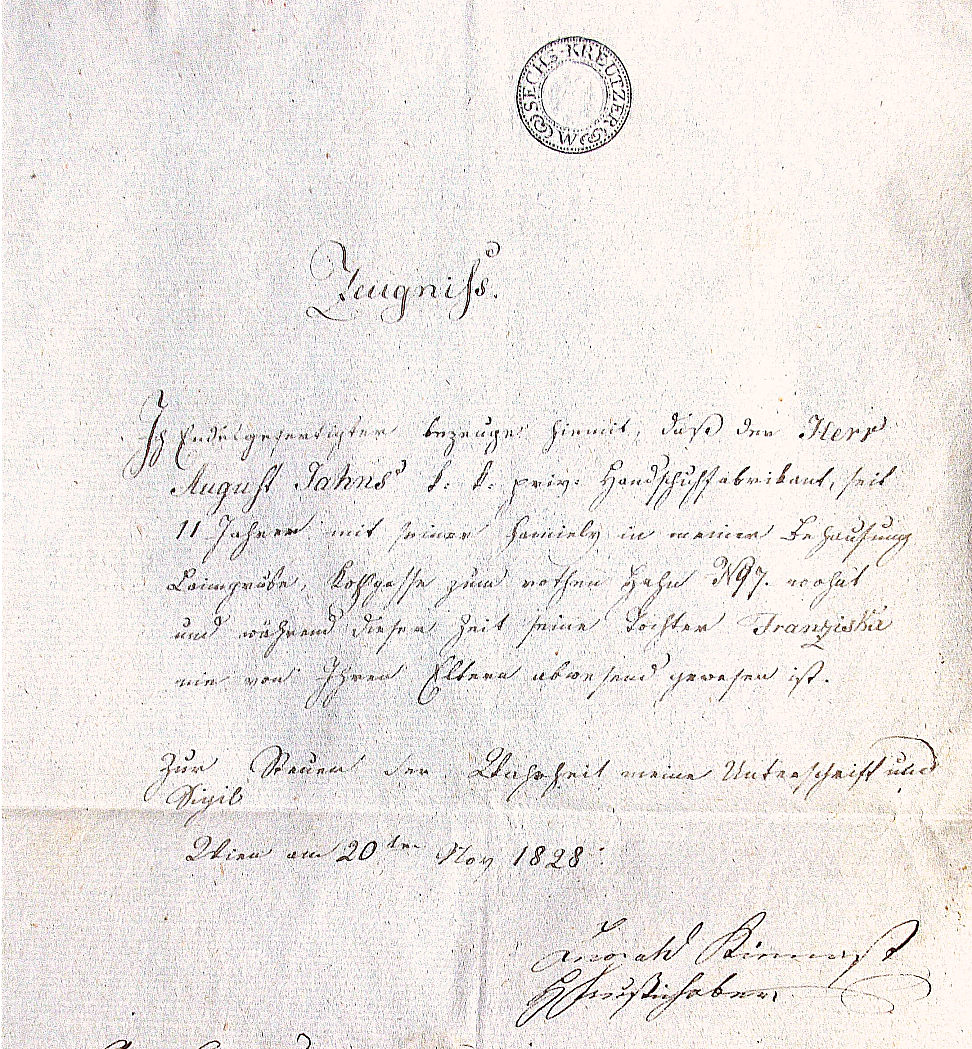
Around 1825 Ferdinand Kimm purchased the house Laimgrube 146, "Zur Goldenen Sonne" (The Golden Sun, today Gumpendorfer Straße 46). This may have brought him into contact with the family of the glover August Jahns, Joseph Lanner's future father-in-law, who lived right opposite Kimm's house, at Laimgrube 97, "Zum
Rothen Hahn" (The Red Rooster, today Gumpendorfer Straße 47).

The houses Laimgrube 146 and 97 opposite each other on the Kothgasse (today's Gumpendorfer Straße) circled in red and Windmühle 28, Katti Lanner's place of birth, circled in blue.
After his first marriage attempt with an innkeeper's daughter had failed, Lanner, on 24 November 1828, married his childhood friend Franziska Jahns. For about a year, the couple lived in Lanner's apartment at Windmühle 28 ("Drey Hacken", today Windmühlgasse 7) where on 14 September 1829, their first child was born and christened Katharina Josepha on the following day at the parish church of St. Joseph ob der Laimgrube. Katharina Kimm served a godmother of Lanner's all in all third (and first legitimate) child.
The entry concerning the baptism of Joseph Lanner's daughter Katharina Josepha on 15 September 1829, with Katharina Kimm's signature as godmother. The words "Fleischhauers Gattin Laimgrube N 146" were added by the officiating priest Thomas Hitzinger (St. Josef ob der Laimgrube, Tom. 18, fol. 160).
Katharina Lanner, who described herself as "dancing disciple of Taglioni's and Fanny Elßler's school", debuted in 1843 at the Kärntnertortheater where, for ten years, she was to be the darling of the audience. She became a famous ballerina and toured all over Europe.

Katti Lanner as Esmeralda in a performance of Pugni's
ballet at the Hamburg Stadttheater. Her other famous roles are written into the corners of the decorative frame (A-Wn, PORT_00006911_01).
In 1872, Katti Lanner gave a guest performance in New York, and in 1875, settled in London where she retired as directress of "Her Majesty's" Ballet Troupe at the National Training School for Dancing.

Katti Lanner did not know the exact address of her place of birth. When in 1878 Josef Wimmer asked her, she misremembered and mixed up the house Windmühle 28 (where she was born) with the house "Zum Rothen Hahn", Laimgrube 97: "denn ich selbst war noch ein Kind als mein Vater starb und kann mich nicht mehr entsinnen. Als ich geboren wurde wohnte mein Vater in der Kothgaße Laimgrube beim rothen Hahn" ("because I was still a child when my father died and cannot remember. When I was born my father lived in the Kothgasse on the Laimgrube at the Red Rooster").

Katti Lanner misremembering her place of birth in a letter written on 10 October 1878 to Josef Wimmer (A-Wst, H.I.N. 20137/1).

Joseph and Franziska Lanner with their first child "Tocht[er] Catharina 829" on an 1830 conscription sheet of Windmühle 28. Note Lanner's date of birth being given as "12 April 801" (A-Wsa, Konskriptionsamt, Windmühle 28/60r). The latest literature on Lanner's Viennese residences (mostly written by Herbert Krenn and Helmut Kretschmer) is a curious mixture of oversights and errors.
Before July 1830, Lanner moved to Laimgrube 97 which is proved by the birth of his son Joseph Ferdinand on 23 July 1830 in this house. As the child's godfather signed "Anton Kimm, bügl. Fleischhauer Meisters Sohn Laimgrube Nro 146". Ferdinand Kimm's son Anton had been born on 7 June 1813, in Gumpendorf (Gumpendorf 16, fol. 41). By 1830, he was his parents' fourth eldest child and like his elder brother Ferdinand (b. 1806) he also became a butcher. He was to die on 18 July 1866 (St. Josef ob der Laimgrube, Tom. 14, fol. 206).

The entry concerning the baptism of Joseph Ferdinand Lanner on 24 July 1830, with Anton Kimm's signature (St. Josef ob der Laimgrube, Tom. 18, fol. 216)
The baby boy Joseph Lanner was put into care with the shoemaker Johann Glatzl and his wife Eleonore at Altlerchenfeld 209 (today Lerchenfelder Straße 129) where he already died on 6 February 1831, of hydrocephalus (A-Wsa, Totenbeschreibamt 169, lit. L, fol. 3v). This baptism was the last documented contact between the Lanner and the Kimm families. The godparents of Lanner's four later children were the cafe owner Augustin Corti (dedicatee of Lanner's "Paradies Soirée Walzer" op. 52), and Corti's mother Franziska Corti, née Hofmann. There is yet another, hidden connection between Katharina Kimm and Joseph Lanner of which none of the people involved probably ever became aware: on 16 February 1817, Katharina Kimm's father Ambros Batzl served as best man at the wedding of the grocer Wolfgang Kraus (Weinhaus, Tom. 2, fol. 52) whose daughter Marie Kraus, in around 1838, became Lanner's mistress, and in 1843 bore Lanner's posthumous son Carl Joseph Maria (Lorenz, 2006/07).
The Stauffer Connection
Ferdinand Kimm was a successful butcher and a relatively wealthy man who had enough money to invest in promising enterprises. His probate papers show that already in January 1820 he invested 15,000 gulden Viennese Currency into Joseph Danhauser's furniture factory. When his father Ferdinand Kimm died on 9 February 1831, at the age of 84, he came into possession of even more money. The value of the house Neubau 80 alone was estimated at 19,500 gulden and Ferdinand also got back the 4,000 gulden that he had lent his father.

Around 1830, Ferdinand Kimm began squandering away his assets which was obviously caused by minor strokes and kidney problems that weakened his mental capacities. He began to buy overpriced junk and gave out bills of exchange to all kinds of people whose intentions were clearly not benevolent. Somehow Johann Georg Stauffer had received word that money was easily available on the Laimgrube. On 30 October 1830, Kimm was declared bankrupt (Wiener Zeitung, 8 Nov 1830, 855), and in the course of the lawsuit, which Stauffer filed at the Vienna civil court against the bankrupt's estate, it became apparent that already on 1 April 1830 (against the loud protests of his wife), Kimm had given Stauffer a debt obligation of 4,000 gulden which was collateralized by Kimm's house on the Laimgrube. All the creditors who had also received bills of exchange appeared as witnesses in the trial against Kimm's bankrupt estate: he owed Franziska Wellisch, née von Hönigsberg 3,000 gulden, to a Herr Kattner 1,000 gulden, and there were many more people who produced bills signed by Kimm, and now filed their legal claims. The records of the lawsuit give Johann Georg Stauffer as "Zeugenführer", i.e. leader of the witnesses who supported his claims. Stauffer's legal representative was Dr. Karl Eckel, Kimm's was Karl Hönig the younger. Katharina Kimm claimed that Stauffer had deceived her husband by telling him that he was just signing an obligation as a witness and not as a debtor. All of Stauffer's witnesses contradicted Katharina Kimm and thus, she could not prove Stauffer's fraudulent intent. The following passage from the summary of the lawsuit provides a telling picture of the events at court.

The seal on the will of Ferdinand Kimm senior, a classic seal of a Viennese butcher (A-Wsa, Patrimoniale Herrschaften, Herrschaft Stift Schotten, II. Reihe, 33954)
Around 1830, Ferdinand Kimm began squandering away his assets which was obviously caused by minor strokes and kidney problems that weakened his mental capacities. He began to buy overpriced junk and gave out bills of exchange to all kinds of people whose intentions were clearly not benevolent. Somehow Johann Georg Stauffer had received word that money was easily available on the Laimgrube. On 30 October 1830, Kimm was declared bankrupt (Wiener Zeitung, 8 Nov 1830, 855), and in the course of the lawsuit, which Stauffer filed at the Vienna civil court against the bankrupt's estate, it became apparent that already on 1 April 1830 (against the loud protests of his wife), Kimm had given Stauffer a debt obligation of 4,000 gulden which was collateralized by Kimm's house on the Laimgrube. All the creditors who had also received bills of exchange appeared as witnesses in the trial against Kimm's bankrupt estate: he owed Franziska Wellisch, née von Hönigsberg 3,000 gulden, to a Herr Kattner 1,000 gulden, and there were many more people who produced bills signed by Kimm, and now filed their legal claims. The records of the lawsuit give Johann Georg Stauffer as "Zeugenführer", i.e. leader of the witnesses who supported his claims. Stauffer's legal representative was Dr. Karl Eckel, Kimm's was Karl Hönig the younger. Katharina Kimm claimed that Stauffer had deceived her husband by telling him that he was just signing an obligation as a witness and not as a debtor. All of Stauffer's witnesses contradicted Katharina Kimm and thus, she could not prove Stauffer's fraudulent intent. The following passage from the summary of the lawsuit provides a telling picture of the events at court.
Katharina Kimm's testimony shows that, in order to calm down Katharina Kimm, Stauffer already at that time applied the white lie that her husband had only signed as witness and that the statement E in question was given to Katharina Kimm and not her husband to calm her down. Regarding question 18., the witness Johann Mayer claims that the fact, that, while Kimm's wife was arguing with Stauffer, Ferdinand Kimm stepped on Stauffer's foot and requested him through signs to leave her alone, points to an agreement between Stauffer and Kimm concerning the appeasement of Katharina Kimm.

The first page of an 1836 summary of the "Sachverhalt" of the lawsuit of Stauffer vs. Kimm (A-Wsa, Mag. ZG, A5, 271/1832)
Kimm lost the lawsuit, but he was able to save the family house on the Laimgrube, which already in 1830 had been transferred into his wife's property. In his probate file he is described as "gewes. Hausinhaber" (former house owner).
Ferdinand Kimm's condition with the word "gewes." inserted before his state as "Hausinhaber" (A-Wsa, Mag. ZG, A2, 6919/1835). The handwriting is that of Anton Slabe (1787–1860) who is mainly known for having been the Sperrskommissär of Franz Schubert's estate.
After the loss of the lawsuit, Katharina Kimm decided that she had enough. On 1 May 1833, she submitted an official petition to the civil court of the Vienna Magistracy to have her husband declared legally insane and to have him put under the guardianship of his son-in-law, the butcher Vincenz Haas. Since her petition is of great historical interest and provides a much better description of the course of events than the records related to the preceding lawsuit, it is presented here in its entirety.

The first page of Katharina Kimm's 1833 petition to the civil court to have her husband declared legally insane (A-Wsa, Mag. ZG, A3, 643/1833)
Honorable Magistracy!According to the medical certificate A., my husband, the civil butcher Ferdinand Kimm, is suffering from one of the gravest illnesses, from kidney stones. About 9 or 10 years ago, the first heavy onset occurred which for a time of eight days put him between life and death, and made him bedridden for 15 days.
This first onset was followed by almost annual, equally severe onsets which for 5 or 6 years have been accompanied by new devastating bouts, such as inflammations that multiplied in number and severity in such a way that my husband has been mostly bedridden for the last two years.
The result of this illness and the accompanying sufferings was a significant decline of my husband's mental capacities which according to the above-mentioned certificate A, in the course of several years, has reached a point that my husband is utterly unable to estimate and judge the results of ordinary actions and enterprises.
In order to explain the medical certificate concerning the point of insanity, I take the liberty to only mention a few of the unfortunately large number of facts which characterize the state of my husband's mental powers.
When we built the rear part of our house, the construction, which had already advanced significantly, collapsed. The investigation revealed that there had been no adequate foundations. Therefore a strong wall was erected in the cellar on which the construction was continued and completed. In the year 1827 my husband proceeded to have this wall torn down again. All my protests were in vain and only our son-in-law, the civil master butcher Mr. Vincenz Haas, who also signed this petition, succeeded in keeping him from the realisation of this plan which may have led to the unavoidable collapse of the whole building. In the ice cellar there is an indentation in the form of a well which serves the purpose of absorbing the water that is released from the ice. Such an indentation is always carefully sealed with clay to prevent the access of spring water that may be in the ground, – because its different state of temperature has a negative effect on the temperature of the cellar; hence these indentations are designed as shallow as possible.
When I was in Baden in 1828, my husband hired people and had this indentation, which fully served its purpose, regardless of the water level of the nearby fountain, dug up so deep that a rich water vein was opened which quickly flooded the whole ice cellar.
Only with great efforts and high expenses was it possible to remove the water and to fill up the pit that had been dug. A full restoration of the cellar was not even possible, because the stonework had taken significant damage from the water. My undersigned son-in-law also confirms this fact.
One year later, towards the end of winter, he had 8 to 10 loads of ice transported, and, in spite of my protest, had it put into a storage room on the ground floor of our house. That the ice, because of the ensuing mild weather, soon melted and flooded the yard and the doorway would have been the least, but a significant drawback was the damage that the water had done to the walls of the shop.
Beside our children and the aforementioned son-in-law this fact is also known to the civil master tailor Joseph Huwerth, who, for this reason, has also signed the present petition.
In our house a lot of rosaries, prayer books, pictures of saints, tobacco boxes, tobacco pipes and sticks can be found and in general all kinds of things that are offered at small stalls in the streets, everything of the lowest and worst kind and totally worthless. All these items were bought by my husband, at prices about which one would want to throw the hands up in despair.
Once he brought home a coffee table cloth for which he had paid 50 gulden and which was not even worth 25 Groschen.
If somebody approaches him, especially if he is an acquaintance, or can really lament, he can be sure to receive everything that he [my husband] is carrying on him.
Because of this and because of his irrepressible passion for buying worthless things, I have established the custom among the children that, as soon as he is about to go out, one or the other is ready to accompany him.
Unfortunately, he only too often was able to fool my and the children's attention and sneaked away from the house alone.
With a sad heart I have to say that in such a case the children already laugh as soon as they see him coming home, because they can count on some worthless purchase to be unpacked and praised.
His bill transactions with the scheming Jew Fanny Wellisch and the habitual debtor Georg Stauffer, which eventually led to his bankruptcy, belong to the same line of events.

"Seine Wechselgeschäfte mit der intrikanten Jüdin Fanny Wellisch und dem Schuldenmacher Georg Stauffer, die späterhin die Konkurseröffnung über sein Vermögen herbeiführten, stehen auf der selben Linie." (A-Wsa, Mag. ZG, A3, 643/183)
Never in his life, my husband has signed a bill of exchange and he never ever knew anything about such bills. For my purpose it is not worth the effort to investigate what those bills of exchange were all about; it is beyond doubt that Fanny Wellisch, who lives on the charity of her relatives, and Georg Stauffer, who is a habitual inmate of the debtors' prison, or is at least in constant danger of winding up there, are definitely not the people, for whom a man, who is in control of himself, would accept or sign bills of exchange, or contract any obligations at all.

"[...] daß die Fanny Wellisch, die von den Wohltaten ihrer Verwandten lebt, und Georg Stauffer, der gewöhnlich im Schuldenarreste wirklich sitzt, oder doch unter der Gefahr desselben schwebt, durchaus nicht die Leute sind [...]" (A-Wsa, Mag. ZG, A3, 643/183)
Ferdinand Kimm Katharina KimmSince the declaration of bankruptcy, his physical ailments have increased and his health has worsened like his mental powers.
In the winter before last, during the hardest frost, he had water sprayed in front of the house which of course immediately resulted in a layer of ice and almost caused unpleasant conflicts. Everybody knows that horses that are heated have to be let cool down before they are washed or given water. Last summer our horses returned steaming from their hard work. On my husband's command the servant immediately had to wash them, because this would have done them very good. The next day both of them were stiff, as was to be expected, and they remained stiff in spite of all applied remedies.
I have to witness such events in the house on a daily basis and especially in his behavior towards the children, even towards the ones he liked best.
It would hurt me too much to go into details in regards of this behavior.
I would have observed the strictest silence concerning the unfortunate state of his mental powers anyway, – however a series of important observations now come to mind, the worry alone, what mischief he could cause, if, in the case of my death, he would be put into paternal power under the premise of having a sane mind, would justify my request to have him declared legally insane.
In confirmation of the correctness of the described facts, all our full-aged children, as well as our son-in-law Vincenz Haas and the civil master tailor Mr. Joseph Huwerth, who is well acquainted with our family, have signed the present petition; even my husband agrees with my application and has therefore signed it. As guardian I propose my son-in-law Mr. Vincenz Haas who has run the business on commission of the bankrupt's estate and who declares with his signature to be willing to accept this appointment.
Thus I submit the obedient request that
The honorable Magistracy may deign to put my husband, the civil master butcher Ferdinand Kimm at Laimgrube N° 146 under guardianship, owing to legal insanity and to appoint the civil butcher Vincenz Haas in Mariahilf N° as his guardian.
Joseph Huwerth Vincenz Haaß
civil butcher as administrator of the estate
Katharina Haaß née Kimm
Ferdinand Kimm junior
Theresia Kimm

The signatures under Katharina Kimm's petition
On 28 May 1833, Ferdinand Kimm was officially declared legally insane and on 14 June 1833, the edict was published in the Wiener Zeitung.

Ferdinand Kimm died of a stroke on 4 December 1835, at 11 p.m., and was buried two days later in the Schmelz cemetery. He was survived by his wife and seven children of whom three were of legal age. According to Kimm's probate file, he had been unable to run his business for several years and with the permission of the Magistrate had given all his furniture and the butchery equipment to his wife. A part of his clothes had been sold to cover the expenses of the treatment of his long and complicated illness, the rest had been given away. His main asset was the house Neubau 80 that he had inherited from his father and which was estimated at 19,500 gulden. Because his son Ferdinand owned a share of 4,000 gulden of this house, Kimm's estate amounted to 15,500 gulden WW (Viennese Currency), a sum that was divided among Kimm's three nephews, one niece and his seven children. Owing to the bankruptcy of the furniture manufacturer Joseph Danhauser (an event that is totally ignored by the Danhauser literature), the amount of 15,000 gulden WW (6,000 gulden CM) that Kimm, in 1820, had invested into Danhauser's furniture factory was uncollectible.

The signatures of Katharina Kimm and five of her children in her husband's probate file (A-Wsa, Mag. ZG, A2, 6919/1835)
Katti Lanner's godmother Katharina Kimm, whose common sense had basically saved the Kimm family from total bankruptcy, died of old age on 6 May 1863, at Gumpendorfer Straße 54 where her son Anton had re-established his father's butchery. Unfortunately, only one leaf of her probate papers survived. It is an "Einantwortungs-Urkunde" (a certificate of handing in) from 1880 of a part of Katharina Kimm's inheritance to her last surviving son Ferdinand and his two children (A-Wsa, BG Mariahilf, 4A, 835/1863).
In 1833, Johann Georg Stauffer was able to temporarily extract himself from his financial difficulties by resigning from his business and transferring his license in 1836 to his son Anton. Of course, Stauffer's financial problems were not over. In 1839, they caused him to temporarily move to the (at that time) Hungarian town of Kaschau (A-Wsa, Konskriptionsamt, Passprotokoll B4/28, fol. 142). But this is a different story.
Bibliography
Grünsteudel, Günther. 2007. "'Bähr blies wie ein Gott' – Der Klarinettist Franz Joseph Beer (1770–1819)". Rohrblatt 23, 151-57.
Lorenz, Michael. 2006/07. "Familie Trampusch - geliebt und totgeschwiegen", Jahrbuch des Vereins für Geschichte der Stadt Wien, Vol. 62/63, 2006/2007, (Vienna: Verein für Geschichte der Stadt Wien), 135-49.
–––––––. 2015. "Six More Unknown Godchildren of Joseph Haydn" (Vienna: Internet publication).
Pisarowitz, Karl Maria. 1973. "Der Bär, den man uns aufband. Differenzierungen ewig Verwechselter". Acta Mozartiana 20, 62–67.
Pohl, Carl Friedrich. 1871. Denkschrift aus Anlass des hundertjährigen Bestehens der Tonkünstler-Societät. Vienna: Selbstverlag des "Haydn".
Updated: 25 August 2024