Showing posts with label Constanze Mozart. Show all posts

May 19, 2014

Agnes Selby: Constanze, Mozart's Beloved (Wien: Hollitzer Wissenschaftsverlag 2013)

Why the Hollitzer Wissenschaftsverlag published a second edition of this smorgasbord of howlers, whose first edition, in 1999, had already been the laughing stock of Mozart scholarship, is a total mystery. Agnes Selby is completely ignorant of the recent Mozart literature. She has to quote Mozart's letters from Emily Anderson's out-dated edition and simply repeats all the old popular nonsense that has been debunked ages ago. This book literally runs over with hogwash and could be turned into a successful comedy program, easily providing endless laughter for attendees of a meeting of musicologists.


A piece of popular literature like this does really not deserve a detailed review. But because this opus has been republished and contains passages that are outrageously funny, I want to quote some of them and point out some of the most glaring mistakes it contains. Selby has an uncanny ability to create what I call "Selbyisms": statements that sparkle with so much nonsense that they are irresistibly funny. For example (from p. 96): 
Mozart had more immediate problems. He was known to be a Freemason and the French revolution had been fostered by French Freemasons who were in contact with their Viennese brethren. King[sic!] Leopold's secret police were well informed about the Lodges in Vienna and soon those connected with Freemasonry were discharged from their government posts.
Where to begin in the face of such ignorance? After the unification of the Lodges by Joseph II in 1785, the Freemasons had to register by name. They were completely harmless and under control. Hence, they posed no threat at all to the Court, and nobody was discharged from a government post. Even professors at the Vienna University (such as Franz Schubert's patron Heinrich Watteroth) were Freemasons. The French Revolution had not "been fostered by the French Freemasons" (it is immensely funny to imagine those French Freemasons beating down the Bastille with their trowels and to visualize all the suddenly unemployed noblemen wandering the streets of Vienna). Mozart's Vienna is presented as a kind of fairytale paradise. That nonsense like this is being published in 2013 by a publishing house that calls itself a Wissenschaftsverlag is truly amazing:
The Vienna that Constanze encountered was unlike any other city in Europe. The population was so homogeneously united that only the epithet 'Viennese' fits its description. There was no question of 'nationality' as such among the inhabitants of Vienna, where Magyars, Bohemians, Slovaks and Slovenes, Germans, Italians and Poles rubbed shoulders in good humour. (p. 23)
This description of the eighteenth-century Viennese population is completely false and obviously caused by Selby's mistaken concept that the Ringstraßenzeit of the late 1900s – when huge numbers of people from all parts of the monarchy moved to Vienna – took place one hundred years earlier. Mozart's Vienna was not "unlike any other city in Europe", and, at that time, only an extremely small part of the city's population were foreigners.
The modest sum of 31 kreutzer would purchase a meal consisting of two meat dishes, soup, vegetables and unlimited bread with a litre[!] of wine. Because people were generous, even industrious citizens accepted the fact that some individuals might prefer begging to working, extreme poverty was practically nonexistent and those who made begging their profession often profited handsomely by it. (p. 23)
Of course, the price of 31 kreuzer for such a meal is based on pure fantasy. And extreme poverty could be found everywhere in Mozart's Vienna. Here is another classic (from p. 32): 
In an amazing display of ill-will Leopold Mozart accused Constanze of being a slut.
Of course, Leopold Mozart did no such thing, and this insult cannot be found anywhere in the Mozart letters. Selby's slanderous claim (which she has repeatedly presented on various Mozart websites and internet forums) is based on her deep hatred of Leopold Mozart and her pathological jealousy of all people, who, in her opinion, were not fond enough of Constanze. There are more of these priceless statements (p. 71):
Mozart had many opportunities to gamble. Mozart's concerts at the Mehlgrube Casino were always followed by gambling tables being set up to allow the aristocracy to participate in their favorite sport. [...] Gambling was also endemic in Salzburg.
There was no public gambling in Joseph II's Vienna, because gambling (except for the state lottery) was illegal. It was also illegal in deeply Catholic Salzburg. That "men would gamble at street corners" in Salzburg (as claimed by Selby) is pure nonsense. All through her book, Selby mistakenly thinks that the word "Casino" refers to a gambling venue. The word Casino, in eighteenth-century Vienna, referred to a venue for social gatherings and events. The book's low scholarly flight level becomes apparent in Selby's imagining Mozart in Prague, losing money to Casanova in a series of card games: 
Casanova was an inveterate gambler who could never resist tempting his friends with a game of cards and it would not be inconceivable that Mozart lost considerable sums to him." (p. 85)
One can only wonder: where was Constanze and why could Mozart's guardian angel not forestall her husband's nightly activities? Emperor Franz II – one of the most hardworking monarchs of all time – is described by Selby in the following inimitable way:
Franz II lived through this period as though in a dream, occupying himself with gardening, attending to his family and walking through the streets of Vienna dressed as just another burgher enjoying a bit of window shopping.
Some of the most glaring nonsense to be found in this book is already well-known from Selby's longstanding and relentless self-praising activities on the Internet. The problem is that all these sparkling bloopers should really not be republished in 2013. Here are some of the most impressive examples (and this list is far from complete):
  • That Joseph Lange signed a document "which bound him to grant his widowed mother-in-law an annual income of 700 ducats" (p. 23) is, of course, false. Lange promised to pay Cäcilia Weber 700 gulden which is less than a quarter of the sum given by Selby. That at the time of her wedding, Aloysia Weber was already pregnant is still an unproven assumption.
  • That Gottfried van Swieten was "dismissed from the Imperial Service on suspicion of participating in the Freemasons' conspiracy of 1791" (p. 35) is a piece of gross misinformation that Robbins Landon presented in his book Mozart: The Golden Years. There was no "Freemasons' conspiracy of 1791". Van Swieten was dismissed by the Emperor "in good grace", because of their differing views concerning the universities' role in science and the freedom of education which was part of van Swieten's political concept.
  • Like many amateur Mozart researchers, Selby mixes up the family of Adam Isaac Arnsteiner (1721–1785) with that of his daughter-in-law Fanny Arnstein. Fanny Arnstein did not "occupy the house at Graben No. 1175" (p. 35), her father-in-law Arnsteiner lived there as subtenant on the second floor.
  • "Johann Thorwart was an altogether unpleasant and unsavory character". We have absolutely no documentary information concerning Thorwart's character. Selby is just jealous of him and picks her negative judgement out of thin air.
  • Selby is unable to let go of the story regarding the music supposedly performed at Mozart's wedding dinner: "During the dinner Constanze was surprised by the unexpected performance of Mozart's Serenade in B-flat (K. 361)." (p. 40). This alleged performance is a myth which may have been caused by a sentence that was willfully added into one of Mozart's letters in Nissen's Mozart biography. There is absolutely no documentary evidence to support it.
  • On p. 50 Selby claims that, on the occasion of the christening of Mozart's first child Raimund Leopold, on 17 June 1783, "Baron Wetzlar could not be present due to the death of his father". What looks like very educated information, is based on pure fantasy. Wetzlar's father Karl Abraham Wetzlar von Plankenstern only died on 3 September 1799 (Wiener Zeitung, 11 September 1799, p. 3063). 
  • The information that "Neustift suburb No. 250 is now Lerchenfelder Straße[sic!] No. 65" (p. 52) is false. As Hans Rotter published in 1925, and as I have explained on this blog, it is Mariahilfer Straße 94.
  • That Mozart "composed the two duets for violin and viola for Michael Haydn [...] who was ill (supposedly due to heavy drinking)" (p. 53) is a fairy tale that has been debunked by Mozart scholarship a long time ago. It should really not reappear in a book released by a publishing house that calls itself Wissenschaftsverlag.
  • Maynard Solomon's estimates concerning Mozart's income, which Selby copied into her book, are based on speculation. They have absolutely no basis in archival sources.
  • "The banns for their marriage were read at the Theatines Chappel." (p. 39) No, they were not. Everybody who has seen Mozart's marriage entry knows that he and Constanze were exempt from the three readings of the banns. Furthermore, no banns were ever read at this chapel, because it was not a parish church. Mozart and his bride visited this chapel to go to confession and to get the "Beichtzettel" (certificates of confession) which they needed for the wedding.
A typical Viennese "Beichtzettel" of the composer Joseph Eybler (A-Wkhm, Archiv der Burgpfarre)
  • "After Lodge meetings, Mozart would join his brother Freemasons at the Cafe Jüngling, whose owner, Johann Jüngling belonged to the Lodge 'Zur neugekrönten Hoffnung'. There the men would sit down to dinner after which they gambled well into the early morning." (p. 63). There was no "Cafe Jüngling" in 1785, because Johann Jüngling (1762–1835) became the owner of this coffee house only in 1791. There was also no gambling at this Cafe. The whole scenario of this supposed "Freemasons' Casino" is the product of one of Selby's countless brain bubbles, obviously triggered by abysmally flawed secondary literature.
  • The "ballet story" concerning Le nozze di Figaro is nice, but it has been shown ages ago that it is purely fictional. There is no documentary confirmation that dancers were hired for the complete production of Figaro in 1786.
  • Franz de Paula Hofer's annual salary in 1788 at St. Stephen's Cathedral was 25 gulden, but (just like another writer, who in her new book calls Hofer a "penniless violinist") Selby is unaware of the fact that Hofer was a court musician and held several well-paid jobs simultaneously. Why should Josepha Weber have married a poor church mouse? At the time of his death, Hofer was making 360 gulden a year at the Court and 100 gulden at St. Stephen's, and he had additional jobs in other churches. Selby's claim (p. 142) that he "left Josepha and their daughter burdened with enormous debts" is simply false. Franz Hofer's debts were managable, because, unlike Mozart, he had actually joined the Tonkünstler-Sozietät to secure the livelihood of his widow and child. Between the death of her first husband on 14 June 1796, and her second marriage on 23 December 1797, Josepha Hofer was paid a pension from the Tonkünstler-Sozietät which, according to § 15 of the society's regulations, in 1797 was passed on to her daughter who received it until 1813, the year she married Karl Hönig.
An unpublished document, issued on 21 July 1788, by the "Stadtwiener Conscriptions Amt", stating that Franz Hofer "is 31 years of age, Catholic, was born in Vienna, is employed as K.K. Hof-Capell Musicus, has been living at Stadt 587 for twelve years", and that "the conscription office does not object to his marriage". The information in the Dokumente that Hofer only became a court musician in 1789 is false.
  • Landstraße No. 224 was not "a large house". It was rather small. The Danish actor Joachim Daniel Preisler did not visit the Mozarts in 1787 at Landstraße No. 224, but in 1788 at Alsergrund No. 135.

A groundplan of the front section of the house Landstraße No. 224 where Mozart lived in 1787 (A-Wsa, Unterkammeramt, Baukonsens 87/1833)
  • Nannerl Mozart did not "retain all the valuable gifts given to the young Mozart". The list, which was drawn up on the occasion of the auction of Leopold Mozart's belongings, proves that those gifts had been sold by Leopold many years earlier. Selby's description of the distribution of Leopold Mozart's estate is based on Solomon's erroneous speculation and is therefore completely false. Nannerl did not "receive 6,000 to 10,000 florins from her father". As I explained in detail in 2012, Solomon's theory is based on a miscalculation of Nannerl's heritage from her husband, who not only bequeathed to his widow an annual pension of 300 gulden from the interests of her children's share, but also the main share of his estate of 22,000 gulden. Selby's descripton of the events after Leopold's death is rife with unfounded speculation and – as always – driven by hatred against all of Constanze's "less well-meaning" contemporaries. That Mozart "received punishment through Leopold's will" is a classic "Selbyism". Selby is ignorant of the sources and the literature dealing with Leopold's estate.
  • Gluck did not receive "a lavish funeral." As a matter of fact, this funeral was performed "in der Stille" (without music) and only cost 28 gulden 49 kreuzer (of which 12 gulden were paid for the carriage with four horses to the Matzleinsdorf Cemetery).
The entry concerning Gluck's modest obsequies on 17 November 1787 at Vienna's Paulanerkirche: "NB: Ist in der Stille Eingesegnet worden" (A-Wd, Bahrleihbuch 1787, fol. 408v)
  • In 1787, Mozart did not earn "1,700 florins in Prague". This estimate is based on Maynard Solomon's flawed presumption.
  • Selby writes: "On December 7, Mozart was appointed to Gluck's vacated position as Chamber Music Composer to the Viennese Court" (p. 86). No, he was not. a) Gluck's position was not that of a "Chamber Music Composer to the Viennese Court". Gluck held an honorary position as a supernumerary which also explains his high annual salary of 2,000 gulden. b) Mozart was not appointed "Chamber Music Composer", but "k.k. Kammermusikus" which is a huge difference and explains the modest annual salary of 800 gulden that came with that position.
  • That Mozart's begging letters to Puchberg are proof for his poverty in 1788 is an out-dated point of view. At this time, Mozart was living in a 300m2 apartment for which he paid an annual rent of 250 gulden. He also owned a horse and a carriage. Of course, he shamelessly took advantage of a well-to-do brother Mason. The suggestion that Mozart's begging letters were mostly theatrical scrounging efforts (which I first published in 2012 in my review of Günther Bauer's book Mozart. Geld, Ruhm und Ehre) has been echoed in a 2014 interview by Nikolaus Harnoncourt who (to nobody's real surprise) disingenuously presented my concept as his own brilliant idea.
  • Selby's account of the origin of Così fan tutte is based on the out-dated popular literature and is therefore worthless.
  • "Theresia von Trattner stood godmother for the little girl and the christening took place in St. Peter's Church". As I have shown in 2009, Theresia Mozart's christening did not take place in St. Peter's Church, but in Mozart's apartment.
  • Prince Lichnowsky's 1791 lawsuit against Mozart had nothing to do with gambling. As a matter of fact, gambling debts were classified as "Naturalobligationen" (so-called imperfect debt relations) and therefore their payment could not be claimed in a court of law. Debts incurred from illegal gambling, on the other hand, were legally void, i.e. they did not exist at all in the eyes of the law. Hence, they could not be considered "Naturalobligationen". On 20 February 1753, Maria Theresia had issued a Patent die hohen Spiele und Wetten betreffend, ruling that "von niemanden, was er auf Borg verspielet, es mag wenig oder viel seyn, dem Gewinner, wenn selbser schon derentwegen eine schriftliche Recognition in Händen hätte, etwas bezahlet, noch der Verspieler von einer Obrigkeit hierzu angehalten werden soll" ("Nobody, who has gambled away money, be it little or much, should be forced by the authorities to pay the winner, even if this person is in possession of a written recognition."). The only gambling contracts that were legally valid were those concluded in connection with legal gambling, such as the official state lottery. Selby's repeated description of Mozart's debts as having been caused by gambling is comparable to the plot of Groundhog Day transferred into late eighteenth-century Vienna.
  • Walther Brauneis did not come across information "in a Logbook of the Special Courts of Aristocrats" (Selby will never understand the correct name of this source). The entry that Otto Mraz found (and Brauneis then mistranscribed and published with a wrong date) is located in the 1791 Cameralprotocoll (FHKA NHK Kaale Ö Bücher 94) of the I. & R. Court Chamber (today's Finanz- und Hofkammerachiv of the Austrian State Archives).
  • The address "Schulerstraße 816" is wrong. Johann Michael Auernhammer was neither a nobleman, nor a wealthy merchant. Gottfried Ignaz von Ployer was not "a high official of the court". He was a minor "Hof-Agent" who, at the time of his death in 1797, was totally broke. Babette Ployer was not a "von Ployer".
The seal of the Sovereign Military Order of Malta and the signature of its Viennese administrator Johann Michael Auernhammer (A-Wsa, Patrimoniale Herrschaften, Johanniter A12/1, 134/1747)

Seal and signature of Gottried Ignaz von Ployer from 1774 (A-Whh, OMaA 641-20)
  • That in 1789 "the priest of the Church am Hof was able to administer an emergency baptism to Anna Mozart" is false. Selby does not know the sources, the literature, or any other documents related to this child's birth. Mozart's daughter Anna was baptized by the midwife.
  • The idea that Mozart's mass K. 317 was performed at the 1790 coronation in Prague (as Selby claims on p. 97) has been soundly debunked by Mozart scholarship years ago.
  • That Die Zauberflöte "embraced the philosophy of Freemasonry" (p. 101) is a popular misconception that has been refuted in several recent scholarly publications. Die Zauberflöte is not a cryptogram of Freemasonry, but a classic fairy tale opera. Its supposed relation to Freemasonry (which nobody ever noticed back in Mozart's days) is a creation of fanciful twentieth-century writers.
  • In summer 1791, in Baden, Constanze was not – as claimed by Selby – "again housed on the first floor above the butcher's". This error is one of the most ancient "Selbyisms", mostly because for years Selby has relentlessly been repeating it on several online forums. In his letter to Anton Stoll of May 1791, Mozart expressedly referred to Joseph Goldhann's former apartment on the ground floor: "das nothwendigste aber ist; daß es zu ebener Erde seye [...] zu ebener Erde, beym Fleischhacker". Because of her bad feet, Constanze could not live "on the first floor above the butcher's", but had to use the apartment beside the butcher's. 
  • The estimation (copied from Solomon) that "Mozart in 1791 earned 5,000 florins" is of course pure hogwash. The rent for Mozart's apartment at the Camesina house was not "320 gulden for six months" (p. 63). It was 450 gulden for one year. 
  • The claims that "Süssmayr had a gift for composing in the style of famous composers" and that "Süssmayr composed numerous ballets which often lasted for three hours and were performed by the monks" (p. 106) are two other priceless "Selbyisms". That Franz Xaver Süßmayr "died of alcoholism" – as Selby impudently states – is nothing but slanderous malarkey. All surviving documents prove that Süßmayr died of tuberculosis.

The previously unpublished entry concerning Süßmayr's burial in the St. Marx cemetery ("An Lungensucht besch[aut] word[en]"). Note that owing to inflation, this third-class burial cost even less than Mozart's 22 years earlier (A-Wd, Bahrleihbuch 1802-03, fol. 304r).
  • Selby claims that "for La Clemenza di Tito Mozart was paid 1,150 gulden[!], including expenses" (p. 107). This alleged fee is an old myth, based on Mozart's claim in 1789 that he was offered "200 Dukaten und 50 Dukaten Reisegeld" for an opera. But there is absolutely no proof that Guardasoni ever made this offer in 1789, and even less that Mozart actually received this amount in 1791.
  • "Many of Mozart's Zettel were found among Süssmayr's papers in the Hungarian National Library." (p. 162). No, they were not.
  • Not "Jakob Haibel's father had been a tenor in the Schikaneder Company", Haibel himself had been that tenor.
  • Like countless amateur Mozart writers, Selby is unaware of the fact that the name of Mozart's last child was not "Franz Xaver", but Wolfgang. The names "Franz Xaver" only appear in the baptismal register and were never used by the parents. Mozart's last child was always called Wolfgang or "Wowi" by his parents and the claim (appearing all over the popular literature) that Constanze "later changed his Christian names" (p. 34, 163, 250 and 253) is simply false. Selby's claim that "Franz Xaver[sic!] inherited from his father his malformed left[sic!] ear" is just too funny to be commented on.
  • On 4 December 1791, Dr. Closset (which one of the brothers, Nikolaus or Thomas?) was of course not "enthralled by Die Zauberflöte that he refused to come". Closset came from the Burgtheater where Die Zauberflöte was not performed.
  • Mozart's belongings were not "catalogued and assessed for taxation purposes", but to secure the assets for the claims of the creditors. Mozart's debts with Lichnovsky, Puchberg, and Lackenbacher were not included in the official records, because "Constanze did not include them in her list prepared for the public records" (as Selby claims on p. 118), but because these creditors did not come forward to file their claims with the Vienna municipal civil court. A widow had no right to determine what the Sperrskommissär put on the list of passiva of her deceased husband.
  • There was no such name as "Walsegg von Stuppach". The correct name is "von Walsegg". Walsegg did not commission "Johann Martin Fischer to create a tomb". He commissioned the sculptor Benedikt Hainrizi to do this.

The design for the tomb of Countess Anna von Walsegg by Benedikt Hainrizi (1749–1799) (Vienna, Albertina)
  • Selby's bizarre presentation of Franz Schubert as "poor, lonely young man who had struggled in a Vienna barely aware of his existence [...]", and who "had died young and of syphilis[sic!]" (p. 119) makes us very glad that Selby has refrained from writing books about other famous dead people.
  • Selby's claim that Constanze "was listed in the Vienna Archives[sic!] as living in the Palais Liechtenstein in the Dorotheergasse which was near the Michaelerplatz" (p. 147) is just a conglobation of errors. There is no "Palais Liechtenstein" in the Dorotheergasse. Selby seems to have mixed it up with the Palais Dietrichstein, where Constanze also never lived. Constanze resided in the Palais Eskeles which is not located near the Michaelerplatz. Wetzlar von Plankenstern's villa in Meidling was not located "on the Grünberg", but at the bottom of this hill, above the so-called "Steurer Mühl Fahrtweg".
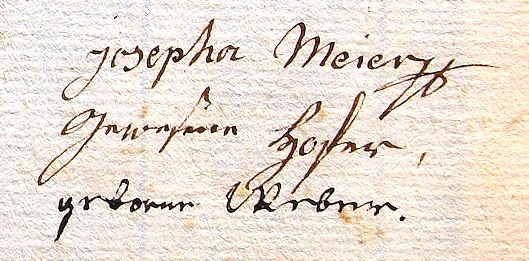
  • The spelling "Friedrich Sebastian Mayer" is wrong. This singer and his wife always signed their names Meier.
Friedrich Sebastian Meier's seal and signature in 1812

 Josepha Meier's signature in 1800
  • Constanze Mozart and her second husband did not get married in Pressburg, because she and Nissen fled from Napoleon's army or wanted to "wait for the storm to blow out". As a matter of fact, in 1809, Pressburg was bombed by Napoleon's army. They went to Hungary, because only there could they get the permission for an interfaith marriage.

In the chapter "Constanze's Second Widowhood" Selby falls into a well-known trap that regularly claims victims among all kinds of enthusiastic amateur Mozartologists: she actually thinks that Leopold Mozart, Euphrosina Pertl, and Genoveva Weber were all buried in the family grave in the cemetery of St. Sebastian in Salzburg. And yet, it has been known for decades – based on the Berchtold von Sonnenburg family papers in Brno – that Leopold Mozart (just like "Theophrastus Paracelsus" as Selby hilariously misnames this historical figure) was not buried in the churchyard, but in the communal crypt of St. Sebastian. The "Mozart family grave" in this cemetery is an artificial site, created by Johann Evangelist Engl for reasons of nostalgia. There were no family graves in today's sense in the eighteenth century. The whole defensive rant, brought forward by Selby against "attacks by Mozartean writers accusing Constanze of desecrating Leopold Mozart's grave by having her aunt Genoveva buried there" is based on ignorance of the literature.

To defend Constanze's absence from her husband's burial, Selby resorts to Philippe Ariès's book Images of Man and Death, but her discussion is completely beside the point. The main issue was not "the wife's place in her home and not at the burial", but the customs related to Josephinism. Constanze was not "forbidden to attend Mozart's burial", she did not even consider to attend it, because it was not customary. At that time, the act of burying a body was no part of the Christian rite as it is today. People bid goodbye to their loved ones at the church and not in the cemetery, a custom that only began to change in the course of the Napoleonic Wars. Selby's musings about "the United States changing western attitudes toward death in the 20th century" (p. 114) have nothing to do with the relevant issues of eighteenth-century cultural life in Vienna. Because Selby is totally ignorant of the intricacies of the Josephinian burial regulations and their partial repeal in 1785, she rehashes all the nonsense about "Mozart having been sewn into a linen sack and having been buried with a reusable coffin". These old misunderstandings have all been refuted and should certainly not resurface in a 2013 publication. Not "eighty-five percent of Vienna's citizenry" received a third-class burial, but ninety-nine percent. Selby extrapolates from a small section of the St. Stephen's burial records which does not represent the situation in all of Vienna's parishes. First-class burials were not (as Selby presumes on p. 117) "reserved for the nobility", but for anybody who was willing to pay for them (this old misunderstanding seems ineradicable). Because Selby's description of the funeral classes is copied from the worst secondary literature (such as Brendan Cormican), it is totally flawed.

Selby repeats her old story about Süßmayr's supposed trip to Kremsmünster Abbey in December 1791, and that after Mozart's death, "Süssmayr was nowhere to be found" (p. 128). Over thirteen years ago, Selby already posed as omniscient archival researcher on public internet forums as follows:
I would like to add that I have serious doubts about Sussmayr working on the Magic Flute which Constanze sold for 100 ducats 23 days after Mozart's death. While working on my book, "Constanze. Mozart's Beloved", I came across Archival evidence at the Vienna National Library, in the archives of Kremsmunster Abbey wherein Sussmayr arrived at the Abbey on 17 December, 1791 in the company of Pater Pasterwitz. It had been Sussmayr's custom to spend Christmas at Kremsmunster where he organised the Christmas festivities. It is also the reason why Constanze could not find him, when pressured for the completion of the Requiem by Count Walsegg's representative and why the Requiem was first handed over to Joseph Eybler who signed for it on 21 December, 1791. Eybler found himself incapable of completing the Requiem and it was then given to Sussmayr on his return from Kremsmunster. I have not been able to find in the archives his departure date from the Abbey. [...] Some further information to iron out one more wrinkle posed by both Carr and Gartner[sic!], Constanze was NOT MAD AT SUSSMAYR when she could not find him after Mozart's death. She was looking for him to complete the Requiem and NOT TO MARRY HER. She could not find Sussmayr because he was at Kremsmunster Abbey making preparations for Christmas festivities which he did every year. Again Kremsmunster archives can be found at the National Library in Vienna. (Agnes Selby on www.openmozart.net, 28 December 2000)
There are no "Kremsmunster archives" at the National Library in Vienna. Apart from that, my on-site research at Kremsmünster Abbey in July 2002 showed that there is no documentary proof that Süßmayr went there in late 1791. The whole story about this Christmas trip is a figment of Selby's imagination. All Viennese sources related to Süßmayr's employment at the Court show that at the end of December 1791, he was working in Vienna at the Burgtheater. Selby has a notorious reputation for fabricating her sources. On 12 June 2001, and on 26 and 27 November 2002, she posted the following statements on the (long defunct) online forum www.openmozart.net.
My studies in the Vienna archives where all Baden records about the comings and goings to and from Baden record that on every occasion Sussmayr was in Baden he travelled with Pater Pasterwitz and not with Constanze. Sussmayr and Pater Pasterwitz were registered at a hotel, the name of which escapes me but if anyone is interested, I would be happy to go through my files. This is very important to understand in order not to perpetuate the lies created by Francis Carr and Heinz Gartner[sic!]. Neither of these two gentleman seems to have taken time for proper research. [...] I checked the Baden records at the Viennese National Library[sic!]. These are records of people coming and leaving Baden. I took as my point of departure the dates of Constanze's presence in Baden. [...] Sussmayr seems to have led a good life, e.g. his trips to Baden. These may have been paid for by Pater Pasterwitz in whose company he travelled. (List of Arrivals and Departures. Baden police file in Archives, Austrian National Library, Vienna). 
There are, of course, no records "about the comings and goings to and from Baden" in the Vienna National Library. None of the archival documents Selby referred to in the above statements do exist, and neither did Selby ever intend to "happily go through her files". Such documents are also not held by the Austrian State Archives. When asked for the location of these mysterious sources, Selby replied: "Records pertaining to this are in Vienna. I am sorry, I do not remember the section in the archives as my research concerned Constanze and the biography I was writing about her." According to Selby, other researchers could not find these sources, "because they lacked the necessary »Sitzfleisch«".

After Dan Leeson, in 2006, had somebody search in vain for these sensational "police records", Selby simply relocated their alleged place of discovery to the Baden City Archives.
Police files from Baden indicate the arrival of Pasterwitz and Sussmayr on at least three occasions and staying together at a hotel in the township. These files are available to researchers in the Baden city archives. (Agnes Selby, 23 November 2006)
The Baden archivist Dr. Rudolf Maurer has assured me personally that these files do not exist. Neither do the Austrian State Archives hold any Baden police files from 1791. The Baden police station was only established in 1809. When Selby was told about Dr. Maurer's statement, she immediately returned to her initial narrative and relocated the fictitious police files back to the Austrian National Library (after all, where else would one expect to find police files?).
As for the Police Files, I know, Mr. Lorenz has had a field day telling me that they do not exist and that they were burnt in a fire. Mr. Lorenz, you know perfectly well that this is not true and the files do exist. Somewhere you have got all this mixed up as the police files rest comfortably in the archives of the Austrian National Library. (Agnes Selby, 17 August 2008)
Needless to say, I had never claimed that "the Baden police files burnt in a fire". Whenever Selby was caught in a lie, she tried to defend herself by producing yet another lie. In 2007, Selby tried to convince the members of an online forum that Alfred Einstein, in his biography of Mozart, had "described the Weber family as useless vagabonds", and "had placed Constanze's sisters as parading in front of Vienna military barracks to catch husbands." (Selby, 11 November 2007). When she was asked to provide an exact quote and a page number to prove these gross accusations, she claimed that she had no access to Einstein's book, because "she had lent it to her daughter Kathryn".

Agnes Selby's fictional sources are not limited to Süßmayr's life. Concerning Mozart's commemorative service, which Emanuel Schikaneder organized on 10 December 1791, she claimed to have received a letter from St. Michael's Church in Vienna.
I wrote to St. Michael's Church and received a polite reply informing me that the singers were listed in the Church records as well as the payment they received from Schikaneder who had organised this Commemorative Service. Although it has often been stated that parts of Mozart's Requiem were performed, I was told that there is no record as to the music performed. (Agnes Selby, 14 August 2008)
This "list of singers in the Church records" does not exist in the parish archive of St. Michael's. It is yet another flimsy figment of Mrs. Selby's imagination. She never corresponded with the staff at St. Michael's who do not even know her name. Selby even claimed to have corresponded with Professor Neal Zaslaw and Robert Levin (or "Levine" as she called him) regarding this issue.
I wrote to St. Michael's Church and was told that although a list of performers exists in the archives of the Church and even how much they were paid, whose Requiem was performed had not been noted. I sent this letter to Dr. Zaslaw who had the same information sent to him. (Agnes Selby, 9 August 2007)
Well it must have been a "ghostie" who wrote to me and to Dr. Levine that the list of performers at St. Michael's Church exists but not what was peformed on that crucial night. (Agnes Selby, 17 August 2008)
It must have been a ghostie indeed, because neither Neal Zaslaw nor Robert Levin ever received any letters from Selby or St. Michael's Church. In August 2004, Selby reported on www.openmozart.net that "an Australian PhD student named Morgan Flannery is currently doing research in the Lichnowsky archive in Prague and will present his findings at a congress in the Mozart Year". This student (originally intended to serve as her sock puppet) also turned out to be one of Selby's countless fabrications. When in 2008 she was asked about Mr. Flannery's research and why he had never published anything concerning the Lichnowsky papers in Prague, Selby simply decided to give Flannery's career an unexpected turn towards family life and to declare the Lichnowsky papers destroyed:
Morgan Flannery lives in London where he has a teaching job. The last I saw him was over a capuccino at the Sydney seaside suburb of Woolloomooloo, where good capos can be found. Morgan has since his Prague adventure got married and has to now "earn his crust". It is true, he has yet to present his findings but I did not realize it was my duty to inform you of his inability to complete his thesis in time. You see, the Lichnowsky files were indeed burnt during World War II by the Germans, and information is difficult to find although he has a good bit of material available. The Germans did a lot of damage to beautiful Prague!!! As a very young and enthusiastic warrior of that era, you must remember it well. (Agnes Selby, 17 August 2008)
It is not quite clear as to whether the words "as a very young and enthusiastic warrior of that era, you must remember it well" were meant to refer to me. The fact that Selby obviously tried to slander me by staging me as Nazi soldier, speaks volumes about her deranged state of mind. I have dealt with Mrs. Selby's amazing concoctions in my article "Süßmayr und die Lichterputzer: von gefundenen und erfundenen Quellen" in the Mozart-Jahrbuch 2006, (Kassel: Bärenreiter, 2008, 425–38).

Selby's book presents a grossly overoptimistic, untrue, and apologetic picture of Constanze Mozart as a flawless saint. This does not correspond to the current state of research and is caused by Selby's only rudimentary knowledge of the scholarly literature. The reissue of Selby's book is a regrettable waste of money and paper. This book has not even come close to an expert musicologist's proofreading eyes, and there is ample reason to presume that not even the publisher bothered to read it with adequate attention. It is a real pity that Selby was unwilling to completely overhaul her work. So many interesting topics related to Constanze Mozart are still waiting to be explored more deeply: Where and when did Constanze move after Mozart's death? Where exactly did Nissen live in Vienna? Why did Constanze reject Schwanthaler's first design of her husband's statue? Who destroyed the many letters of Leopold Mozart? Who is the woman on the supposed "photograph of Constanze Mozart" that, for simple technical reasons, cannot originate from before 1842? What about the early musical career of Karl Mozart who in many Viennese sources is being addressed as "Tonkünstler"?

Karl and Wolfgang Mozart, both addressed as "Tonkünstler" in an 1811 register of the Hauptregistratur of the Vienna Magistrate (A-Wsa, HReg. B1/104, fol. 180r)

Karl Mozart being described as "als Hand[lungs]pr[aktikant] abwesend soll klein seyn" ("absent as business intern, is said to be small") on an 1805 conscription sheet of the Palais Eskeles (A-Wsa, Konskriptionsamt, Stadt 1110/1r). Selby considers it possible that "Constanze feared that Wolfgang might be conscripted into the Austrian army", but in fact both Mozart brothers were exempt from service owing to their small body height. The above entry was first published in 1957 by Gustav Gugitz, but Selby is completely ignorant of the standard German Mozart literature.

Georg "von Niessen" listed as "Dänischer Gesandschafts Rath" on a Viennese conscription sheet from 1805 (A-Wsa, Konskriptionamt, Stadt 4/2r). This entry proves that Nissen already was living with Constanze Mozart in 1805, in the house Stadt No. 4.

The Hollitzer Wissenschaftsverlag did not put any editorial effort into the production of this superfluous book, which is proved by glaring typos such as "Beamarchais", "Greisinger", a "quintet K. 542" (p. 60), numerous missing spaces, and a letter written by Leopold Mozart on "November 17, 1886" (p. 78). It would also have helped if the editors (i.e. the notoriously sloppy Michael Hüttler) had at least done a little research concerning Mrs. Selby's reputation as an extraordinarily imaginative author. While the negative effect of Selby's book had already died down in Australia, her work from the 1990s is now unfortunately being revived in Europe, as if it were a scholarly contribution that meets today's standards.

Selby's book was not the only biography of Constanze Mozart published in 2013. At the same time, the German musicologist Gesa Finke published her dissertation entitled Die Komponistenwitwe Constanze Mozart. This book, which addresses the topic "Mozart's widow" from the perspective of "commemorative and gender studies", also resulted in a massive failure, albeit on an academic level. Finke was completely on her own and had to fulfill her task without any competent help from her incompetent advisor. But this will be the topic of a future blogpost.


Wir sehen voraus, daß wir auch manchmal in den Fall kommen werden, daß ein Liebling der Menge nicht gerade auch unser Liebling sei und wollen die deshalb unvermeidlichen Vorwürfe gern über uns ergehen lassen.

(Goethe: Über strenge Urteile)


© Dr. Michael Lorenz 2014.

Updated: 8 November 2024

Sep 29, 2013

Tadeusz Krzeszowiak: Freihaustheater in Wien 1787-1801 (Vienna: Böhlau, 2009)

The following is an extended version of a review that I published in 2010 on the Web and in the Newsletter of the Mozart Society of America. This book – which is the most amazing festival of Mozart related nonsense published in the last ten years – would normally be of very little interest. But the fact that it was partially funded with Austrian taxpayers' money, makes it worthy of a more detailed treatment. I recently came across a "scholarly" Mozart project (initiated by the Mozartgemeinde Wien and also funded by the City of Vienna's culture department) whose results are so ludicrously worthless that I decided to revisit Krzeszowiak's book and to concern myself with other enterprises of this splendid public institution called "Kulturabteilung der Stadt Wien".


This book makes a formidable initial impression, containing numerous reproductions of well-known images and some less known documents. The author, a professor of engineering, has approached his topic with great enthusiasm; he attempts to collect all the research on the history of the Theater auf der Wieden in a single volume, a project made possible with the financial support of the Austrian Ministry of Science and two Austrian federal state governments. Unfortunately, closer inspection reveals serious problems characteristic of many amateur historians.

Krzeszowiak presents himself as a pioneer, offering new sources to the reader, but he seems unaware of nearly all previous scholarly research on Vienna's Freihaus and the Wiednertheater. He has obviously established his own parallel universe of make-believe Mozart scholarship where he pretends to be a pioneer of archival research. With the exception of a few theater posters (given with erroneous shelfmarks), there are actually no "photos and documents presented here for the first time" as advertised in the blurb. It has been decades since Otto Erich Deutsch and Else Spiesberger published the Linz archival material on the Freihaus, and the plans in the Lower Austrian Federal Archive in St. Pölten were the subject of my presentation in 2006 in Brussels, and my 2008 article "Neue Forschungsergebnisse zum Theater auf der Wieden und Emanuel Schikaneder" in the journal Wiener Geschichtsblätter. Ignaz von Seyfried's "Journal des Theaters an der Wien", parts of which Krzeszowiak presents in transcription (rife with amusing errors and Seyfried's signature presented as "illegible"), has been available complete since 1997 in Stephan Punderlitschek's transcription, and Anke Sonnek has also transcribed much of the manuscript in her 1999 book about Emanuel Schikaneder. Had Krzeszowiak been aware of David J. Buch's publications over the last twelve years on this theater's repertory, he would have been able to give correct dates and titles for pieces. For example, Emanuel Schikaneder's Der wohltätige Derwisch was already in the repertory of the Theater auf der Wieden in 1791 and was not first performed in 1793, as Kreszowiak claims. He would also have been aware of the surviving musical and textual sources from the theater that Buch has discussed in numerous publications.

Krzeszowiak's citations from eighteenth-century periodicals and cited archival shelfmarks are taken almost exclusively from older German-language secondary literature (particularly the writings of Anton Bauer and Carl Glossy). Because he uses shelfmarks that are outdated by decades (such as "Archiv des Landes Niederösterreich, Wiener Stadthauptmannschaft, Akt Nr. 161 ex 1800 ƒƒ."), sometimes from archives that were disbanded right after WWII ("Archiv der Ministeriums für Inneres und Justiz"), and because he faithfully repeats the errors in the secondary literature, it is obvious that he never personally examined the majority of these documents himself. Concerning the Freemasonry documents in the "Vertrauliches Archiv" in the Haus-, Hof- und Staatsarchiv, Krzeszowiak diligently copies all the shelfmarks from the secondary literature and presents them as if this material had not been published elsewhere decades ago, thereby staging himself as pioneering researcher. Moreover, there is not a single transcription in this book without mistakes. No archival source is cited with the correct shelfmark. Countless words, easily recognized by readers familiar with contemporary Kurrentschrift, are merely indicated as "illegible". The fact that the author has only a marginal knowledge of the Mozart literature, results in a continuous stream of absurdities. For example, Krzeszowiak claims to provide the "first" transcription of Mozart's marriage certificate. In actuality, this document has been transcribed and published decades ago, and in a far more accurate and complete manner than Krzeszowiak's botched edition. Krzeszowiak reproduces the plans of the Freihaus in black and white, failing to understand the significance of the colors that separate actual structures from proposed building projects.

Roughly half way into the book, the author suddenly changes to a topic that has nothing to do with the title of the book: "Mozart 1756-1791. Aspects of Biography." Here too we encounter a jumble of inaccuracies and errors that have long since been corrected by Mozart scholarship. The nonsense compiled in this book never fails to amaze. We learn that Schikaneder used "live[!] lions, monkeys and snakes" in the performance of "Die Zauberflöte"; that "Gluck himself chose Mozart as his successor as court musician"; that Mozart received "a fee of 900 gulden" for Così fan tutte (only 450 gulden are documented); that Franz de Paula Hofer "was a violinist in Schikaneder's troupe" (he was a court musician), and that Schikaneder "was expelled from the freemasons, because in the 'Zauberflöte' he had betrayed one of their secret initiation rituals". Josepha Hofer's 1790 employment contract with Schikaneder is copied right out of Rudolph Angermüller's deeply flawed book MOZART 1485/86 bis 2003 (Tutzing: Schneider, 2004). But Krzeszowiak did not realize that Angermüller's version of this document is a mere torso (presenting only three of nine paragraphs), because Angermüller just copied the text from two pictures which were published on the internet, when in 2006 the contract was auctioned by the firm Otto Haas. Just like Angermüller, Krzeszowiak is unaware of the fact that Emil Karl Blümml already published this document in its entirety in 1923, when it still belonged to Franz Josef Böhm.

Krzeszowiak presents us with a "Constanze van Nissen", a "Franz Xaver Mozart" (all through his life his first name was Wolfgang), a "National-Hoftheter", a month by the name of "rber" (recte "7ber", i.e. September), a monthly rent of 130[!] gulden for one of Mozart's apartments, Joseph von Bauernfeld as "Unternehmer des Wiedner Hof und Gerichtsadvokat. Theaters", and syphilis as cause of Franz Xaver Süßmayr's death. The author claims that Mozart was buried in a mass grave, together with other corpses; that a painting of a supposedly Viennese lodge includes portraits of Mozart and Schikaneder, and that a photograph of Max Keller's family shows Constanze Mozart. The first issue has been settled recently in a post of mine on this blog. The erroneous assumption that the painting of a lodge in the Wien Museum actually shows Mozart was caused by the late H. C. Robbins Landon, who, a freemason himself, failed to realize that the two persons on the far right of the picture both wear a golden angle on their chest. In my aforesaid article about Schikaneder and the Theater auf der Wieden, I pointed out that these angles are the exclusive insignia of the lodge's chairman and the first supervisor which precludes the identification of the two individuals as Mozart and Schikaneder.

Painting of the interior of a masonic lodge, still falsely described as "Viennese" in the museum's online catalog (Wien Museum I.N. 47927)

The notorious "photograph of Constanze Mozart" issue was caused in 2006 by a hallucination of an Altötting archivist who was so heavily afflicted by the "2006 Mozart anniversary craze" that he dug up a carton curio which had already been published by Erich Herrmann Müller von Asow in 1958, in the journal Österreichische Musikzeitschrift. But of course, neither naivete nor gullibility of journalists can alter the well-documented history of photography. Owing to the lack of doublet achromatic lenses, which were not yet available in 1840 Bavaria, there are no short-exposure open air group portraits from that time. There are always ignorant people who try to transplant a Petzval lense into Bavaria in October 1840, but the historical facts steadfastly oppose such a scenario. The lens invented by Petzval was not physically realized until the end of 1840 by Voigtländer. In an article entitled "Neues aus der Daguerrotypie" in the Wiener Zeitung of 12 Aug 1842, we read the following: "Zunächst war es das zuletzt genannte [Problem], welches von dem Professor der höhern Mathematik an der hiesigen Universität, Herrn Petzval, gelöst wurde, indem er eine Linsen-Combination berechnete, die von den bekannten Optikern Voigtländer und Sohn zu Ende des Jahres[sic!] 1840 meisterhaft ausgeführt wurde, welche das Bild des lebenden, im Zustande der Ruhe sich befindenden Menschen treu und wahr, mit ausgezeichneter Schärfe in der Zeit von 1½ bis 2 Minuten[sic!] gab." Note that this technique still refers to indoor photography of single persons, not outdoor pictures of whole groups of people. The earliest daylight photographs of this kind are Carl Ferdinand Stelzner's group portraits of the "Hamburger Künstlerverein", taken on 6 May 1843 (one year after Constanze Mozart's death), at the summer inn on the so-called Caffamacherreihe in Hamburg. Note that the alleged Constanze photograph was not made with a Petzval lense, because it lacks the typical Bokeh effect that appears in Stelzner's photos.

One of Stelzner's 1843 group portraits of the Hamburger Künstlerverein, one of the earliest open air photographs of a group of people (Museum für Kunst und Gewerbe Hamburg). The second photograph, taken on the same day, can be seen here. Note the typical circular distortion (Bokeh) of an early Petzval lens.

We encounter such faulty readings as "Jacob …. CugHauptmann" (actually Jacob Edler Herr v Schickh Kreishauptmann), "Johann Thams (actually Thomas) von Trattner" as godfather of Mozart's son, as well as the note that "Herr Mayer" in 1800 performed the role of "Anraux" (this singer's name was Meier and the role was Aeneas). Mistakes also occur when Krzeszowiak reads printed sources, for example, he was not even able to correctly transcribe the Zettel of the "Zauberflöte" premiere (turning Mozart from a "Kammerkompositeur" into a "Hofkompositeur"). Benedikt Schack's opera "Die  geplagten Ehemänner" ends up as "Die geplanten Ehemänner", the comedy "Die schlaue Nanette" becomes "Die schöne Nanette", and Neukäufler's "Der Rothgärbers Sohn" repeatedly appears as "Der Rothgräbers Sohn" (this is not a typo, the author simply does not know better). One finds numerous incorrect proper names such as "Karl Gorifchet's Buchhandlung" (recte Gorischek's), "Oskar Teuber" (recte Teubner), "Reghini" (recte Righini) and "Händl" (recte Händel), and flawed original citations being disingenuously presented as if they are complete and accurate (for example the quotes from Blümml's and Gugitz's book Alt-Wiener Thespiskarren on p. 72 and Friedl's Vertraute Briefe on p. 169). How Josepha Hofer, "ein Mädchen von 8 Grafen[!] in 1799 performed "im[!] Conzert auf dem Pianoforte" at a "muskialische[!] Akademie" has to be seen to be believed – and keep in mind that these goofs define the general quality of the whole book.


The book lacks a bibliography and a list of primary sources; instead, the end of the volume contains a series of advertisements by sponsors. More than 100 typos are proof that the book was never subjected to a thorough proofreading and editing process. But even with such corrections, one would be left wondering why the author did not consult experts in the field in order to produce a credible and more focused study.

Two questions remain after the reading of 496 pages: 1) Did Professor Krzeszowiak really think that he was doing pathbreaking new research? And 2) Should such a bizarrely flawed book not be taken as an opportunity to rethink the funding of such publications with taxpayers' money, and try to involve independent, if possible foreign experts into the distribution of these funds?


© Dr. Michael Lorenz 2013. All rights reserved.

Updated: 24 December 2024

Nov 19, 2012

Constanze Mozart's Pearl Necklace and the Heß Brothers

In her will, written on 23 June 1841, Constanze Nissen bequeathed a pearl necklace to her sons with the following words: "11 Schnüre gute Perlen mit Elfenbein-Schließe, von dem berühmten Hesse in Brillanten gefaßt"("11 strings of good pearls with an ivory clasp by the famous Hesse edged in diamonds"). A miniature portrait of Constanze Nissen, allegedly by Thomas Spitzer shows her wearing the pearl necklace in question.


According to the Mozarteum, this portrait was done in 1826, but Johann Evangelist Engl's attribution of this miniature is false. Since Thomas Spitzer already died on 15 August 1821, the portrait must be a work of Franz Spitzer (Julius Leisching: "Die Bildnis-Miniaturen des Salzburger Museums", Salzburger Wacht, Nr. 39, 15).

In early 2010, Günther G. Bauer published a book entitled Mozart. Geld, Ruhm und Ehre, in which he claimed to shed light on Mozart's finances. Bauer's book was one of the worst Mozart books in recent years and a true example of what today's fake Mozart scholarship can lead to. Bauer presented an endless heap of pointless speculation on Mozart's expenses that had no basis in archival research and no connection whatsoever with primary sources. One of the worst flaws of Bauer's book was the fact that he naively took his data on Mozart's income from Maynard Solomon's Mozart biography, not realizing that Solomon's numbers themselves were the result of ill-informed presumptions and flawed estimates. Bauer's book was basically a huge waste of money which Bauer mistook for a pathbreaking study in cultural history. The most entertaining parts in Bauer's opus were definitely the ones where he tried to apply his imaginary research skills to deal with special issues of Mozart's finances. In the chapter titled "Goldene Uhren, Schmuck und Tabatieren" ("Gold Watches, Jewelry and Tobacco Boxes"), Bauer claimed to have identified the jeweler who made Constanze Mozart's pearl necklace and its valuable clasp. His line of argument was absolutely priceless.

In one of his legendary begging letters to Michael von Puchberg, Mozart refers to a "Galanteriewarenhändler" (owner of a fancy store) located at the Stock im Eisen, whom he owed 100 gulden. Bauer arbitrarily identified this merchant as Johann Georg Haas who ran a "Galanteriewarenhandlung" named "Zum König von Ungarn" in the house No. 1093 (from 1795 until 1821, No. 1159) on the Graben, opposite St. Stephen's Cathedral. Bauer located an interesting list of goods that were available at Haas's shop.


Curiously, Bauer turns the name Haas into "Häas", an error which was obviously caused by two scratches above the first "a" in Haas's name on the printing plate of the above list.


Of course, the name of this tradesman was Haas (Allgemeiner Wiener-Handelsstands-Kalender für das Jahr 1791). The name "Häas" does not exist, except in Bauer's imagination. All the primary sources, related to the merchant Johann Georg Haas (1754–1826) in Vienna's archives, are absolutely clear concerning this issue.

Johann Georg Haas's signature on his 1780 marriage contract (A-Wsa, Merkantilgericht, Fasz. 3, 1. Reihe, H 61)

It turns out, however, that Bauer desperately needed the hallucinated umlaut in "Häas" to establish a connection between Constanze Mozart's pearl necklace, Mozart's debt, and Johann Georg Haas. Based on his willful renaming, Bauer identified the "famous Hesse", whom Constanze Mozart mentions in her will, as the Viennese "Galanteriewarenhändler" Johann Georg Haas, whom, for the sake of this tormented identification, he had to call "Häas". And yet, whoever knows even a little bit about jewelry and ivory sculpture in the eighteenth century, realizes immediately that the "famous Hesse" can only refer to the really famous Sebastian Heß (1733–1800), or his younger brother Paul Heß (1744–1798). Because of their miniature ivory sculptures, carved with inexplicable mastery, set on a blue background, and covered with rock crystal glass, these two engravers (as they modestly called themselves) have become truly legendary figures in the history of art. The Viennese Galanteriewarenhändler Johann Georg Haas (who was not a regular jeweler and therefore was not allowed to sell pearl necklaces) has no provable connection with Constanze Mozart's pearl necklace.

Owing to the fact that Viennese art historians are even less competent in doing biographical research than their local musicologist colleagues, very little is known about Sebastian and Paul Heß. The only author, who has recently published on the Heß brothers, is the Austrian art historian Peter Hartmann who, however, does not even know when exactly those two artists died. Therefore I decided to shed more light on the two brothers from Bamberg who produced some of the most amazing specimens of ivory micro-carving known today. To realize the very special kind of art we are dealing with, when we speak of the wonders the Heß brothers produced, we have to take a look at Sebastian Heß's so-called "Maria-Theresia Brooch" which took the artist three years to make.


This unique piece of jewelry, whose value at a 2002 auction was estimated at 375,000 €, is only seven centimeters wide. The three river miniature landscapes contain 26 figurines, five houses, five trees, and two ships (of which one is only one milimeter high). The blue background is made of pulverized cobalt, applied inside the silver cases that hold the sculptures.

 
Sebastian Heß: Centerpiece of the Maria-Theresia Brooch (2,4 x 1,7 cm)

The fishing rod of the fisherman on this centerpiece of the brooch is about 0,02 mm thick. How Sebastian Heß managed to carve the branches of the trees without ever tilting the file or breaking a branch, is a total mystery. The problem is not only the cutting and filing of the piece of ivory, it is also the extremely difficult task of mechanically stabilizing it in such a way that prevents it from breaking while being worked on. The carvings of Paul Heß (whose ename was definitely not Paul Johann) excel in similar dazzling micro-artistry. The exquisitely lifelike shape of his trees is even more intricate, and thus, quite distinguishable from his brother's work. The size of the following landscape with a classical facade (with the signature HESS)  is 3,2 x 2,7 cm.

Paul Heß: Landscape with Classical Facade

Both of the above pieces of jewelry were given by Maria Theresia to her personal physician Jan Ingenhousz for rescuing her family from smallpox. In 1779, after his return to England, Ingenhousz sold them for a fortune and until their sale in December 2002, they were part of the so-called Connoisseur Collection which consisted of 29 micro carvings. In 1782, the German historian Johann Georg Meusel (1743–1820), who was personally acquainted with the Heß brothers, described their work in his addenda to Füeßli's Lexicon Miscellaneen artistischen Inhalts as follows.

The brothers Heß, born in Bamberg; for a long time they lived in Brussels, where especially the elder stood in high regard with the late Prince Charles of Lorraine whom he had to assist in the Prince's various hobbies. Since several years, both brothers have settled in Vienna where they still reside. The actual object of their art consists of ivory, whereof especially the younger delivers pieces of incomprehensible smallness and delicacy; by then (1780) he was working on a box lid for the Russian Empress that shows a rural landscape with trees, a farmhouse, and a view on the water where one could see people, cattle and everything arranged and executed so splendidly that the incomprehensibly small is in no way inferior to the greatest in art. He also makes bracelets of this kind for ladies and rings for both sexes that currently are so very popular in Vienna that only few ladies and gentlemen don't wear them. Heß makes his trees and figures through a magnifying glass piece by piece and then pins them with glue into the ivory bottom one after the other. The background is always blue to make the beauty of his wooly incomparable trees even more discernible. His forgrounds he usually decorates with a bridge, Roman ruins or a country house. At the same time he knows how to set everything properly into action; at one place he engages a countrywoman in feeding her fowl and you see the oats fall from her hands: elsewhere a young man is standing in a tree, throwing an apple into the apron of a girl and you can actually see the apple's stem in his hand: at a third place a woman is drawing water from a well and in her hands one can see the ivory rope going across a wheel: here and there he puts a recumbent sheperd with his cattle, or assigns some other rural activity to his figures. [...] Heß is a completely singular genius and an enthusiast of this art which he is able to judge with deep understanding. The easiness of his work is incredible; I have been watching him many times for hours with amazement, how he produces one creature after the other with his delicate saw; one thinks to be able to imitate the man's work, only to finally leave him, indignant about the fact that nobody can learn anything from this man who certainly has no peer.
Paul Heß: Maid at the Well (1,4 x 1,2 cm!)


Paul Heß: Pastoral Scene at the Foot of a Rock (clasp of a necklace, 3,2 x 2,7 cm)


The Four Heß Brothers

Archival research shows that during the last quarter of the eighteenth century, four Heß brothers lived in Vienna.

1) Johann Theodor Heß was born on 30 November 1730, on the Kaulberg in Bamberg, and was baptized on the following day in the Obere Pfarre (Unsere Liebe Frau, M8/21, 219). He was the first child of the master locksmith Philipp Jacob Heß (Höss) from Bebenhausen in Swabia, who, on 20 February 1730 had married Maria Margaretha Flensberger, daughter of the Bamberg court assessor Bernhard Flensberger (Bamberg, Unsere Liebe Frau, M16/43, fol. 261r).

The entry concerning Johann Theodor Heß's baptism on 1 December 1730, in Bamberg's Obere Pfarre (Bamberg, Unsere Liebe Frau, M8/21, 219). The names "Johann Theodor" meant that the name of a child was Theodor. "Johann" was just an attribute.

Theodor was the first of the Heß brothers who moved to Vienna. At the occasion of his wedding on 14 August 1768 to Maria Magdalena Kreyl, he declared to have come to Vienna already in 1764.

The entry concerning Theodor Heß's wedding on 14 August 1768, in Vienna's Schottenkirche (Schotten 32, fol. 188v)

Theodor Heß's best man in 1768 was his younger brother Conrad's father-in-law Joseph Gissinger. From 1768 (or even earlier) until his death, Theodor Heß always lived in the house "Zum weißen Schlüssel" (The White Key) No. 363 on the Tiefer Graben (today Tiefer Graben 13).

The house Tiefer Graben 363. Puthon's house Am Hof 309 is on the left (W-Waw, Sammlung Woldan).

With his first wife, Heß had one daughter and three sons, all of whom had Johann Baptist Puthon and his mother Eva Barbara Schuller as prominent godparents. Puthon (1745–1816), who at that time, was still addressed as "Wechsler" (banker), was soon to become one of the wealthiest factory owners and merchants of the Austrian monarchy. Heß must have made the banker's acquaintance at the house of his first father-in-law Franz Kreyl who ran an inn in Puthon's house at Stadt No. 309 "Zur großen Weintraube" (The Large Grape, today Am Hof 7, the place of birth of the painter Joseph Mathias Grassi). After the death of his first wife, Theodor Heß married again in 1782 (Schotten 35, fol. 150r). His second wife was Elisabeth Schubert, daughter of Albert Schubert, a carpenter at the Schottenhof. She bore Heß two more daughters (b. 1783 and 1789). Theodor Heß, "K.K. Hof und bürgerlicher Schlossermeister" died on 5 December 1798, of "Harnblasen" (some urologic problem).

The left half of the entry in the Schotten death register concerning Theodor Heß's death on 5 December 1798, at 11 p.m. (Schotten 15, fol. 87). Heß was buried in the communal Währing cemetery.

2) Johann Sebastian Heß was born on 14 April 1733, in Bamberg (Unsere Liebe Frau, M8/21, 284).

The entry concerning Johann Sebastian Heß's baptism on 14 April 1733, in Bamberg's Obere Pfarre (Bamberg, Unsere Liebe Frau, M8/21, 284). The child's godfather was the butcher Sebastian Oberreuter.

Like his father and his brothers, Sebastian Heß became a locksmith. This profession seems to have been essential for the micro-sculpturing craftsmanship of the Heß brothers, because many of the inexplicable mysteries of their art were obviously based on various self-invented and specially handcrafted metal tools. In the second volume of his encyclopedia Das gelehrte Oesterreich, Ignaz de Luca expressedly refers to Heß's initial profession.


The sources suggest that Sebastian Heß and his brothers already came to Vienna before 1770. By 1773, Sebastian was definitely active there, since in that year he started to work on his brooch for the Empress which he finished in 1775.

The two Heß brothers listed as ivory sculptors in Joseph von Kurzböck's Neueste Beschreibung aller Merkwürdigkeiten Wiens (Vienna 1779)

In 1790, Sebastian Heß published a book titled Geschichte des alten Roms in Medaillen von Johann Dassier und Sohn (gedruckt bey Fr. Ant. Schrämbl. k. k. privileg. Buchdrucker und Buchhändler) in which he calls himself "engraver and mechanic at the late Prince Charles Alexander of Lorraine". In Vienna the brothers Sebastian and Paul lived together in the house Stadt 116 on the Schottenbastei (today Helferstorferstraße 1) which is documented by the church records of the Schotten parish and Ignaz de Luca's 1787 handbook Wiens gegenwärtiger Zustand unter Josephs Regierung.


In another Viennese guidebook, von Lichtenstern's Statistisch-geographische Beschreibung des Erzherzogthums Oestreich unter der Ens (Kleinmayr 1791), Sebastian Heß is described as "arguably the most famous and most skillful ivory sculptor in Europe".


Sebastian Heß also produced medals and cast copies of his own micro-sculptures which he made of a special alabaster-like substance and sold for seven Kreuzer apiece (Wiener Zeitung 1792, 1862). Before 1798, a major strife seems to have occurred between the brothers, because on 23 March 1799, almost a year after the death of his younger brother, Sebastian Heß published an ad in the Wiener Zeitung, in which he completely denied the artistic activity of his brother Paul and denounced him as mere distributor of his own ivory artworks (a claim that is of course refuted by J. G. Meusel's account and other testimonies).
Nachricht.
Dem verehrungswürdigsten Publikum den irrigen Wahn zu benehmen, daß mein nicht mehr lebender Bruder Paul Heß, der wahre Künstler in Graveur=Arbeiten aus Elfenbein gewesen wäre, fordert mich auf, hiermit öffentlich bekannt zu machen, daß ich diesem, nur den Verkehr meiner Arbeiten, in Rücksicht seiner Familie, übertragen hatte, zugleich aber auch anzuzeigen, daß von nun an bey mir selbst Bestellungen auf alle Gattungen von Graveur=Arbeiten aus Elfenbein, als: Figuren, Blumen, Opfer, Namen, kleine Landschaften u.s.w. für Kabinetstücke, Schliessen, Medaillons, Dosen und Ringe können gemacht werden.
Notice.
To relieve the honorable public of the mistaken illusion that my deceased brother was the true artist of the ivory engravings, I see myself obliged to publicly declare that, out of consideration for his family, I had merely assigned him with the distribution of my work. At the same time, I herewith announce that from now on, orders can be made with me personally for all kind of engravings from ivory, i.e. figures, flowers, votiv pictures, names, small landscapes etc. for cabinet pieces, clasps, medallions, boxes, and rings.


Sebastian's wife Anna Heß ("Kunst=Graveurs Ehegattin") died on 5 February 1786, of uterine cancer, at the age of 55 in the so-called Tischlerherberg, Stadt 1344 (The Carpenters' Hostel, today Ballgasse 8). In the 1788 municipal tax register, Sebastian Heß is still listed as tenant of a three-room apartment on the fourth floor of this building.

Sebastian Heß listed as tenant at Stadt 1344 in the 1788 Josephinische Steuerfassion (A-Wsa, Steueramt B34/5, fol. 372v)

Sebastian Heß had two children: Elisabeth, born in Brussels in 1767, and Franz, born in 1769, who at the time of his mother's death, served as artillerist in the Austrian army in Kaiserebersdorf Castle. When Sebastian Heß died on 13 December 1800, of dyspnea ("an Dampf") in the house Jägergasse 20 on the Laimgrube (today Papagenogasse 4), both his children were already dead.

The outside of the cover sheet of Sebastian Heß's Sperrs-Relation (A-Wsa, Mag. ZG, A2, 4594/1800)

Heß's belongings were auctioned off for net 255 fl 28 x, but at the gathering of the creditors on 26 March 1801, it turned out that the debts of the deceased amounted to 1533 fl 27 x. The meager assets were used to cover the remaining rent, the physician's fee, and the burial expenses. Not surprisingly, Sebastian's younger brother Conrad Heß renounced the inheritance.

Sebastian Heß (A-Wn, PORT_00115962_01)

3) Johann Conrad Heß was born on 21 September 1738, in Bamberg (Unsere Liebe Frau M9/24, 59).

The entry concerning Johann Conrad Heß's baptism on 21 September 1738 in Bamberg's Obere Pfarre (Bamberg, Unsere Liebe Frau, M9/24, 59)

Conrad also became a locksmith and moved to Vienna. His first marriage on 10 May 1767 to Eleonora Gissinger (b. 1744, daughter of the Viennese locksmith Joseph Gissinger) at St. Stephen's is the second earliest documentary evidence of a Heß sibling's actual presence in Vienna.

The entry concerning Conrad Heß's marriage to Eleonora Gissinger on 10 May 1767 (A-Wd, Tom. 64, fol. 9v)

After the death of his first wife on 23 December 1770, Conrad Heß, on 27 January 1771, married a certain Anna Maria Hallmann, a farmer's daughter from Untergrub in Lower Austria.

The entry concerning Conrad Heß's second wedding on 27 January 1771 (St. Ulrich 27, fol. 66v)

It seems likely that his brothers and his half-sister Johanna Heß came to Vienna around the year 1770. On 12 May 1786, Conrad Heß's success in his profession enabled him to purchase the house Stadt 640 (today Rotgasse 9) which on 2 October 1807 he sold again for 10,500 gulden to the merchant Bernhard von Grandin. Conrad Heß and his second wife, who died on 28 March 1808 (A-Wsa, Mag. ZG, A2,  2261/1808), had no children. He died on 31 January 1809 (A-Wsa, Mag. ZG, A2, 2151/1809), in the house Stadt 756 (today Fleischmarkt 11) and in his will bequeathed 12,733 gulden to his half-sister Johanna and the two children of his younger brother Paul. 

The will of Conrad Heß which he signed on 30 January 1809 (A-Wsa, Mag. ZG, A10, 67/1809)

The main part of Conrad Heß's estate, however, consisted of a debt certificate from the buyer of his house which two years later was to lose significantly in value.

Conrad Hess's seal and signature from his and his wife's joint will which they signed on 15 January 1796 (A-Wsa, Mag. ZG, A10, 210/1808)

4) Johann Paul Heß was born in Bamberg on 13 February 1744, and baptized in the church of St. Martin (St. Martin, M7/18, fol. 120r).

The entry concerning Johann Paul Heß's baptism on 13 February 1744 in Bamberg's church of St. Martin (Bamberg, St. Martin M7/18, fol. 120r). The wrong name sequence "Paul Johann", that appears widely in the literature, is based on a misunderstanding. Since the name "Johann" in combination with another name was always used attributively (like in "Johann Gottfried" or "Johann Ignaz"), it was always the first forename that remained unused.

Like his brothers, Paul Heß seems at first to have taken up the profession of a locksmith. His marriage to Katharina Dobler, daughter of an employee of Archduchess Maria Elisabeth of Austria (1680–1741), took place in Brussels. He had several children of whom only two reached adulthood.

Paul Heß listed in the 1788 Steuerfassion as tenant of an apartment on the 4th floor of the house Stadt 116 (A-Wsa, Steueramt B34/1, fol. 150v)

Paul Heß did not only dedicate himself to ivory carving, but also made a number of technical inventions. In 1791, he unsuccessfully tried to establish a production of self designed "English buckles" and in 1795, in Vienna's Prater, he presented a newly invented telegraph ("eine von ihm ganz neu erfundene, noch nie gesehene beleuchtete Fernschreibmaschine") (Kurfürstlich gnädigst privilegirte Münchner-Zeitung, 1795, 990) that used colored light signals to communicate information. In November 1795, he also demonstrated his telegraph in the k.k. Reitschule for an entrance fee of ten to 30 Kreuzer. In order to be able to become a member of the Viennese K.K. Pensionsverein bildender Künstler (the I. & R. pension society of visual artists), he needed to apply to the Empress herself, presenting a certificate of his entitlement. On 2 June 1794, Lorenz Kohl, K.K. Hofzeichenmeister and vice director of the society, duly obliged and wrote the following:
Von der Bildenden Künstler=pensions=Gesellschaft in Wien, wird dem Herrn Paul Heeß hiemit bezeuget, daß derselbe ein bekanter Künstler in Figuren verschneiden im kleinen, besonders in Elfenbein seÿe und zur Classe der bildenden Künstler gehöre.

It is herewith certified by the Pension Society of Visual Artists in Vienna that Paul Heß is a well-known artist in carving small figures, especially of ivory and that he belongs to the class of visual artists.

Lorenz Kohl's testimony for Paul Heß written on 2 June 1794 (A-Wsa, Private Institutionen, Pensionsgesellschaft bildender Künstler, A1/1)

On 5 July 1794, Paul Heß submitted a detailed application to Empress Marie Therese in which he explained the main reason for his dire financial situation:
Ist Endesgefertigten durch die unglücklichen Revolutionen und den so langwierigen Krieg, sein Nahrungszweig, welcher meistens im Auslande durch Versendung seiner kleinen Elfenbeinarbeit guten Fortgang hatte, gänzlich, dergestalt zurückgesetzt, daß er die erforderliche Einlage zu bemeldten Institut zu bestreiten außer Stand ist.

Owing to the unfortunate revolutions and the lengthy war, the livelihood of the undersigned, which made good progress based on the shipment of small ivory works to foreign countries, has been cut back to such an extent that he is unable to raise the necessary deposit for the membership in the aforesaid institution.

Paul Heß's letter to Empress Marie Therese (A-Wsa, Private Institutionen, Pensionsgesellschaft bildender Künstler, A1/1)

Of course, the Empress granted Paul Heß a free membership in the Pensionsgesellschaft bildender Künstler. His financial situation, however, did not improve. At least he was able to procure a secure job for his son Franz Joseph (b. 8 April 1774 [Schotten 38, fol. 109r]), who, being employed as Ingrossist der K.K. Tabakgefällsbuchhalterei, provided housing and financial support for his parents. On 17 May 1798, Paul Heß committed suicide by drowning himself in the Danube. His body was found almost one month later, and on 13 June 1798, was autopsied in Vienna's General Hospital (Alservorstadtkrankenhaus 7, fol. 52). The entry in the municipal death register reads as follows.

The entry concerning Paul Heß's death in the municipal death register (A-Wsa, Totenbeschreibamt 108, H, fol. 39v). See also Wiener Zeitung, 27 June 1798, 1917.
Heß, Paul Graveur von N° 14 in der Josephstadt, welcher in der Donau ertrunken gefunden, und im Allgemeinen Krankenhaus gerichtl[ich] besch[au]t worden, alt 54 J[ah]r. Seifert [coroner]
Paul Heß was survived by his wife, his son Franz Joseph, and his daughter Katharina (b. 25 October 1778 [Schotten 39, fol. 121v]). He left absolutely nothing and therefore his estate was "armuthshalber abgetan" (discounted owing to poverty) by the civil court. The Emperor, who was notoriously interested in cases of murder and suicide, took keen interest in Heß's tragic death, and the protocol of the Imperial Cabinet-Chancellery (A-Whh, Protokoll der Kabinettskanzlei 139, Nr. 955) duly noted: "Hess, Paul Elfenbeingraveur. Hat sich wahrscheinlich wegen Schulden in der Donau ersäuft." ("Hess, Paul ivory engraver. Drowned himself in the Danube presumably because of debts."). Not surprisingly, in the course of the legal proceedings at the civil court, none of Paul Heß's three brothers reported to the authorities. It seems that the rift between Paul and Sebastian was mainly caused by Paul's inability to pay back money his brother had lent him. In 1799, Paul's son Franz Joseph Heß was promoted to the rank of Raitoffizier (accounting official), he married (Altsimmering 5, fol. 56), and together with his wife and his sister moved to his new place of employment in West Galicia.

Paul Heß was not easily forgotten. In 1799, his friend, the Austrian poet Johann Carl Unger published a collection of dedication poems titled Feierstunden. Wiens Bewohnern gewidmet (bey I. Alberti's Wittwe) that contains an "Elegie auf den Tod des biedern Künstlers Paul Heß" ("Elegy to the death of the honest artist Paul Heß").


In Unger's poem (of which the remaining five stanzas can be read on Google books) we also learn that Paul Heß was a proficient singer.

I do not know where Constanze Mozart's pearl necklace is today. Regardless of its current location – whether it is lost or held by the Mozarteum – its value increases immensely by the identification of the creator of its clasp. Only about 100 ivory micro-carvings are known today worldwide. Most of the Heß brothers' masterpieces are held by the Kunsthistorisches Museum in Vienna, the British Museum, and the Hermitage Museum in Saint Petersburg. The inexplicable mastership of the art of Sebastian and Paul Heß will never cease to amaze.


Bibliography

Meusel, Johann Georg. 1782. Miscellaneen artistischen Innhalts. Dreyzehnter Heft. Erfurt: im Verlag der Keyserschen Buchhandlung.

The Connoiseur Collection. The collection of the finest carved pictures in the world. 2002. Auction Catalogue, Stuttgart 386th Auction. Stuttgarter Kunstauktionshaus Dr. Fritz Nagel.

Unger, Johann Carl. 1799. Feierstunden. Wiens Bewohnern gewidmet. Wien: bey I. Alberti's Wittwe.


© Dr. Michael Lorenz 2012. All rights reserved.

Updated: 11 February 2026