Showing posts with label Carl Ferdinand Pohl. Show all posts

Jul 21, 2014

Anton Kraft's Date of Birth (And his Wine Consumption)

Anton Kraft was the greatest cellist of his time. His significance as a pioneer regarding the technical development of cello playing is only rivalled by his contemporaries Jean-Louis Duport and James Cervetto.

Anton Kraft (US-NYp, Muller Collection 1258107)

To Kraft's exceptional technical skills today's cellists owe passages like the following in the third movement of Haydn's Cello Concerto i n D Major, Hob. VIIb/2:


Anton Kraft was born in the Bohemian town of Rokycany, son of Franz and Magdalena Kraft – but when exactly? The majority of the biographical and musicological literature agrees on 30 December 1749 as Kraft's date of birth, but some authors disagree. In his article in the ÖBL, Theophil Antonicek gives the date 30 December 1752, which differs from the information that in 1958 Othmar Wessely published in vol. 7 of the old edition of the MGG. New Grove and the new MGG also give 30 December 1749 as Kraft's date of birth. Wurzbach's source for Kraft's year of birth were Ernst Ludwig Gerber and Gottfried Johann Dlabacz's Allgemeines historisches Künstler-Lexikon für Böhmen und zum Theil für Mähren und Schlesien published in 1815.
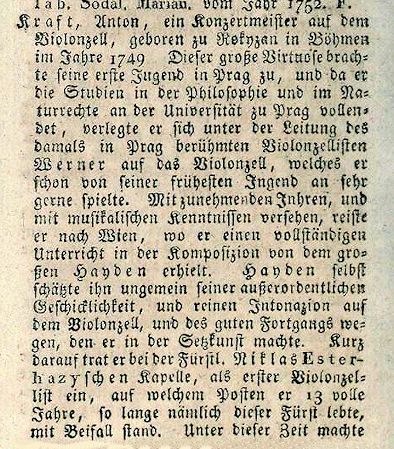
The beginning of Dlabacz's article on Anton Kraft in the Allgemeines historisches Künstler-Lexikon

The English and the German Wikipedia articles (as of July 2014) give 30 December 1752 as Kraft's date of birth. The Beethoven-Haus also has 1752. Where did the wrong year 1752 originate? It entered the literature from vol. 5 of Robert Eitner's Biographisch-Bibliographisches Quellen-Lexikon. Eitner relied on what he rightly considered to be an excellent source: Carl Ferdinand Pohl's 1871 study entitled Denkschrift aus Anlaß des hundertjährigen Bestehens der Tonkünstler-Societät. In Pohl's list of society members Kraft's name, his biographical dates, and the time of his joining the society (15 December 1791) appear on p. 107.


Pohl's data are incorrect. Kraft was not born in 1752. Pohl drew the false year of birth from the minutes of the society where Krafts career as a member is meticulously recorded. As a matter of fact, Kraft had already joined the Tonkünstler-Sozietät in 1783, but was expelled for failing to pay his deposit. When in April 1786 he applied again for membership, he had to submit his birth certificate (a procedure Mozart never managed to follow through) and thus, his date of birth – according to this certificate – is documented in the society's protocol. The entry in question reads as follows:
8. [1786]
Kraft Anton (gebohren den 30ten Xber 752) Hochfürstl.[ich] Esterhazischer Kammer Violoncellist, welcher a[nn]o 783 zwar in die Societät aufgenommen worden, nachhero aber seine Einlaag zu entrichten unterlassen, suchet wiederum an als Mitglied in die Societät aufgenommen zu werden. Er führet zu Unterstüzung seines Gesuchs an, daß er 1tens durch mehrere Jahre denen Societäts Musiken fleissig beÿgewohnet 2tens daß er einer dauerhaften Gesundheit geniesse und von seinen allzeit bezeigten guten Lebenswandel sich auf jedermans Zeugnüsse gründen könne. 3tens Bittet er denen in Wien domicilirenden (so wie einsmal Schöringer und Hammer) gleich benommen zu werden, da es bekannt ist, daß S[ein]e Durchl:[aucht] Fürst Esterhazy seinen Pallast und Hofstaat hier in Wienn habe, und nur Sommers Zeit gleich anderen Herrschaften sich auf dero Güter befinden. ––
Wieder hinauszugeben und kann in das Gesuch des Supplicanten, da derselbe ein auswärtiger, vermög dem Institut nicht gewilliget werden. Exped:[itum] d[en] 26t April a[nni]:c:[urrentis]

[translation:]

Kraft Anton (born on 30 December 1752), chamber cellist of Prince Esterházy, who joined the society in 1783, but later failed to submit his deposit, applies again to be accepted into the society. In support of his application he points out that 1) for several years he has diligently taken part in the society's concerts and 2) he is enjoying stable health and can rely on everybody's testimony concerning his moral conduct. 3) He requests to be treated like members who live in Vienna (like formerly Schöringer and Hammer), because it is known that His Excellency Prince Esterházy has his palace and his court in Vienna and, like other sovereigns, only lives on his estate in the summer.––
To be returned. Owing to the society's regulation, the supplicant's request cannot be granted, because he is an out-of-towner. Issued on 26 April of the current year [1786].


The entry concerning Anton Kraft's application to rejoin the Tonkünstler-Sozietät in April 1786 (A-Wsa, Private Institutionen, Haydn-Verein, 2.9.1.2. A3/1)

Kraft's situation was similar to Haydn's in 1778, who, being an "Auswärtiger" (out-of-towner) residing in Hungary, had to deposit 300 gulden to be accepted as a member (Haydn's application was eventually unsuccessful for other reasons). Carl Schöringer and Franz Xaver Hammer (Marteau), whom Kraft named as precedents, were musicians in Prince Esterházy's orchestra who had been allowed to join the society in 1775 and 1776, respectively, in spite of being "Auswärtige". Kraft was only able to rejoin the Tonkünstler-Sozietät in 1791, after he had moved back to Vienna and had become an employee of Count Antal Grassalkovich.

The only possible explanation for the wrong date of Anton Kraft's birth recorded in the minutes of the Tonkünstler-Sozietät is that the date on this birth certificate was false, or the secretary of the society misread the document. It is unlikely that the parish priest had misidentified the year in the church register, because Kraft's entry is closely followed by the headline "Anno Domini 1750".

The entry concerning Anton Kraft's baptism on 30 December 1749, in the church of Saint Mary of the Snows in Rokycany with the headline of the following year 1750 (Státní oblastní archiv v Plzni. Rokycany 04, p. 270)

Pohl's book contains several wrong dates of birth of members of the society. Sometimes Pohl blindly copied the list of members which had been written in 1844 by the society's then secretary Stephan Franz, sometimes the entry in the minutes is already wrong, because either the secretary made a mistake, or the original baptismal certificate was incorrect, like in the case of the Court copyist Wenzel Sukowaty who, according to Pohl, was born on 31 July 1746, but actually was born on 31 August of that year.

The entry concerning the baptism of Wenzel Sukowaty on 31 August 1746 in Pozořice (Moravský zemský archiv Brno, Pozořice 1563, fol. 217)

Now for something completely different. At some time around 1801, Nikolaus II, Prince Esterházy thought of hiring Kraft again, but he did not want to trump the salary that Kraft received from Prince Lobkowitz. And yet, in honor of his service for Nikolaus I, Anton Kraft never lost his "Deputat" (payment in kind) from the Esterházy court which consisted of firewood, tallow, and wine. Kraft died of exhaustion on 28 August 1820 (Wiener Zeitung, 1 September 1820, 799), at the age of 70. He left behind a widow and eight grown up children of whom the eldest, the cellist Nikolaus Kraft, inherited his father's cello, an instrument by Vincenzo Ruggieri (1663–1719) which was valued at 80 gulden.

The passage in Anton Kraft's will in which he bequeaths his cello "verfertigt von Vincenz Rugger detto il Peer" and his musical scores to his son Nikolaus. (A-Wsa, Mag. ZG, A10, 420/1820)

This instrument is probably the cello labelled "Vincenzo Ruger detto il Per. In Cremona 1697" which was last sold in 1987 by the dealer Jacques Français (1923–2004).


The cello by "Vincenzo Ruger detto il Per" from 1697 in Sotheby's Fine Musical Instruments Auction Catalog (June 4, 1982)

Soon after her husband's death, Marie Kraft applied to Prince Nikolaus II to receive the amount of wine that had been granted to her late husband. But her request was denied.
[Numerus exhibitorum] 3254. [Datum Præsentati. October 1820]
[Auszug des Exhibiti.] Kraft Marie, Wittwe des verstorbenen fürst[lichen] Violoncellisten Anton Kraft, bittet um das durch ihren Gemahl bezogene Wein Deputat.
[Erledigung.] An die Wiener Hofstaats Kellerverrechnung. der Wein des Kraft mit 6 Eimern wird von 28. Aug[ust] l.[aufenden] J.[ahres] abgestellt, u. der Witt[w]e tägl[ich] ein Seitl bewilligt.
den 22. Oct.

[translation:]

[Number of the exhibits] Kraft Marie, widow of the deceased princely violoncellist Anton Kraft, requests the payment in wine that her husband received.
[Conclusion] To the wine cellar management of the court in Vienna. As of 28 August the 6 buckets of wine for Kraft are cancelled and the widow is allowed to receive one seidel per day.
22 October [1820]

The entry in the protocol of the Esterházy Zentraldirektion concerning Marie Kraft's request for her late husband's Weindeputat and its rejection (Archiv der Esterházy Privatstiftung, Forchtenstein, Zentraldirektion 3254/1820)

My own experience as cellist has taught me that cellists need a sufficient amount of wine. The annual six Eimer of the better brand called "Offizierswein" that Anton Kraft had received was quite a lot of liquor. One Austrian Eimer was 56,589 liters which means that Anton Kraft received almost 340 liters of wine per year (0,93 liters per day). The supply that his widow had to content herself with was much smaller. The seidel she got every day was only 0,35 liters. Marie Kraft died on 20 June 1825 (Wiener Zeitung, 24 June 1825, 611), at the age of 75.

Anton Kraft's signature as witness to the wedding of Anton Schreiber, employee of Prince Lobkowitz, on 13 June 1810 (St. Augustin, Tom. 8, fol. 48)

Anton Kraft's seal (A-Wsa, Mag. ZG, A10, 420/1820)

© Dr. Michael Lorenz 2014.

Updated: 11 July 2022

Aug 28, 2012

The Haydn Hamburger

On 26 November 1760, in the Eligius Chapel of Vienna's St. Stephen's Cathedral, Joseph Haydn married Maria Anna  Keller, third daughter of the wigmaker Johann Peter Keller.

The entry concerning Joseph Haydn's and Maria Anna Keller's wedding on 26 November 1760, at St. Stephen's Cathedral (A-Wd, Tom. 59, fol. 417v)

As a craftsman Keller was "hofbefreit", which means he had the permission to receive commissions as a master wigmaker directly from the Imperial Court. This special status lead to Keller's relative wealth which enabled him to purchase a house in the Viennese suburb Landstraße. As I already pointed out two years ago in my short essay "Einige Korrekturen und Ergänzungen zu Klaus Martin Kopitz' Aufsatz 'Anmerkungen und Korrekturen zu Haydns Wiener Wohnungen'", the Haydn literature is wrong as to where Johann Peter Keller's house was located, an error that was created by Albert Christoph Dies and Carl Ferdinand Pohl. This building, Landstraße No. 51 ("one half an acre of vinyard in front of the Stubentor on the Joÿsen", as it is described in the Domkapitel land register), was not located in the Ungargasse, as stated by Pohl, but in the Raaben Gasse (today Beatrixgasse 21). Keller and his wife owned this house from 10 September 1734 until 1766. It can be seen on the following clip from Joseph Daniel von Huber's 1778 map of Vienna.

Johann Peter Keller's house Landstraße No. 51 in the Raaben Gasse on Huber's map (W-Waw, Sammlung Woldan)

Keller's house also appears on Joseph Anton Nagel's 1773 map of Vienna.

The house Landstraße 51, circled in red, on Joseph Anton Nagel's map of Vienna. The street at the bottom is the Landstraße, the diagonal street leading to the upper left is the Ungargasse. On the right is the glacis towards the Inner City (A-Wn, Kartensammlung, K I 111937)

The first two pages of the entry in a Domkapitel land register concerning the purchase of the house Landstraße 51 on 10 September 1734, by Johann Peter Keller and his wife Maria Elisabeth (A-Wsa, Patrimonialherrschaften B2.9, fol. 222v and 223r).

The above entry concerning the purchase of Keller's house in 1734 reads as follows: 
Herr Johann Peter Keller Kaÿl: Hofberfreÿter Peruquenmacher, und Maria Elisabeth desßen Fr: Ehe Consortin haben mit Eines WohlEdl Hochweißen Statt Raths über eingereichtes anbringen, und von dem Grundbuch erstatte[n] Bericht den 27t jüngst abgeruckhte[n] [fol. 223r] Monat Septembris ertheilt gegen Consens, zugleich Nuz und Gewöhr empfangen eines halben Joch Weingarttens vor dem Stubenthor auf der Joÿsen, worauf anjezo eine Behausung erbauet und das übrige zu einem Gartten zugerichtet worden ist, zwischen des Kaÿl: Seminarij, und Matthä Feigl Behausung und Gartten gelegen; darum dient man G[e]m[eine]r Statt Wienn Dombcapitl Grundbuch jährl: Michaelis Fünf Schilling, achtzehen Pfening zurechten Grunddienst und nicht mehr. Darumben hirvor in Lib: N° 1. fol: 180 Sebastian Glaßner, und Eva Maria desßen Ehewürthin zugleich an der Gewöhr beschriben gestanden, dise aber solches lauth eines den 10t Septemb: dis Jahrs gefertigten Kauf=Contracts anfangs ged:[achten] H: Johann Peter Keller, und dess[en] Fr: Ehe Consortin Maria Elisabeth umb eine gewisße Summam Gelds Käuflich [fol. 223v] hinumbgelasßen, und durch schriftl[iche] aufsandung aigenthuml: übergeben haben. Die mögen also darmit ihren nuz und frombe[n] schafen, und betrachten, wie gleicher Gewöhr und der Statt Wienn Grundbuchs Recht ist, jedoch des burgl: Mitleidens unvergrifen; Neben dißen Reservat und Vorbehalt, daß von solchen der burgl: Jurisdiction unterworfenen Grundstuckh alle burgl: onera willig getragen, die Steüer zu rechter Zeit entrichtet, und wann sich deßhalben Stritt oder jrrunge[n] eraignen solten, solche beÿ Einem löbl: Statt Magistrat angebracht, und beantwortet, auch beÿ einer Veralienirung dißes Keinem anderen als einem würckhl: burger oder burger Rechts: fähigen hinumbgelasßen werden solle, und wolle, wie es dann der ad off[ici]um des Grundbuchs erlegte Revers mit [fol. 224r] mit mehrern ausweißet. ohne Gevährde. Actum Wienn den 12t[en] Octob: 1734.
Nunc in Lib: N° 2. Fol: 74. Ihro Excell: H: Johann Michael FreÿH: v: Kleinholdt.
On 18 September 1766, Keller and his wife sold the house to Johann Wilhelm Baron von Kleinholt (A-Wsa, Patrimonialherrschaften B2.11, fol. 74).

Although we have absolutely no documentation as to how Haydn became acquainted with his father-in-law, Pohl assumed that Haydn was introduced to the wigmaker's family by Keller's alleged brother Georg Ignaz Keller, a musician at St. Stephen's, whom Haydn had supposedly known since his days as choirboy at the Cathedral. Georg Ignaz Keller was born around 1699 in the Bohemian town of Chlumec nad Cidlinou and came to Vienna before 1726, as an employee of the Bohemian Court Chancellor Leopold Count Kinsky for whom he served as chamberlain and violinist. Therefore Haydn scholars universally assumed that Haydn's father-in-law also hailed from Bohemia.

The entry concerning the wedding on 17 November 1726, of the (then) chamberlain Georg Ignatz Keller ("von Chlumetz aus Böhm[en]") and Barbara Antonia Scheiblauer (A-Wd, Tom. 45, 286). When on 7 January 1770, Keller married for the second time, he was already a "K:K: Hof Musicus" (A-Wd, Tom. 65, fol. 132v)

In his article "Joseph Haydns Jugendliebe" (Festschrift Wilhelm Fischer zum 70. Geburtstag, Innsbruck: Sprachwissenschaftliches Seminar der Universität Innsbruck, 1956), Ernst Fritz Schmid vividly describes Georg Ignaz Keller's progress as a musician in Vienna, and how in 1731, he rose from a simple servant to a violinist at St. Stephen's Cathedral, and to court musician in 1765. In spite of complete lack of evidence, Schmid presents the kinship between the "Keller brothers" as a fact.
Der kaiserliche Hofmusikus Georg Ignaz Keller ist es nun gewesen, der Haydn die Bekanntschaft mit der Familie seiner Jugendliebe und damit auch seiner späteren Frau vermittelte. Kellers älterer Bruder, der "hofbefreite" Perückenmacher Johann Peter Keller, der um 1691 ebenfalls in Chlumetz in Böhmen geboren war, besaß zu Wien in der Vorstadt Landstraße in der Ungargasse ein eigenes Haus und einigen Wohlstand [...] Georg Ignaz Keller brachte Haydn in das Haus des Bruders, wo mehrere Kinder, darunter anmutige Töchter heranwuchsen, deren Klavierunterricht der junge Meister übernahm.

[translation:]

It was the imperial court musician Georg Ignaz Keller who established Haydn's acquaintance with the family of his early love and also of his future wife. Keller's older brother, the wigmaker to the court Johann Peter Keller, who had been born around 1691, also in Chlumetz in Bohemia, was considerably wealthy and owned a house in Vienna in the suburb of Landstraße in the Ungargasse [...] Georg Ignaz Keller brought Haydn into his brother's house, where several children were growing up, among them lovely daughters whose piano lessons were taken over by Haydn.
Schmid did not let himself be distracted by the fact that archival sources do not support the presumption that the wigmaker Johann Peter and the violinist Georg Ignaz Keller were brothers or had any mutual family relation. Not once did both Kellers or their wives serve as godparents of each other's children: Johann Peter Keller chose (among others) the "Stiftsverwalter bei St. Joseph" Johann Heinrich Reischmann and his wife, a "k.k. Cammer-Fourier" Anton Joachim and the surgeon Johann Franz Schlegelhofer as godparents. Georg Ignaz Keller, on the other hand, relied (among others) on the services of his employer Count Kinsky, the merchant Leopold Wührer (Joseph Jenamy's best man at his wedding with Victoire Noverre in 1768), Maria Sophia Muffat (Georg Muffat's daughter-in-law) and the wealthy apothecary Georg Friedrich Eulenschenk and his wife (whose daughter in 1768 would marry Franz Anton Mesmer and in 1772 was still rich enough to eventually buy her husband his country estate on the Landstraße).

What do we know about Johann Peter Keller's origin? He was born around 1691, and on 12 November 1722, at St. Michael's in Vienna, got married to Maria Anna Seiller. As usual, the marriage records of this parish provide only meager information concerning the bridal couple, such as the date of the wedding, the names of the couple and their parents and the names of the witnesses. No places of birth of groom and bride are given.

The 1722 entry concerning the wedding of Haydn's parents-in-law: "Dominus Joannes Petrus Keller, Joannis Georgij, et Aloysiæ filius, cum Virg:[ine] Maria Elisabetha Seillerin, Georgij et Elisabethae filia, Tes:[tes] Do[min]us Ferdinandus Marher, et D:[ominus] Antonius Geissnhoff. 12. [November]" (A-Wstm, Tom. 4, 345).

This is the only known source on which Haydn scholarship in general, and Ernst Fritz Schmid in particular, always relied. But the sparseness of the entries in the marriage records of St. Michael's has a special reason: there is an – unfortunately not complete – series of "Verkündbücher" which contain the basic personal information that the parish priests wrote down, when the engaged couple first appeared and announced their intention of getting married, and the banns were to be published. The entry concerning Johann Peter Keller's wedding is (as was regularly the case with these first and only provisional entries that were to be crossed out later) much more detailed. Among other information – such as the date of the first announcement and the couple's address – this entry gives Johann Peter Keller as being of German origin, namely having been born in Hamburg.

The entry concerning the publication of the banns on 31 October 1722, for the wedding of Haydn's parents-in-law (A-Wstm, Verkündbuch 15, 475). From 1718 until his death, Keller's best man, the goldsmith Ferdinand Mahrer (1676–1742) owned the house Stadt 1030 (Bräunerstraße 6).
Den 31 October 1722 copulati sunt 12 9ber 1722 / Der Kunstreiche Herr Johann Peter Keller, ein Keÿ[serlich] Hofbefreiter Porakhenmacher, b in dem / 3 tauben in der unde[r]n Preinerstrasen wonhaft. / Zu Hamburg gebirtig, des H[errn] Johann Georg Keller, undt Frau Aloysiæ sel[ig] beder / ehlicher Sohnn. nimbt zur ehe die tugent / same Jungfrau Mariam Elisabetham / Seillerin, des H[errn] Georgij Seiller und Elisabethæ sel beeder eheliche tochtor / Zu Wacheram in Österreich gebürtig, / beÿ den 3 taube[n] in der under / Preinerstrass wonhaft. /     1 2 3     Ambo in parochia / per plures annos.

Tes[tes]:
H[err] Ferdinand Mahrer, bürgerlicher Golt / arbeiter in dem 3 taube[n] in eigener Be= / hausung wonhaft, H[err] Antonius Geisen= / hof, Keÿ[serlicher] Hof Golt schlager.


And there it is: a Haydn-trifle of world-shattering insignificance. Haydn's father-in-law, the wigmaker Johann Peter Keller and the musician Georg Ignaz Keller were not brothers, but came from very different regions in Europe. It remains to be investigated if Georg Ignaz Keller played any role at all in Haydn's life. Of course one could argue that in the above entry the priest actually referred to the Austrian town of Hainburg an der Donau. But the fact that the word definitely has an "m" and only Wagram bears the attribute "in Österreich" (as if to set it apart from the non-Austrian birthplace of the groom) makes it very clear that (apart from Brahms having written variations on a tune not written by Haydn) this Hansa City has finally gained a family relationship to the composer of the Deutschlandlied. (Since the baptismal register of the town of Hainburg from before 1700 is lost, the question whether Keller was born there cannot be answered).

During the 1750s, Johann Peter Keller enjoyed some wealth. On the occasion of the entry of his daughter Theresia into the convent of Poor Clares at St. Nikolai in 1755, he raised the necessary costs of 1,000 gulden and in a contract appointed the convent co-heir of his and his wife's estate.

Seals and signatures of Johann Peter Keller and his wife on the contract, dated 14 May 1755, concerning the donation on the occasion of their daughter's entry into the convent of Poor Clares at St. Nikolai (A-Wsa, Staatliche Verwaltung, Klosterrat, 2.2.6.15.A1/2, 100). This document was published in 1956 by Schmid, albeit with several transcription errors. The shelfmark of this document given by Schmid is now out-of-date.

Twenty years later, Johann Peter Keller's wealth was gone. Approaching the end of his life, he suffered hard times which in a fascinating way may reflect the demise of the wig as a social and economic factor in eighteenth-century Vienna. Keller died on 9 August 1771 (Wiener Zeitung, 14 Aug 1771), absolutely destitute, in the "Klerfisches Haus" on the Hoher Markt and was buried on the following day in the new crypt of St. Stephen's. His relatively wealthy children (and maybe his son-in-law Joseph Haydn) made sure that his third-class obsequies cost 27 gulden 36 kreuzer and, for an expense of four additional gulden, included a "Music vors Miserere".

The entry concerning Johann Peter Keller's obsequies on 10 August 1771, at St. Stephen's (A-Wd, Bahrleihbuch 1771, fol. 227r). Keller was buried in the new crypt of St. Stephen's Cathedral.


© Dr. Michael Lorenz 2012

Updated: 22 April 2025


The information concerning Haydn's wife at the beginning of this post has been superseded by research which was published in September 2014 in a blogpost titled "Joseph Haydn's Real Wife".